
Four Treasures Reference Database
Record No. 29970
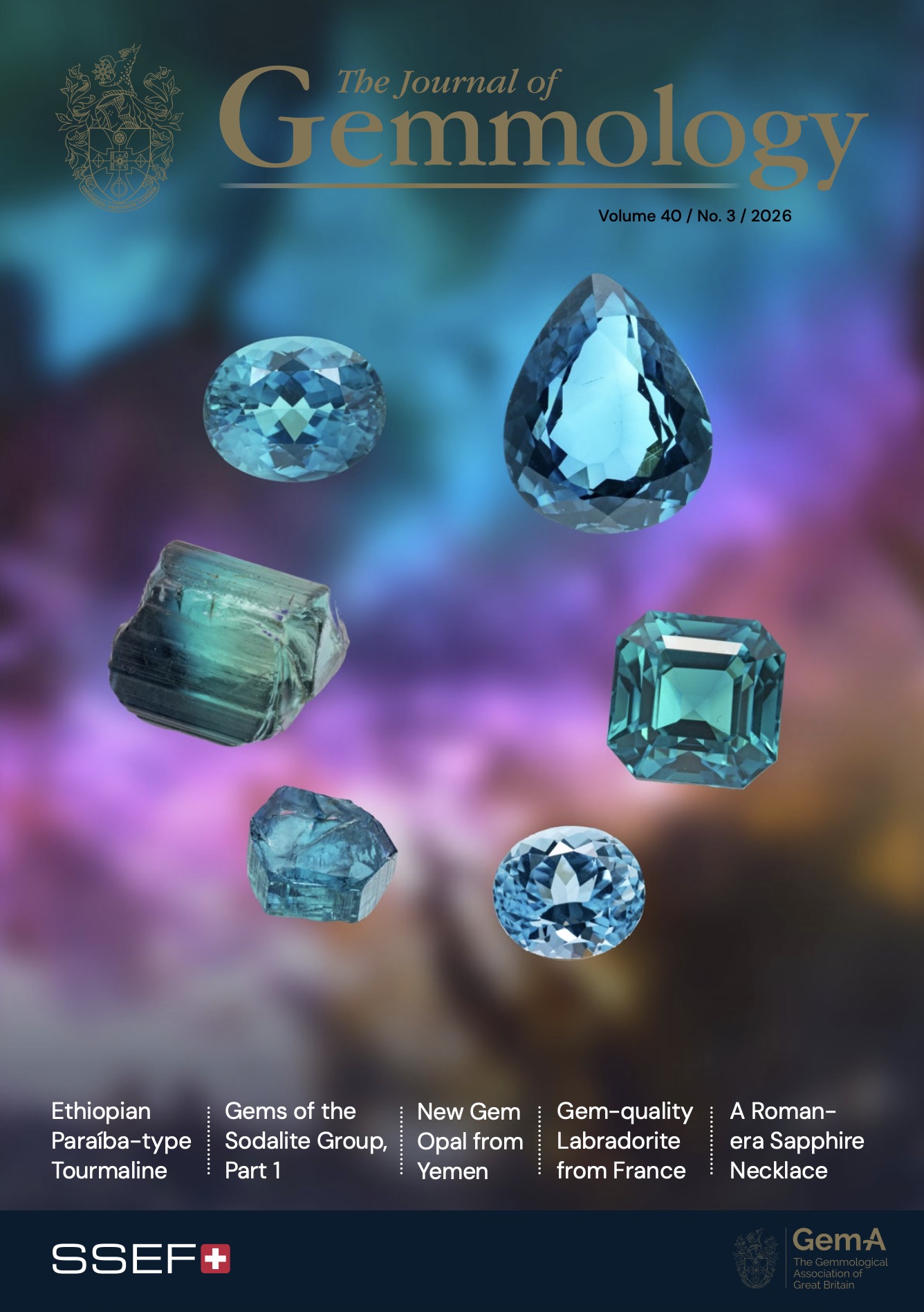
Characterisation of Cu-bearing tourmaline from Ethiopia, and implications for geographic origin determination
Journal Article
Wang, H.A.O., Zhou, W., Sun, Y., Wälle, M., Krzemnicki, M.S., Lefèvre, P., Sato, A., Cartier, L.E. and Sintayehu, T. (2026) Characterisation of Cu-bearing tourmaline from Ethiopia, and implications for geographic origin determination. Journal of Gemmology, Vol. 40, No. 3, pp. 242–261.
gems, tourmaline, Ethiopia, paraíba tourmaline, cuprian tourmaline
Reports the June 2026 discovery of Cu-bearing tourmaline from Abulo Rukessa (Abuloo), Guji Zone, southern Ethiopia, and presents gemmological, spectroscopic and chemical characterization of 14 reportedly representative stones. Standard testing, microscopy, polarized UV-Vis-NIR and Raman spectroscopy, together with LA-ICP-TOF-MS, showed all samples to belong to the elbaite–fluor-elbaite series. Copper generally exceeded iron, with Cu ranging from 373 to 26,157 ppmw and Fe from 2 to 7,368 ppmw. Bismuth contents formed three distinct high-, intermediate- and low-Bi groups, and these tiers occurred as growth zoning within individual stones. Comparison with 1,653 analyses of Cu-bearing tourmalines from Brazil, Mozambique and Nigeria showed vanadium to be the clearest provenance discriminator, with Ethiopian samples containing 42.9–146 ppmw V, compared with a maximum of 20.3 ppmw in the comparison set. t-SNE statistical analysis likewise separated the Ethiopian data into a distinct compositional field. Rare-earth-element patterns were enriched in light REE and showed mild Eu anomalies. Representative ordinary-ray Vis-NIR spectra displayed stronger Cu²⁺ absorption near 900 nm than the combined Cu²⁺ + Fe²⁺ absorption near 700 nm, and the analyzed faceted stones therefore meet LMHC criteria for the trade designation “paraíba tourmaline.”