Emerald Bibliography

Emerald Bibliography

Explore books, articles and historical sources on emerald in Four Treasures, the Lotus Gemology reference database. This bibliography brings together matching records from the collection, with publication details, abstracts and cover images where available.

Emerald References

The list below matches the terms emerald or emeralds in the database's searchable fields. Some references discuss emeralds as part of a broader subject.
721–740 of 980 matching references

India: Part III—Advanced Economic Geography of India and Pakistan
Book
Chhibber, H.L. (1949) India: Part III—Advanced Economic Geography of India and Pakistan. Banaras, Nand Kishore & Bros., 419 pp. (precious stones, see pp. 223–231)
Record No. 505  |  Sinkankas/Born No.: NIS/NIB  |  RWHL
India had a reputation for gem-stones from very early times. She had the proud privilege of having produced the best diamonds in the world, but her production has now considerably dwindled. However, Kashmir is noted for its sapphires, Rajputana for its emeralds, and Central India for its diamonds. Besides, a number of semi-precious stones also occur. The beauty and value of a gem-stone are determined by its colour, lustre, play of colours, and brilliancy. Cutting and polishing bring out these properties in a remarkable manner.

The Muzo emerald zone, Colombia, S.A.
Journal Article
Oppenheim, V. (1948) The Muzo emerald zone, Colombia, S.A. Economic Geology, Vol. 43, No. 1, pp. 31–38.
Record No. 4249  |  DOI: https://doi.org/10.2113/gsecongeo.43.1.31  |  Sinkankas/Born No.: NIS/NIB  |  RWHL
The Muzo Emerald Mines represent the only large emerald deposits that can be successfully mined and that produce the highest quality emeralds known. Although mined in a very primitive way for the last 400 years, Muzo still has quite unpredictable emerald reserves, which do not seem to have diminished after centuries of mining. The invariable relation of the Muzo emeralds with the Cretaceous Villeta shales is quite peculiar and has not yet been given an adequate explanation.

Die diagnostische Bedeutung der Einschlüsse in Edelsteinen
The diagnostic significance of the inclusions in gemstones
Journal Article
Gübelin, E.J. (1948) Die diagnostische Bedeutung der Einschlüsse in Edelsteinen. [The diagnostic significance of the inclusions in gemstones] Schweizerische Mineralogische und Petrographische Mitteilungen, Vol. 28, No. 1, pp. 146–156.
Record No. 2033  |  Sinkankas/Born No.: NIS/NIB  |  Language: in German  |  RWHL
Gübelin reviews the diagnostic value of gemstone inclusions and their significance for understanding mineral formation. Improved dark-field binocular microscopy permits examination of inclusions throughout a faceted stone, revealing characteristic differences in their composition, form, orientation, and distribution. Inclusions are classified both by their timing relative to host-crystal growth and as solid, liquid, or gaseous components. Examples from diamond, corundum, beryl, garnet, tourmaline, spinel, moonstone, and fluorite illustrate their use in gemstone identification and, in some cases, determining geographical origin. Particular attention is given to locality-specific inclusion assemblages in rubies and sapphires, three-phase inclusions in emeralds, and characteristic mineral inclusions in garnets. The paper emphasizes that diagnostic value frequently resides in the overall inclusion pattern and its relationship to crystal structure, rather than in an isolated inclusion. Five plates illustrate representative features. Gübelin advocates closer collaboration between gemmology and mineralogy to advance both practical identification and interpretation of crystal growth.

Identification of synthetic gems, parts I–III
Journal Article
Gübelin, E.J. and Liddicoat, R.T. (1946–7) Identification of synthetic gems, parts I–III. Gems & Gemology, Vol. 5, No. 7, Fall, pp. 349–354 (corundum); No. 9, Spring, pp. 399–402 (corundum); No. 10, Summer, pp. 421–427 (spinel & emerald).
Record No. 5040  |  ISBN/ISSN: 0016626X  |  Sinkankas/Born No.: NIS/NIB  |  RWHL
This three-part series reviews methods available in 1946–1947 for distinguishing synthetic corundum, spinel, and emerald from their natural counterparts, emphasizing microscopic examination of inclusions and growth structures. R.T. Liddicoat introduces the distinction between a synthetic gem, which reproduces the chemical composition and atomic structure of its natural counterpart, and an imitation marketed under an inaccurate name. Materials sold as synthetic alexandrite, zircon, garnet, or aquamarine are described as corundum or spinel substitutes identifiable by their different properties. For natural and synthetic corundum, however, ordinary refractive-index and density measurements provide little assistance, making internal features particularly important. Natural ruby and sapphire are illustrated by fingerprintlike fluid inclusions, zircon crystals with surrounding fractures, oriented silk intersecting at 60°, and straight or hexagonally arranged growth zoning. Synthetic material produced by the Verneuil process is characterized by spherical or elongated gas bubbles and curved growth striae. The authors explain that nearly flawless specimens require higher magnification, careful control of illumination, examination from different directions, and sometimes immersion to reduce distracting surface reflections. E.J. Gübelin expands the discussion of gas inclusions, describing isolated bubbles, localized clouds, and concentrations following growth layers, while noting that improvements in production reduce their abundance and size. He cautions that subsurface cracks caused by rapid polishing occur in both natural and synthetic corundum and therefore do not establish synthetic origin. The third installment treats synthetic spinel separately because curved striae are absent from the material examined. Its gas inclusions may be spherical, tubular, wormlike, or irregularly elongated, while characteristic strain patterns under crossed polarizers provide further evidence. Gübelin contrasts the cloudy, fibrous, or feathery anomalous birefringence of synthetic spinel with the generally fainter, less sharply defined patterns observed in natural specimens. Synthetic emerald presents a different problem because its slower crystallization can produce straight or hexagonal zoning resembling natural growth. Slightly lower refractive index, density, and birefringence are discussed as supporting distinctions, but microscopic features receive greater practical emphasis. These include scattered minute solid particles, undulating wisps or feathers described as groups of small liquid inclusions containing gas bubbles, irregular cavities, and pronounced strain-related anomalous birefringence. Gübelin treats the identity of the scattered solid particles as uncertain, tentatively suggesting coloring material. Recommended observation methods include dark-field microscopy, transmitted light, crossed polarizers, and immersion, with the lighting selected to reveal particular structures. Spectroscopy and luminescence are mentioned as supplementary approaches when microscopy proves insufficient. Throughout, the series presents identification as a matter of recognizing diagnostic internal features while avoiding conclusions based on ambiguous cracks, superficial resemblance, or the absence of conspicuous imperfections.

Jewels of the Russian Diamond Fund

Journal Article
Fersman, A.E. (1946–47) Jewels of the Russian Diamond Fund. Gems & Gemology, Trans. by Marie Pavlovna Warner, Vol. 5, Part I: No. 8, Winter, pp. 363, 372–376; Part II: No. 9, Spring, pp. 403–405; Part III: No. 10, Summer, pp. 432–434; Part IV: No. 11, Fall, pp. 467–470.
Record No. 760  |  ISBN/ISSN: 0016626X  |  Sinkankas/Born No.: NIS/NIB  |  RWHL
Drawing on his examination of the Russian Diamond Fund, A.E. Fersman combines descriptions of exceptional gemstones and jewelry with historical narratives, mineralogical observations, and personal recollections. Translated by Marie Pavlovna Warner, the four installments present the collection as a record of gemstone sources, craftsmanship, royal patronage, and the movement of treasures between countries. The opening survey describes notable diamonds, including the Orlov and Shah, alongside colored diamonds, large emeralds, sapphires, rubies, spinels, tourmalines, and pearls. Fersman distinguishes natural color from effects produced by settings, explaining that the reputedly red diamond associated with Paul I owes its strong appearance to colored backing rather than an inherently ruby-red body color. He also questions historical accounts of enormous rubies, suggesting that some celebrated red stones were actually spinel or tourmaline. His appreciation of jewelry emphasizes composition and workmanship rather than gemstone quality alone: eighteenth-century artists could combine imperfect or relatively inexpensive stones into outstanding designs. Examples include emerald-and-diamond bouquets with flexible stems and moving flowers, a diamond rivière, a fountain-shaped aigrette, and floral ornaments employing yellow and white diamonds. The third installment concentrates on three historically significant diamonds. A flat portrait diamond illustrates the preservation of a large transparent surface and the technical uses of similarly shaped stones. Fersman argues that the Orlov and Koh-i-Noor are separate stones, rejecting accounts that confuse their histories, and relates his reconstruction of the Orlov’s Indian origin, subsequent ownership, and acquisition for Catherine II. The Shah diamond’s engraved inscriptions provide a framework for tracing its passage through Indian and Persian courts and its eventual presentation to Russia following the killing of the diplomat and writer A.S. Griboyedov. The concluding installment returns to the distinction between historical names and mineral identity, identifying Catherine II’s celebrated large “ruby” as rubellite on the basis of appearance, color, and density evidence. It then broadens beyond the Diamond Fund to discuss lapis lazuli from Afghanistan and the Pamirs, including an expedition’s encounter with high-altitude deposits and Fersman’s recollection of a carved lapis elephant given to Amanullah Khan. The final narrative concerns the large emerald associated with Yakov Ivanovich Kakovin, tracing its discovery in the Urals, disputed custody, incorporation into a private collection, and eventual preservation in the Academy of Sciences’ mineralogical museum. Throughout, Fersman treats gemstones as scientific specimens and cultural objects whose significance depends on mineral identity, artistic treatment, provenance, and the reliability of historical testimony.

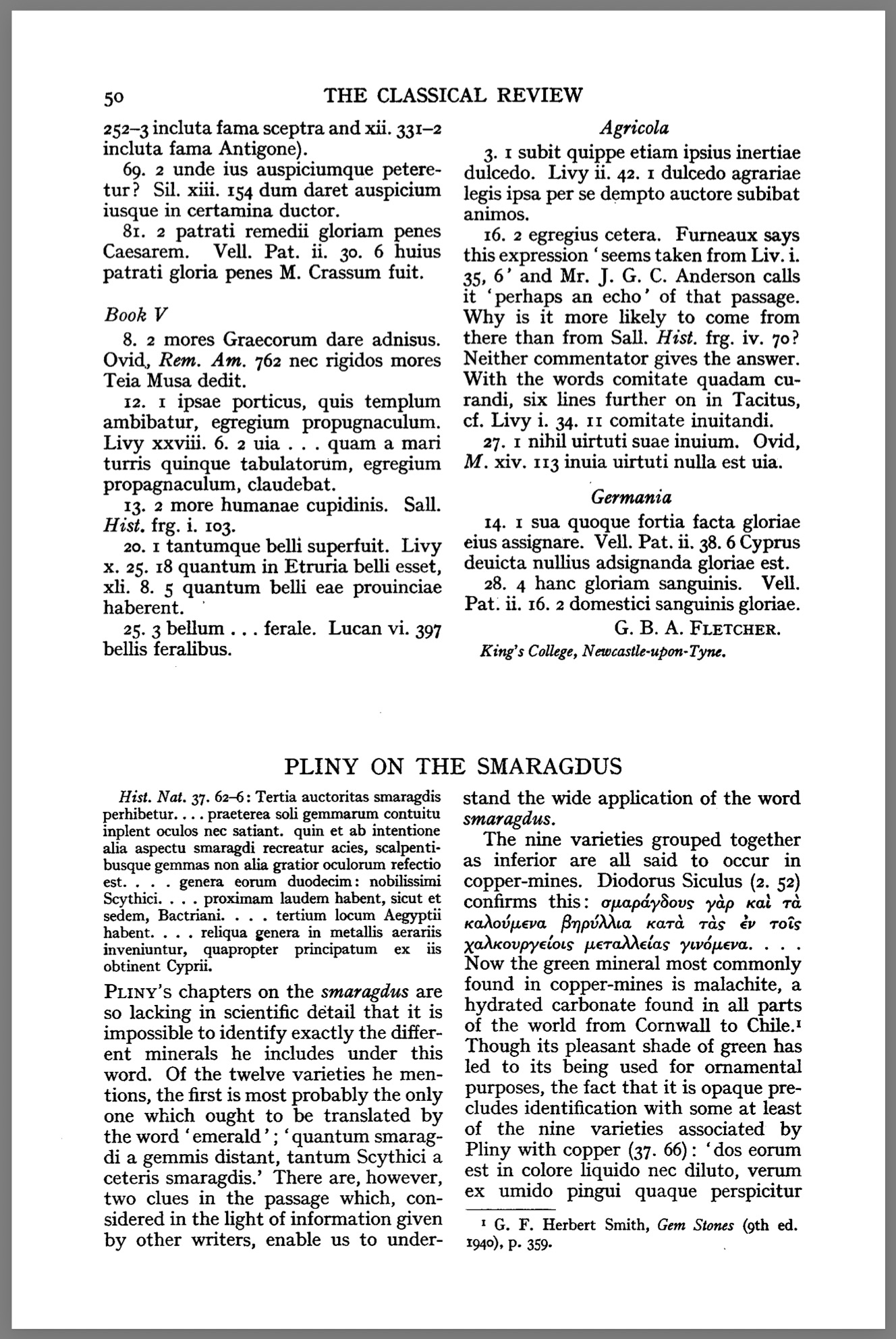
Pliny on the smaragdus

Journal Article
Meadows, J.W. (1945) Pliny on the smaragdus. Classical Review, Vol. 59, pp. 50–51.
Record No. 28817  |  Sinkankas/Born No.: NIS/NIB  |  RWHL
Pliny the Elder’s chapters on the smaragdus are so lacking in scientific detail that it is impossible to identify exactly the different minerals he includes under this term. Of the twelve varieties he mentions, the first is most probably the only one that ought properly to be translated as “emerald”: quantum smaragdi a gemmis distant, tantum Scythici a ceteris smaragdis. There are, however, two clues in the passage which, considered in light of information provided by other writers, help explain the broad application of the word smaragdus. The mineral in question may have been a hydrated carbonate found in many parts of the world, from Cornwall to Chile. Although its pleasing green color led to its use for ornamental purposes, its opacity excludes identification with at least some of the nine varieties associated by Pliny with copper (37.66): dos eorum est in colore liquido nec diluto, verum ex umido pingui quaque perspicitur.

Inclusions as a means of identification
Journal Article
Gübelin, E.J. (1945) Inclusions as a means of identification. Gems & Gemology, Vol. 5, 1945: No. 2, Summer, pp. 226–231 (garnet); No. 3, Fall, pp. 242–247 (garnet); No. 4, Winter, pp. 270–274 (garnet),
Record No. 2029  |  ISBN/ISSN: 0016626X  |  Sinkankas/Born No.: NIS/NIB  |  RWHL
Gübelin examines the diagnostic value of inclusions in garnets, arguing that their internal mineral associations can provide a rapid means of identifying stones whose outward appearance resembles other gems. Such associations also preserve evidence of the circumstances of crystallization. The practical benefits are particularly apparent when instruments are unavailable or when numerous small stones require sorting, making individual measurements of specific gravity and optical properties laborious. Illustrated with 22 photomicrographs, the three installments describe characteristic features of demantoid, hessonite, pyrope, almandine, rhodolite, and spessartine. In demantoid, Gübelin reports fine brown or colorless fibers, identified in the article as byssolite, arranged in curved bundles, radiating clusters, or irregular tangles. These conspicuous inclusions help distinguish the green garnet from emerald and peridot and may be recognizable with a pocket loupe. Hessonite is characterized by numerous enclosed diopside crystals and streaks that produce its granular, internally oily appearance, providing a distinction from similarly colored zircon, tourmaline, citrine, and glass. Pyrope, almandine, and rhodolite are less readily separated from one another by inclusions, although their internal features assist in distinguishing them from other red and purple gemstones. Gübelin describes dark needles and rods, tentatively attributed to hornblende, arranged in three dimensions according to the host’s crystallography, contrasting this arrangement with the predominantly planar distribution of rutile silk in corundum. Other examples include thin birefringent tablets, sharply formed quartz crystals in Bohemian garnets, and circular arrangements of unidentified crystals possibly representing augite. Sri Lankan almandines contain abundant minute crystals, tubular liquid inclusions, and zircon crystals surrounded by radiation halos; specimens from near Trincomalee are described as densely packed with coarse hornblende inclusions. The concluding installment considers the concentric discoloration rings surrounding radioactive zircon inclusions. Gübelin suggests that differences in the range of alpha particles within different host minerals might eventually provide an additional diagnostic criterion, while presenting this as a preliminary research possibility requiring further investigation. Spessartine is distinguished by wavy, irregular feathers composed of minute liquid inclusions, occurring singly or in bundles and resembling fluid feathers in rubellite. Examination with a polarizing microscope, or a Diamondscope combined with a polariscope, also reveals the gratinglike extinction patterns attributed to strain-induced anomalous birefringence in garnet. Although acknowledging that inclusion study cannot identify every specimen, especially flawless material, Gübelin advocates familiarity with these internal features as an efficient way to reduce identification errors, using both microscopy and an ordinary jeweler’s loupe.

Gemstone inclusions

Journal Article
Gübelin, E.J. (1944–46) Gemstone inclusions. Gems & Gemology, Vol. 4–5, Vol. 4, No. 10, Summer, pp. 142–149 (sapphire); No. 11, Fall, pp. 158–163 (ruby); No. 12, Winter, pp. 174–179 (emerald); Vol. 5, No. 1, Spring, pp. 205–210 (diamond); No. 5, Spring, p. 294–300; No. 6, Summer, pp. 318–323 (various gems).
Record No. 2027  |  ISBN/ISSN: 0016626X  |  Sinkankas/Born No.: NIS/NIB  |  RWHL
This illustrated series presents gemstone inclusions as practical evidence for identification, distinguishing natural from synthetic stones, and interpreting the conditions under which gems formed. Drawn from Gübelin’s photomicrographic studies and a collection of Kodachrome transparencies supplied to the Gemological Institute of America, the installments combine explanatory text with photographs and descriptive captions. Microscopic examination, particularly with dark-field illumination, reveals structures that may be overlooked or misinterpreted with a loupe. The sapphire section illustrates oriented needles and silk, angular growth zoning, mineral crystals, fluid cavities, and featherlike networks. Examples include hematite plates, enclosed corundum crystals, and cavities containing liquid and gas. These features are compared with curved growth striae and gas bubbles in synthetic sapphire. Gübelin cautions that appearances can be deceptive: natural cavities may resemble bubbles, while the curvature of synthetic growth lines may be difficult to recognize within a small field of view. The ruby installment similarly contrasts natural rutile arrangements, straight structural features, mineral inclusions, and fluid-related formations with curved striae and concentrations of gas bubbles in synthetic material. Zircon inclusions surrounded by halos and intersecting rutile needles illustrate characteristic internal features of individual specimens from Sri Lanka and Myanmar. The emerald section describes enclosed crystals, irregular cavities, and inclusions containing liquid, gas, and a solid phase, while comparing these with wispy formations and other internal features observed in synthetic emeralds. The diamond installment demonstrates the importance of illumination when interpreting dark inclusions: objects commonly regarded as black or carbonaceous may prove to be transparent crystals when examined appropriately. Photographs show enclosed crystals, including diamond, together with cleavage features and fractures associated with inclusions or extending inward from the surface. Subsequent installments broaden the survey to additional sapphires and other gem materials. Illustrated examples include fine networks of channels, negative crystals, mineral plates, zircon-associated halos, liquid inclusions with mobile bubbles, and cavities containing separate liquids. Topaz and tourmaline provide further examples of fluid-bearing inclusions, while the concluding selection extends the illustrated material to emerald, peridot, quartz, garnet, and moldavite. Biotite flakes in peridot and fibrous actinolite in quartz demonstrate the variety of solid inclusions; a fluid-bearing negative crystal in citrine reproduces the host’s prismatic form. Throughout the series, the diagnostic value lies in the combined character, arrangement, and appearance of internal features rather than in an isolated resemblance. Gübelin advocates making inclusion study an early part of gem examination, potentially preceding routine measurements of physical and optical properties. The series also emphasizes the scientific and aesthetic interest of microscopic structures, presenting gemstone interiors as records of mineral growth and subsequent events as well as aids to identification.

American-made synthetic crystals

Journal Article
Seemann, A.K. (1944) American-made synthetic crystals. Gems & Gemology, Vol. 4, No. 9, Spring, pp. 129–133.
Record No. 1572  |  ISBN/ISSN: 0016626X  |  Sinkankas/Born No.: NIS/NIB  |  RWHL
Gübelin investigates microscopic criteria for distinguishing emeralds from Colombia and Russia’s Ural Mountains, arguing that color alone provides an unreliable indication of origin. Although Colombian emeralds are associated with a velvety green and Russian stones with more yellowish hues, examples from either source may resemble those from the other, particularly in small sizes. A comparative table records their appearances through several colored filters, but the author emphasizes that interpreting these subtle differences requires considerable experience, a sensitive eye, and suitable comparison material. Seeking more objective evidence, he examined numerous emeralds of known provenance, including specimens supplied by the Colombian Consulate in Paris. He identifies minute fluid inclusions, rather than conspicuous fractures or cloudy areas, as the most useful distinguishing features. Colombian emeralds are described as containing scattered, irregular groups of delicate, frequently tail-like cavities. Their boundaries are faint, suggesting that the enclosed liquid has a refractive index relatively close to that of the host. The liquid’s composition was not established, although behavior during heating and considerations of formation led the author to suggest water. The cavities show no consistent crystallographic orientation and remain separate even when grouped. Almost every cavity is reported to contain a tiny cubic crystal, commonly adjoining a rounded gas bubble with a dark outline, so that solid, liquid, and gaseous phases coexist within one inclusion. Carbon dioxide is proposed as the gas, while the solid’s chemical identity remains unresolved. Gübelin regards the cubic form of this solid inclusion as the principal diagnostic feature of Colombian material. Russian emeralds likewise contain multiphase inclusions, but their distribution, cavity shapes, and enclosed crystals differ. Their cavities are more closely associated with fractures and moss-like internal features, lack the characteristic Colombian tails, and contain solid crystals displaying lozenge-shaped or rhombic outlines rather than clearly rectangular cubic forms. The author presents this contrast as a dependable means of separating the two sources and supplies a mnemonic linking Colombian origin with cubic crystals and Russian origin with rhombic crystals. He recommends photomicrography to document the observations and notes that the features can also be examined with a diamondscope. The concluding discussion separates geographical interest from intrinsic quality: identifying a fine emerald as Russian need not diminish its value, while knowledge of provenance may increase an owner’s appreciation of either a Colombian stone or an unusually fine-colored Ural specimen.

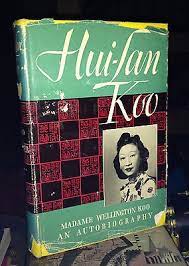
Hui-Lan Koo (Madame Wellington Koo) • An Autobiograpy as Told to Mary Van Rensselaer Thayer
Book
Koo, H.-L. and Rensselaer Thayer, M., van (1943) Hui-Lan Koo (Madame Wellington Koo) • An Autobiograpy as Told to Mary Van Rensselaer Thayer. New York, Dial Press, 364 pp.
Record No. 7181  |  Sinkankas/Born No.: NIS  |  RWHL
An autobiography of Hui-Lan Koo (née Oei Hui-lan), daughter of the wealthy Chinese-Indonesian businessman Oei Tiong Ham and wife of the distinguished Chinese diplomat Wellington Koo, as recounted to Mary Van Rensselaer Thayer. The book traces her privileged childhood in Java, her family's commercial empire, her education and travels in Asia and Europe, and her marriage to Wellington Koo in 1920. Much of the narrative concerns her experiences in international diplomatic society during a turbulent period in Chinese history, including the League of Nations, the Washington Naval Conference, the political instability of Republican China, and the Japanese invasion of Manchuria. Particularly noteworthy are her descriptions of Chinese customs, elaborate wedding ceremonies, court etiquette, luxury, fashion, and jewelry. The book contains numerous references to precious stones, including diamonds, emeralds, rubies, pearls, and jade. Her mother possessed magnificent jewelry, including jeweled hairpins and matching parures set with diamonds, emeralds, and rubies. During a childhood visit to Burma, Hui-Lan recalled shopping for rubies that were so inexpensive that her father purchased small stones in parcels to distribute as souvenirs. Her own engagement ring was a Kashmir sapphire, and she describes wearing pearls purchased from Cartier, along with other jewels associated with her position in diplomatic society. The narrative also records the use of jade ornaments in traditional Chinese ceremonial dress, including a jade button signifying rank on a bridegroom's mandarin hat. Beyond its autobiographical interest, the work provides a firsthand account of the material culture and social customs of wealthy overseas Chinese families and the diplomatic elite during the transition from imperial to Republican China, with valuable incidental observations on the ownership, display, and cultural significance of gemstones and jewelry.

The chemical compounds of some liquid inclusions
Journal Article
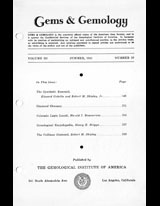
Gübelin, E.J. (1943) The chemical compounds of some liquid inclusions. Gems & Gemology, Vol. 4, No. 6, Summer, pp. 82–86; No. 7, Fall, pp. 98–100.
Record No. 2021  |  ISBN/ISSN: 0016626X  |  Sinkankas/Born No.: NIS/NIB  |  RWHL
Gübelin investigates the composition of fluid inclusions in gemstones through microscopic observation during heating and cooling, relating their phase behavior to the conditions of gem formation. He reviews earlier work by David Brewster, R.Th. Simmler, H. Vogelsang, H. Geissler, H.C. Sorby, and P.J. Butler, emphasizing evidence for water and carbon dioxide in cavities within quartz, corundum, beryl, topaz, and other minerals. The experimental method uses heat from a diamondscope’s illuminator, regulated through its transformer, together with temperature measurements; further investigations employ a special electric heating furnace attached to a microscope. Inclusions containing a mobile gas bubble are particularly suitable because changes in the liquid–gas boundary can be followed directly. A large negative-crystal inclusion in smoky quartz provides the principal example. As the stone warms, the curved meniscus progressively flattens, the liquid expands, and the bubble diminishes. At a reported temperature of 29.9 ± 0.1 °C, the boundary disappears abruptly; cooling restores the two-phase appearance, sometimes after a transient mist develops within the cavity. Gübelin interprets this behavior as evidence of nearly pure carbon dioxide with minor impurities, comparing the observed transition with the approximately 31 °C critical temperature of pure carbon dioxide. He reports comparable behavior in selected inclusions in Colombian emerald, Ceylon ruby, sapphire, and alexandrite, other beryls, topaz, phenakite, and several quartz varieties. The same response was absent from the tourmaline and chrysoberyl specimens examined, certain topaz inclusions, and some solid-bearing three-phase inclusions in Colombian and Ural emeralds. The continuation discusses cavities containing two distinguishable liquids and a gas bubble. Heating experiments lead the author to identify the liquids as water and liquid carbon dioxide, with water wetting the cavity walls and occupying marginal extensions, while carbon dioxide occupies the central region and contains the gas bubble. From these observations, he proposes a model in which crystals initially grow from aqueous solutions saturated with carbon dioxide under pressure. A sudden pressure release, possibly caused by tectonic movement, induces boiling and the separation of bubbles containing water vapor and carbon dioxide. Rapid subsequent crystal growth traps these bubbles against crystal surfaces. Larger cavities may reproduce an earlier crystal outline, whereas smaller inclusions preserve rounded or elongated bubble shapes. Gübelin also proposes pressure and temperature limits for formation from the phase relationships, presenting these as deductions from his interpretation. He considers the occurrence of carbon dioxide particularly consistent with gems associated with limestone and dolomite. The study presents thermal microscopy as a practical means of investigating inclusion chemistry and developing hypotheses about gemstone genesis.

The synthetic emerald

Journal Article
Gübelin, E.J. (1941) The synthetic emerald. Gems & Gemology, Vol. 3, No. 10, Summer, pp. 146–150.
Record No. 2020  |  ISBN/ISSN: 0016626X  |  Sinkankas/Born No.: NIS/NIB  |  RWHL
Gübelin and Robert M. Shipley, Jr., examine the identification of synthetic emerald following its introduction into the American jewelry trade, including reports of synthetic stones mixed with natural emeralds. Their account draws on five specimens studied by Gübelin and ten examined at the Gemological Institute of America’s Los Angeles laboratory. It discusses the German product marketed by I.G. Farbenindustrie as “Igmerald,” while an editorial note states that the American laboratory’s specimens came from an agent claiming independent manufacture in the United States. Synthetic emerald resembles natural material in color, luster, chemical composition, and crystal form. Unlike the pear-shaped boules associated with synthetic corundum and spinel, it develops as groups of well-formed hexagonal crystals, sometimes large enough to yield fashioned stones exceeding one carat. Straight growth bands parallel to the basal plane may occur, but external appearance and crystal habit provide little assistance in identification. The authors instead advocate combining optical measurements with microscopic examination. Their synthetic specimens show lower refractive indices and birefringence than the natural emeralds tabulated for comparison; representative synthetic values are 1.562–1.564 for the ordinary ray and 1.559–1.561 for the extraordinary ray, giving birefringence of approximately 0.003. Recent synthetic material displays relatively weak dichroism, contrasting with earlier reports of strong dichroism and indicating changes accompanying manufacturing progress. Pronounced anomalous double refraction produces birefringent patches and interference colors, attributed to internal strain probably associated with rapid growth. Previously published Laue photographs are cited as additional evidence of strain. Igmerald also exhibits absorption bands at 594 and 606 nm beyond the chromium-related features discussed for emerald; the authors propose these as diagnostic of that product and tentatively associate them with increased chromium content. Specific gravity is generally lower in synthetic material, but overlapping values limit its usefulness alone. Microscopic inclusions receive particular emphasis as a practical means of distinction. The examined synthetics lack the solid crystalline particles within fluid cavities that the authors associate with natural emerald’s three-phase inclusions. Separate minute solid particles may nevertheless occur in swarms. The most characteristic internal features are delicate featherlike, wispy, or veil-shaped formations resembling cracked lacquer or cloisonné. At approximately 250× magnification, these resolve into numerous small liquid inclusions containing rounded gas bubbles, arranged in broad, slightly curved groups. Nearly parallel rodlike features, interpreted as probable gas-filled cavities, are especially conspicuous in older synthetic material. The authors conclude that the combined evidence of refractive properties, strain patterns, absorption features, and characteristic inclusions permits reliable separation of the synthetic emeralds examined from natural stones, despite their close visual resemblance.

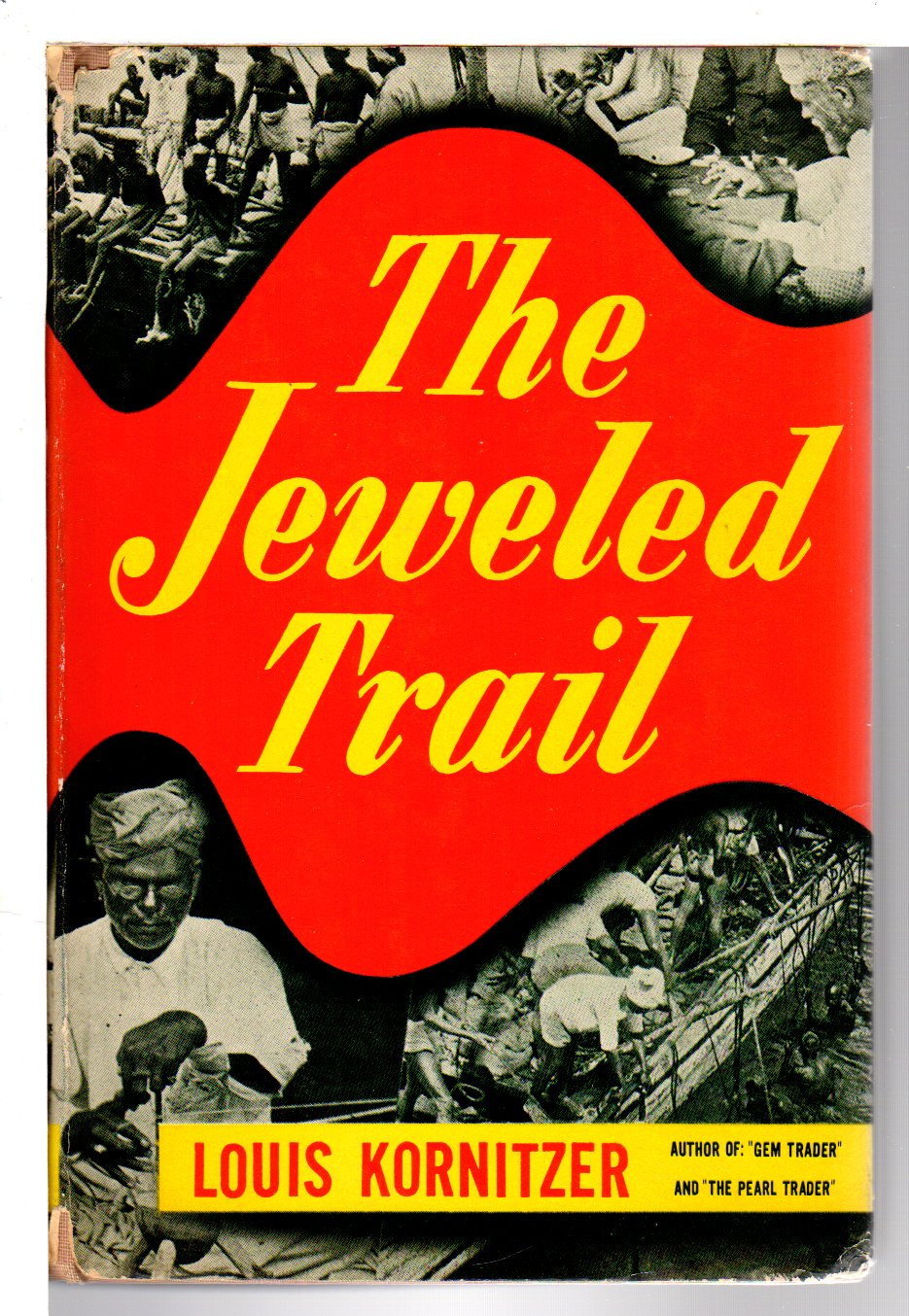
The Jeweled Trail

Book
Kornitzer, L. (1941) The Jeweled Trail. New York, Sheridan House, 280 pp., 16 plates
Record No. 1127  |  Sinkankas/Born No.: NIS/NIB  |  RWHL
A collection of reminiscences and anecdotes drawn from Louis Kornitzer’s career in the international gem trade, ranging from his apprenticeship to encounters with refugees dealing in precious stones. Episodes set in Europe, Asia, and the United States bring together diamonds, pearls, emeralds, jade, rubies, and other gem materials with the merchants, buyers, and adventurers whose lives intersected with them. Kornitzer combines observations on gems and commercial dealings with stories of human ambition, ingenuity, misfortune, and chance, moving between comedy and near tragedy. The illustrations depict notable jewelry and aspects of lapidary work. Written as entertaining recollections rather than a systematic gemological treatise, the book conveys the atmosphere and personalities of the trade through a practiced storyteller’s eye. Some of its more sensational adventures prompted contemporary reviewers to question their literal accuracy, making the volume valuable as a record of gem-trade storytelling as well as personal experience. The book contains the Rudolph Oblatt story on reconstructed rubies.

Differentiation between Russian and Colombian emerald
Journal Article
Gübelin, E.J. (1940) Differentiation between Russian and Colombian emerald. Gems & Gemology, Vol. 3, No. 6, Summer, pp. 89–92.
Record No. 2018  |  ISBN/ISSN: 0016626X  |  Sinkankas/Born No.: NIS/NIB  |  RWHL
Gübelin investigates microscopic criteria for distinguishing emeralds from Colombia and Russia’s Ural Mountains, arguing that color alone provides an unreliable indication of origin. Although Colombian emeralds are associated with a velvety green and Russian stones with more yellowish hues, examples from either source may resemble those from the other, particularly in small sizes. A comparative table records their appearances through several colored filters, but the author emphasizes that interpreting these subtle differences requires considerable experience, a sensitive eye, and suitable comparison material. Seeking more objective evidence, he examined numerous emeralds of known provenance, including specimens supplied by the Colombian Consulate in Paris. He identifies minute fluid inclusions, rather than conspicuous fractures or cloudy areas, as the most useful distinguishing features. Colombian emeralds are described as containing scattered, irregular groups of delicate, frequently tail-like cavities. Their boundaries are faint, suggesting that the enclosed liquid has a refractive index relatively close to that of the host. The liquid’s composition was not established, although behavior during heating and considerations of formation led the author to suggest water. The cavities show no consistent crystallographic orientation and remain separate even when grouped. Almost every cavity is reported to contain a tiny cubic crystal, commonly adjoining a rounded gas bubble with a dark outline, so that solid, liquid, and gaseous phases coexist within one inclusion. Carbon dioxide is proposed as the gas, while the solid’s chemical identity remains unresolved. Gübelin regards the cubic form of this solid inclusion as the principal diagnostic feature of Colombian material. Russian emeralds likewise contain multiphase inclusions, but their distribution, cavity shapes, and enclosed crystals differ. Their cavities are more closely associated with fractures and moss-like internal features, lack the characteristic Colombian tails, and contain solid crystals displaying lozenge-shaped or rhombic outlines rather than clearly rectangular cubic forms. The author presents this contrast as a dependable means of separating the two sources and supplies a mnemonic linking Colombian origin with cubic crystals and Russian origin with rhombic crystals. He recommends photomicrography to document the observations and notes that the features can also be examined with a diamondscope. The concluding discussion separates geographical interest from intrinsic quality: identifying a fine emerald as Russian need not diminish its value, while knowledge of provenance may increase an owner’s appreciation of either a Colombian stone or an unusually fine-colored Ural specimen.

The Choice of Treasures on the Conditions of Gemstones
Nukhab al-dhakhair fi ahwal al-jawahir
Book
Ibn al-Akfānī, M.i.M.i.a.-ʿ. [الأكفاني, ا.] (1939) The Choice of Treasures on the Conditions of Gemstones. [Nukhab al-dhakhair fi ahwal al-jawahir] [al-Qahirah], al-Matbaah al-Asriyah, 188 pp.
Record No. 221  |  Sinkankas/Born No.: NIS/NIB  |  Language: in Arabic  |  RWHL
Ibn al-Akfānī presents a concise medieval Arabic treatise on precious stones, summarizing earlier authorities while adding observations of his own. He treats ruby (yāqūt), balas ruby, garnet, diamond, pearl, emerald, peridot, turquoise, rock crystal, agate, malachite, jasper, bezoar, and other materials, describing their varieties, colors and qualities, principal sources, methods of testing and working, relative values, and reputed medicinal or talismanic properties. Commercial information is particularly valuable, including distinctions of quality and contemporary systems of valuation; diamonds are also discussed as tools for drilling other gemstones. Although traditional lore is repeated, Ibn al-Akfānī sometimes tests inherited claims critically—for example, he reports experimenting with the supposed effect of emerald on snakes and finding it untrue. The work thus combines mineralogical and gemological observation, trade knowledge, lapidary practice, medicine, and traditional stone lore, providing an important account of gemstone knowledge and commerce in the fourteenth-century Islamic world.

A comparison of the lapidary of Marbode with a Spanish fifteenth-century adaptation
Journal Article
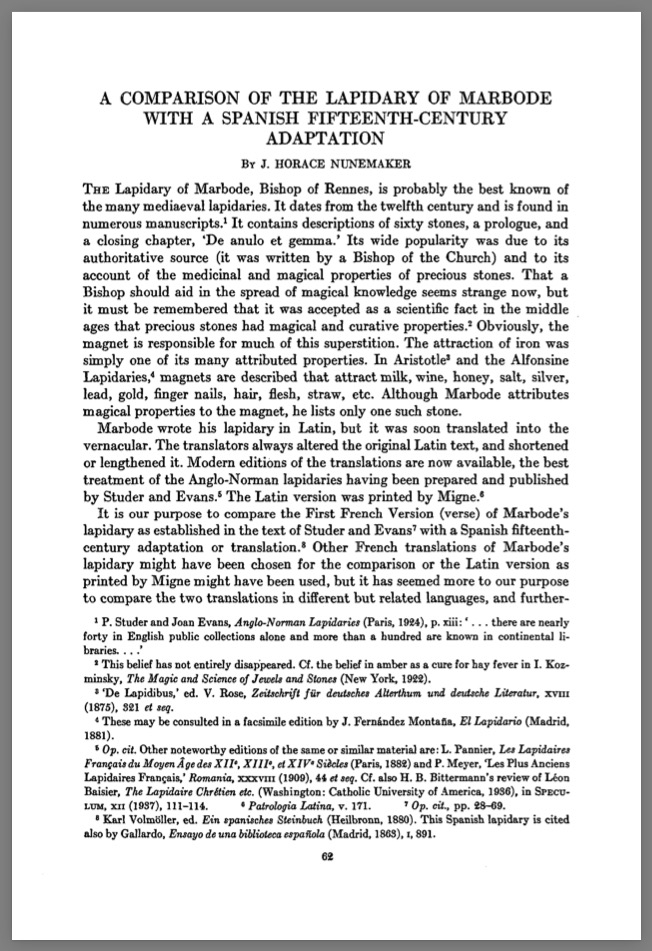
Nunemaker, J.H. (1938) A comparison of the lapidary of Marbode with a Spanish fifteenth-century adaptation. Speculum, Vol. 13, pp. 62–67.
Record No. 3103  |  Sinkankas/Born No.: NIS/NIB  |  RWHL
J.H. Nunemaker compares a fifteenth-century Spanish prose adaptation of Marbode’s lapidary with the First French Version in verse, examining how vernacular transmission reshaped descriptions of stones and their attributed medicinal and magical powers. He situates Marbode’s popularity within a medieval intellectual framework that accepted such powers as natural properties and identifies episcopal authority as another source of the work’s prestige. The principal comparison uses the French text edited by Studer and Evans because it contains more of the stones represented in the Spanish adaptation than other French versions; for the prologues, Nunemaker instead selects the First Anglo-Norman Prose Lapidary because its wording offers a closer parallel. The Spanish work describes forty-two stones, compared with sixty in Marbode’s lapidary, and includes eight absent from Marbode that its editor, Karl Vollmöller, attributed to Isidore. Despite these differences in coverage, the sequence of shared stones remains nearly identical. Through a systematic comparison of individual entries, Nunemaker documents additions, omissions, changes of order, subdivisions, and variations in descriptive detail. He argues that prose permits the Spanish adapter to expand material presented more compactly in French verse, supplying additional geographical information, classifications, classical references, therapeutic recipes, and supernatural virtues. The Spanish treatment divides the diamond material into three separate articles, increases the stated varieties of emerald from six to twenty-two, and elaborates accounts of stones associated with marriage, protection, persuasion, and nocturnal fears. Nunemaker particularly emphasizes the greater prominence of magic, demons, and marvellous effects in the Spanish text, contrasting these passages with what he interprets as the French version’s more cautious treatment or avoidance of witchcraft. Examples include coral’s power against demonic apparitions, additional virtues assigned to the magnet, and recommendations of certain stones for people believed to be possessed. Other entries preserve essentially the same information, demonstrating substantial continuity alongside adaptation. The comparison also identifies a conspicuous textual misunderstanding in which a reference to Theophrastus becomes the name of a stone in the Spanish account of lyn curium. Rather than establishing a complete genealogy of the Spanish text, the article provides an inventory of correspondences and divergences, showing how a shared lapidary tradition could retain its basic arrangement while acquiring fuller descriptions and a more explicit supernatural emphasis in a later vernacular form.

Crown of the Andes: A History of the Oldest and Largest Collection of Emeralds in the World
Book
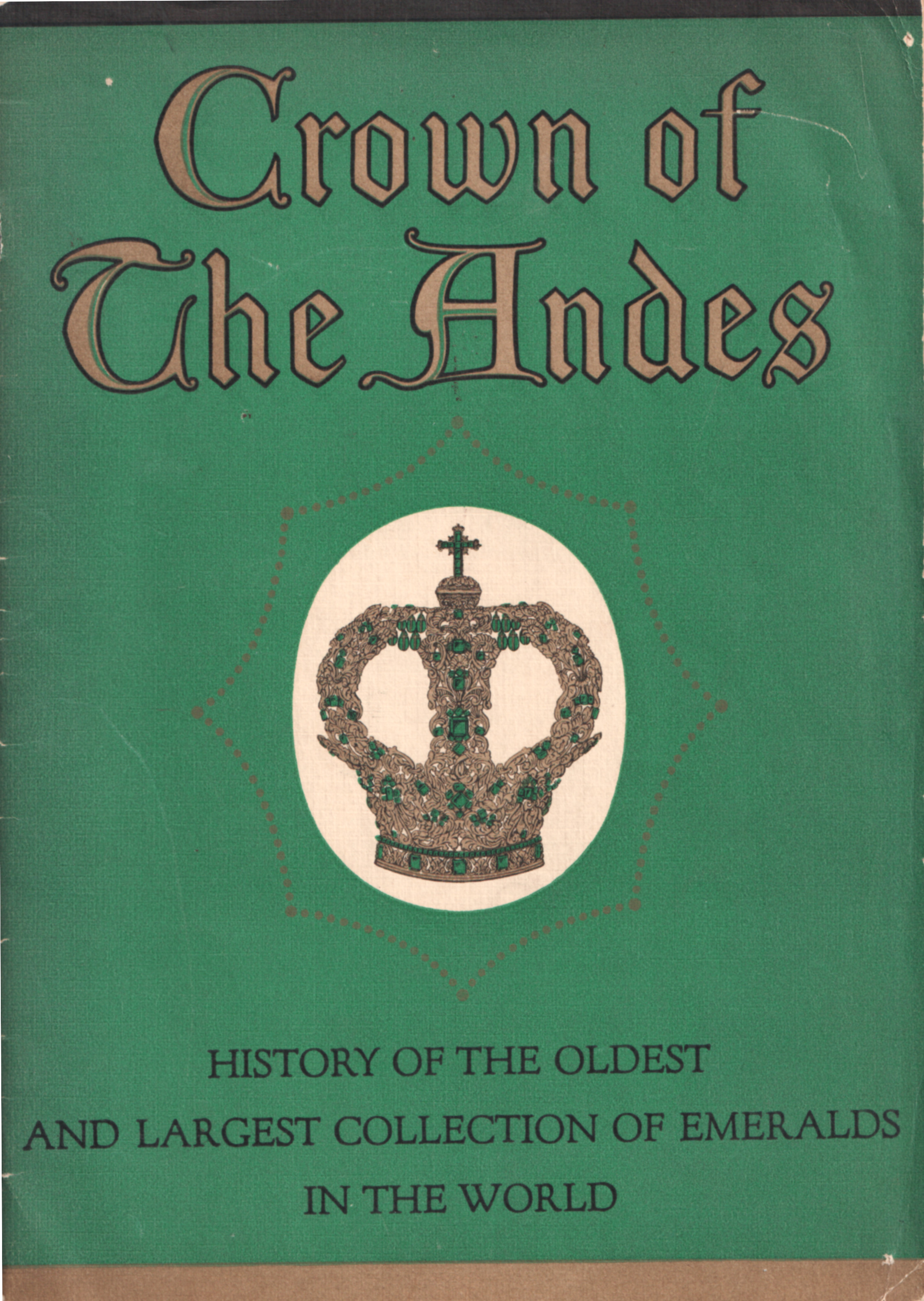
Stewart, F. and Crown of the Andes Company Chicago. (1936) Crown of the Andes: A History of the Oldest and Largest Collection of Emeralds in the World. Chicago, Crown of the Andes Co., 29 pp.
Record No. 7400  |  Sinkankas/Born No.: 6355  |  RWHL
Sinkankas: Describes the famous Crown of the Andes, made from gold and set with numerous emeralds, and donated to the Catholic Church of the city of Popayan, Colombia by grateful citizens when they were spared from an attack of the plague which affected other communities in the year 1590 . The crown was begun in 1593 and finished in 1599. The text gives its history up to the time when dire need impelled the city to sell the crown, for which purpose a Papal dispensation was obtained in 1914 to sell it to Czar Nicholas II of Russia. However, events in Europe halted the sale and after many years it was finally sold to a syndicate of buyers from the United States. This handsome and rare pamphlet is richly illustrated and contains much useful information.

The Story of the Emerald

Book
Marcus and Co. (1936) The Story of the Emerald. New York, Marcus and Co., unpaginated; 22 pp.
Record No. 4076  |  Sinkankas/Born No.: 4201  |  RWHL
Tastefully-designed, all in same format, and distinguished by use of Rockwell Kent's characteristic drawings as vignettes on each title page in addition to a tipped-in color plate of high quality. The text is in popular vein, with a few technical facts and more on lore and legend. A second printing issued on thinner, whiter paper, and enclosed in a wrap of white, silver-flecked paper, which also used for endpapers. [from Sinkankas]

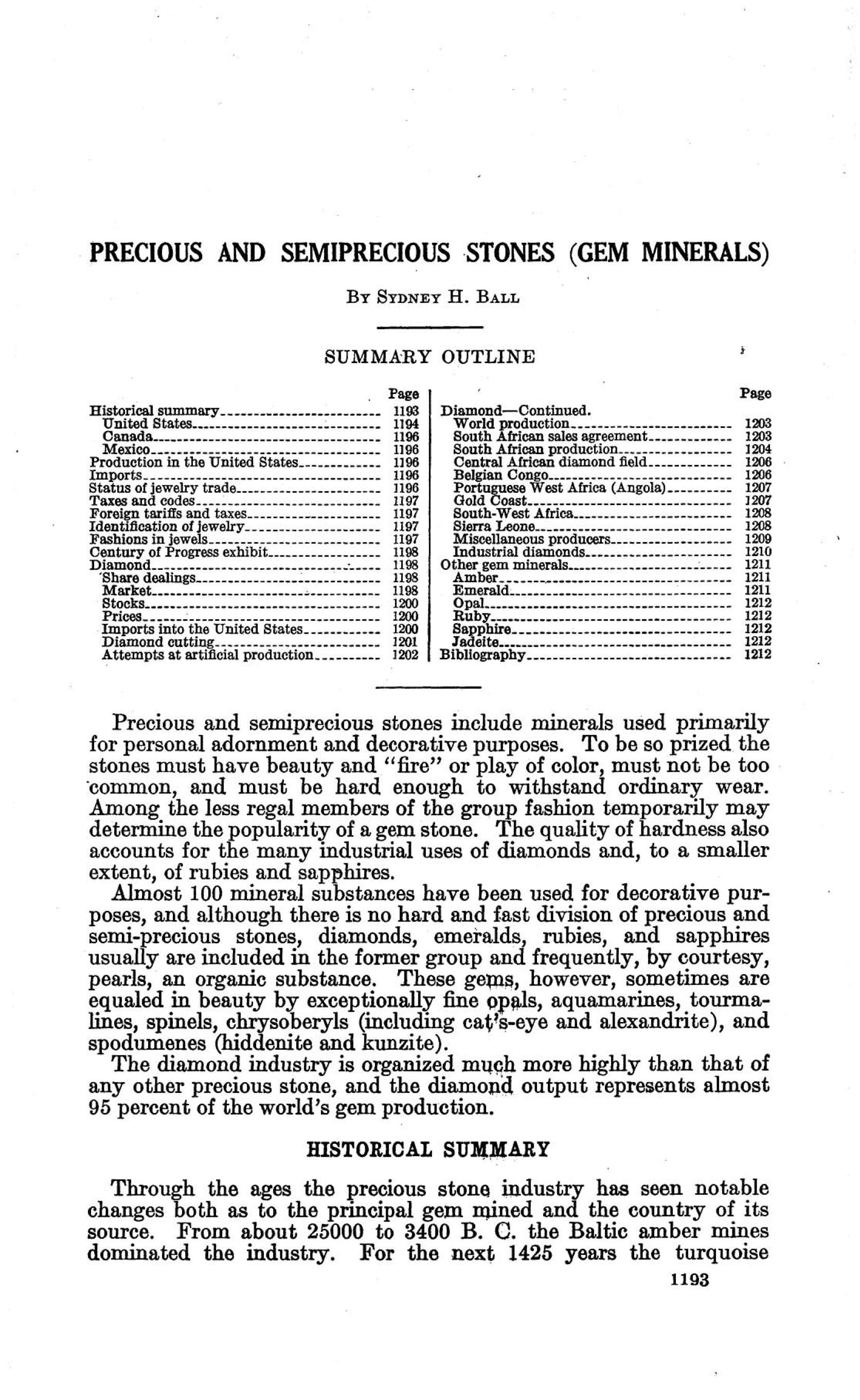
Precious and semiprecious stones

Journal Article
Ball, S.H. (1936) Precious and semiprecious stones. Minerals Yearbook, pp. 1193–1212.
Record No. 3035  |  Sinkankas/Born No.: NIS/NIB  |  RWHL
Reviews the production, trade and economic conditions of precious and semiprecious stones, chiefly during 1934, with historical background and developments extending into early 1935. Ball outlines the changing geographical centres of gem production and summarizes the history and diversity of United States deposits, contrasting their modest commercial output with the country’s importance as a consumer. American jewellery sales improved over 1933 but remained approximately 45% of their 1929 level. Diamonds receive the fullest treatment, including markets, company shares, inventories, prices, imports, cutting centres, attempted synthesis and production by country. World diamond output in 1934 is estimated at 4,179,581 ct, valued at US$18,469,923, increases of 21% in quantity and 33% in value over 1933, although production remained well below pre-depression levels. Particular attention is given to the Diamond Corporation’s marketing role and the South African sales agreement establishing centralized sorting, producer quotas and a single sales channel. Regional accounts describe African alluvial fields, the continued closure of South African pipe mines and the emergence of Sierra Leone as a significant producer, together with smaller operations elsewhere. The cutting industry remained troubled by excess capacity, unemployment and competition, while demand for fine large stones strengthened. Industrial diamond sales increased, and expanding applications included drilling, wire-drawing dies, abrasive-wheel dressing and bonded diamond grinding wheels. Shorter sections report developments in amber, emerald, opal, ruby, sapphire and jadeite, including production figures, regulations and changes in demand. Tariffs, taxation, jewellery fashions, gem identification and exhibitions are also discussed; statistical tables and a bibliography support the survey.

Septuaginta: Id est Vetus Testamentum Graece iuxta LXX Interpretes

The Septuagint: That is, the Old Testament in Greek according to the seventy translators
Book
Rahlfs, A. and Hanhart, R. (1935) Septuaginta: Id est Vetus Testamentum Graece iuxta LXX Interpretes. [The Septuagint: That is, the Old Testament in Greek according to the seventy translators] Stuttgart, Privilegierte württembergische Bibelanstalt, 2 Vols., Vol. 1: Leges et historiae; Vol. 2: Libri poetici et prophetic , 1184, 941 pp.
Record No. 26370  |  ISBN/ISSN: 3438051206  |  Sinkankas/Born No.: NIS/NIB  |  Language: in Greek and German  |  RWHL
The Septuagint, or Vetus Testamentum Graece iuxta LXX Interpretes, is the ancient Greek translation of the Hebrew Scriptures, traditionally attributed to seventy (or seventy-two) Jewish scholars in the 3rd to 2nd centuries BCE. This edition presents the Old Testament text in its Greek form, preserving the linguistic and textual heritage that significantly influenced early Jewish and Christian traditions. It is a foundational text for biblical studies, particularly for understanding the development of the Hebrew Bible, its reception in the Hellenistic world, and its use in early Christianity, where it often served as the primary scriptural source.

Exploring the Literature of Emerald

Emerald literature spans gemology, mineralogy, deposits, identification, treatments, synthesis, history and the gem trade, with important sources covering deposits around the world.

For a curated guide to this subject, read Green Fire — Lotus Gemology's Guide to the Literature of Emerald.

About Four Treasures

Four Treasures is Lotus Gemology's freely accessible gemological reference database. Use the full database to search by author, title or keyword and explore literature on gemology, mineralogy, jewelry and related fields. Where available, hyperlinks on titles may lead directly to the full publication.

Search the Complete Four Treasures Database