

Colorful Mosaic Pattern in Heated Orange Sapphire
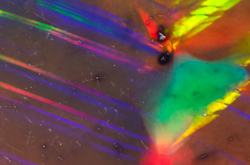
Colorful mosaic-like inclusions in a heated orange sapphire reveal tiny thin-film decrepitation inclusions associated with high-temperature heat treatment.
Colorful mosaic-like inclusions in a heated orange sapphire reveal tiny thin-film decrepitation inclusions associated with high-temperature heat treatment.

Fluorescent diopside, phlogopite, and edenite inclusions in a spinel reportedly from Tanzania reveal identification clues under short-wave ultraviolet light.

In our social media polls, 87% of Instagram respondents and 96% of Facebook respondents thought this ruby was unheated.

Mong Hsu ruby is known for cottony diaspore 'silk,' but in rare cases another type of silk can be observed.
A parcel of opals shows tell-tale signs of smoke treatment.
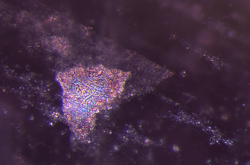
Mottled fissures and planes provide evidence of heat treated spinel.
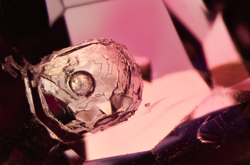
A mobile bubble floats in a cavity in spinel.
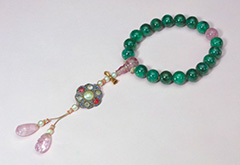
The early history of Burmese fei cui (pyroxene jade) in China has not been examined in detail. However, China’s economic expansion since 1978 has sparked renewed interest, prompting fresh efforts to better understand the history of this important gem. Building on earlier research, this article draws on both established and newly uncovered historical materials to provide a more comprehensive account of Empress Dowager Cixi’s influence on fei cui culture, while also addressing additional questions.
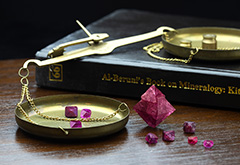
Abū Rayḥān Muḥammad ibn Aḥmad al-Bīrūnī was born in 973 CE, in what is now Uzbekistan. A polymath of the Islamic Golden Age, he distinguished himself in numerous fields, including medicine, astronomy, history, mathematics, physics, mineralogy, gemmology, encyclopedism, geography, philosophy, sociology, and travel. His vast intellectual contributions rank him among the greatest minds of any era. Al-Bīrūnī authored some 145 works, but tragically many of these are now lost. Given the sheer scale and depth of his intellectual legacy, any attempt to comprehensively study al-Bīrūnī’s contributions is inevitably limited and fraught with gaps. However, what we do know demonstrates that this was a remarkable man, on the order of an Aristotle or Einstein. And yet much of the world has never even heard of him. This paper will largely focus on his gemmological work, while also touching on his other accomplishments.
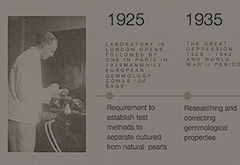
This article traces the development of the modern gemological laboratory from 1925 to the present date, a 100-year journey that has seen not just a gradual and then explosive evolution in the application and maturity of the science, but importantly the standing that gemological laboratories have enjoyed within the gemstone industry and the scientific community. The passionate people involved have made tremendous contributions to the understanding of gem materials, and their willingness to embrace the latest technology as well as attract successive generations to the field has made the study of gem materials within gemological laboratories one of the most exciting theatres of life.