Gemology Books Bibliography

Gemology Books Bibliography

Explore books on gems, gemology, jewelry and mineralogy in Four Treasures, the Lotus Gemology reference database. This bibliography brings together matching book records from the collection, with publication details, abstracts and cover images where available.

Gemology Book References

The list below matches books concerning gemology and related subjects in the database's searchable fields. Some works cover several branches of gems, jewelry or mineralogy.
2,801–2,820 of 3,464 matching references

The Romance of Mining

Book
Williams, A. (1905) The Romance of Mining. London, C. Arthur Pearson, 402 pp.
Record No. 16841  |  Sinkankas/Born No.: NIS/NIB  |  RWHL
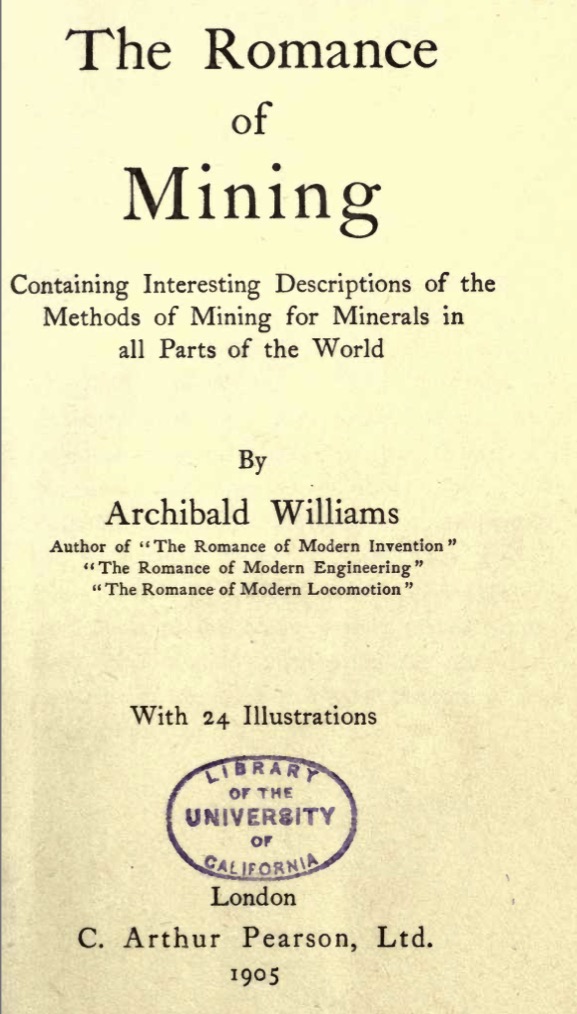
A popular survey of mining throughout the world, written for the general reader and describing the extraction of gold, silver, diamonds, coal, iron, copper, tin, mercury and other mineral resources. Of particular gemological interest is Chapter XXII, “The Burma Ruby Mines” (pp. 358–366), which summarizes the history of the Mogok ruby district and the methods then employed to recover rubies from the gem-bearing gravels. Williams describes both traditional workings and the more organized operations of the Burma Ruby Mines, Limited, including excavation, washing and sorting of the ruby-bearing material. The chapter provides a useful contemporary overview of Mogok at the beginning of the twentieth century and places ruby mining alongside the major mining industries of the period. The book is illustrated with 24 plates and is valuable as a readily accessible contemporary account of mining technology and practice worldwide.

The Life of the Marquis of Dufferin and Ava
Book
Lyall, A. (1905) The Life of the Marquis of Dufferin and Ava. London, John Murray, 2 Vols., 328, 339 pp.
Record No. 2823  |  Sinkankas/Born No.: NIS/NIB  |  RWHL
A two-volume biography of Frederick Temple Hamilton-Temple-Blackwood, Marquis of Dufferin and Ava, based extensively on his correspondence, diaries and official papers. Lyall follows Dufferin’s diplomatic and administrative career in Syria, Canada, Russia, Turkey, Egypt, India, Italy and France, with particularly detailed treatment of his tenure as Viceroy of India from 1884 to 1888. Of gemological interest is the account of the crisis preceding the British annexation of Upper Burma in 1885. Among the commercial and strategic issues troubling Dufferin were Burmese negotiations with French interests, including proposals involving concessions to the valuable royal ruby mines. The subsequent expedition to Mandalay, deposition of King Thibaw and annexation of Upper Burma brought the Mogok ruby district under British control, an important turning point in the modern history of the mines. The work is therefore useful for understanding the political setting in which Burma’s ruby resources passed from royal monopoly to colonial administration and, soon afterward, commercial exploitation by British interests.

The Journal of John Jordain, 1608–1617
Edited Book
Foster, W., editor (1905) The Journal of John Jordain, 1608–1617.. London, Hakluyt Society, Second Series, No. 16 , 394 pp.. Reprinted by Kraus, 1967.
Record No. 2764  |  Sinkankas/Born No.: NIS/NIB  |  RWHL
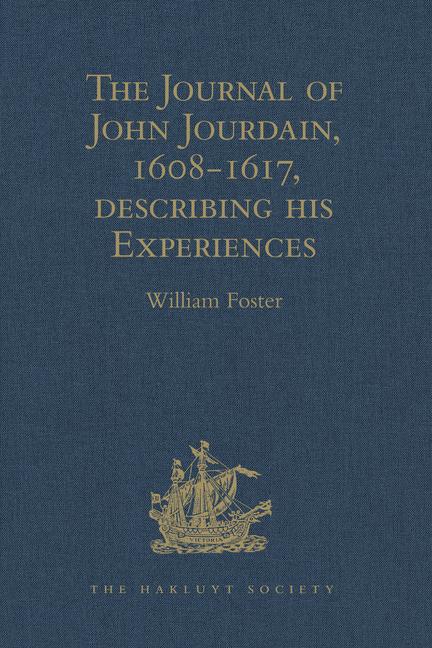
An edited account of John Jourdain’s travels during the English East India Company’s Fourth Voyage, describing his experiences between 1608 and 1617 in Arabia, India and the Malay Archipelago. Jourdain records local geography, customs, political conditions and, above all, the commodities and trading practices encountered at ports and commercial centers along his route. Of gemological interest is his description of a mountain near Sana’a where cat’s-eyes, agates, bloodstones and other stones “of better value” were found, and his account of Mocha as a major entrepôt receiving “precious stones of all sorts” from Indian shipping, which were purchased by merchants connected with Cairo and subsequently carried into the Mediterranean and Ottoman trading network. He also notes that the country associated with Dabhol produced diamonds in “great store of the new rock,” together with other stones of lesser value. Beyond these specific references, the journal provides valuable firsthand evidence for the commercial routes linking western India, Arabia and Southeast Asia during the formative years of English participation in the Asian trade. Foster’s edition includes extensive historical notes, contemporary supplementary narratives, maps and a bibliography.

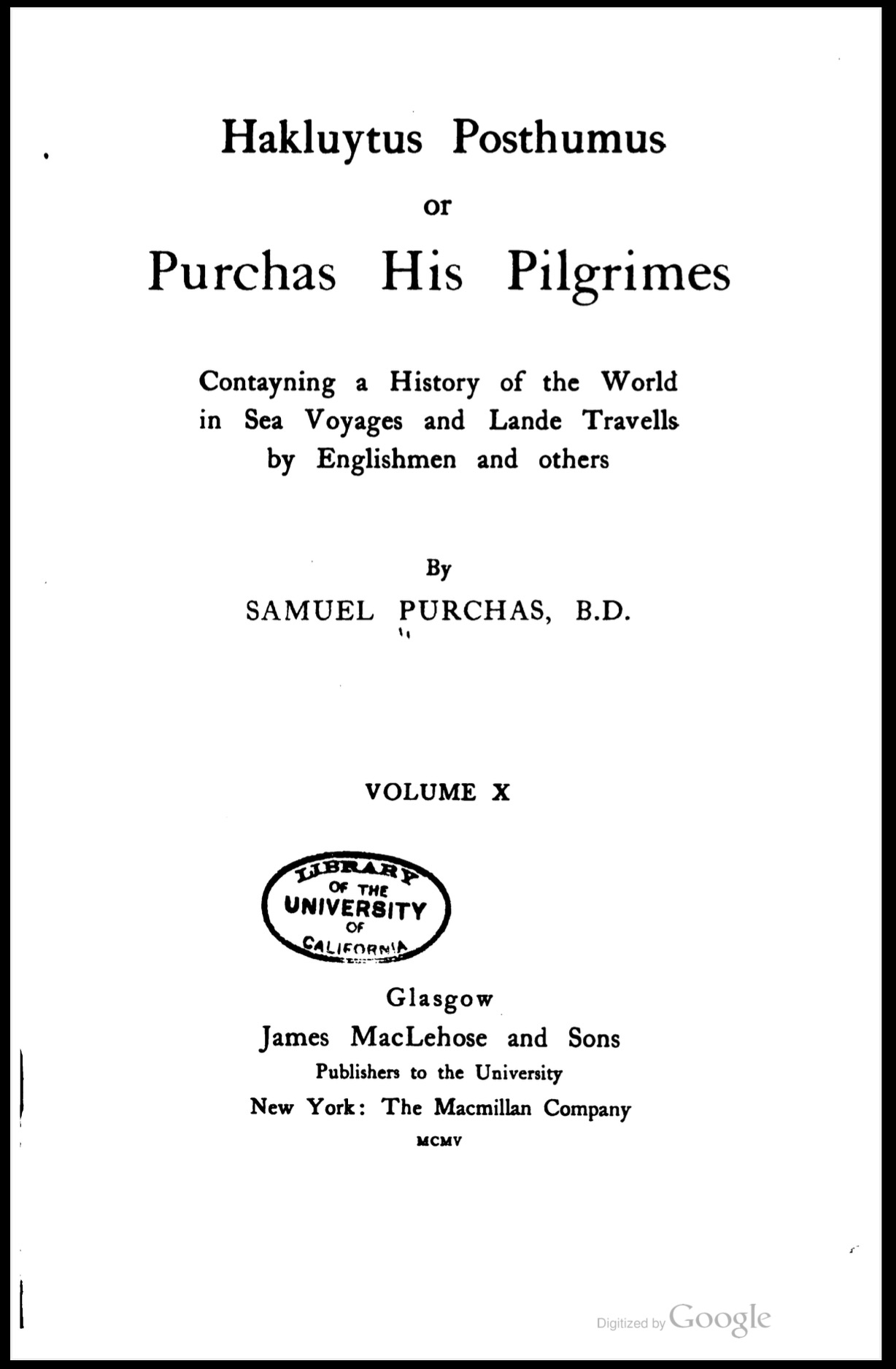
Hakluytus Posthumas or Purchas His Pilgrimes
Book
Purchas, S. (1905) Hakluytus Posthumas or Purchas His Pilgrimes. Glasgow, James MacLehose and Sons, 20 Vols., Vol. 10: pp. 88–143, Caesar Fredericke of Venice (1563–1581); pp. 143–164, Gasparo Balbi, the Venetian jeweller (1579–1583); pp. 165–204, Ralph Fitch, the first English chronicler (1583–1591); pp. 222–318, John Huighen van Linschoten (1513); Vol. 11: pp. 394–400, Nicolo Di Conti (1444)
Record No. 1452  |  Sinkankas/Born No.: NIS/NIB  |  RWHL
A monumental collection of early travel narratives assembled by Samuel Purchas from manuscripts, printed sources, and materials associated with Richard Hakluyt, preserving many of the most important European accounts of Asia before the seventeenth century. Of particular gemological value are the narratives in Vol. 10 by Caesar Fredericke, Gasparo Balbi, Ralph Fitch, and Jan Huygen van Linschoten, which contain firsthand or near-contemporary observations on the gem-producing and trading regions of India, Ceylon, Pegu, and other parts of Southeast Asia. Fredericke and Fitch are especially important for their notices of rubies, sapphires, spinels, diamonds, pearls, and the commercial centers through which these stones passed, while Balbi’s account is notable because he was himself a Venetian jeweller and visited the court of Pegu. Linschoten provides extensive information on Asian trade, commodities, and maritime routes linking India and Southeast Asia with the Portuguese commercial world. Vol. 11 includes Nicolo di Conti’s fifteenth-century travels, one of the earlier European descriptions of India and the East. Taken together, these narratives constitute an exceptionally important body of primary source material for the history of Asian gemstones, their sources, terminology, trade routes, and European knowledge of the gem-producing regions before 1600. The MacLehose edition is a 20-volume reprint of Purchas’s 1625 work, issued in Glasgow in 1905–1907.

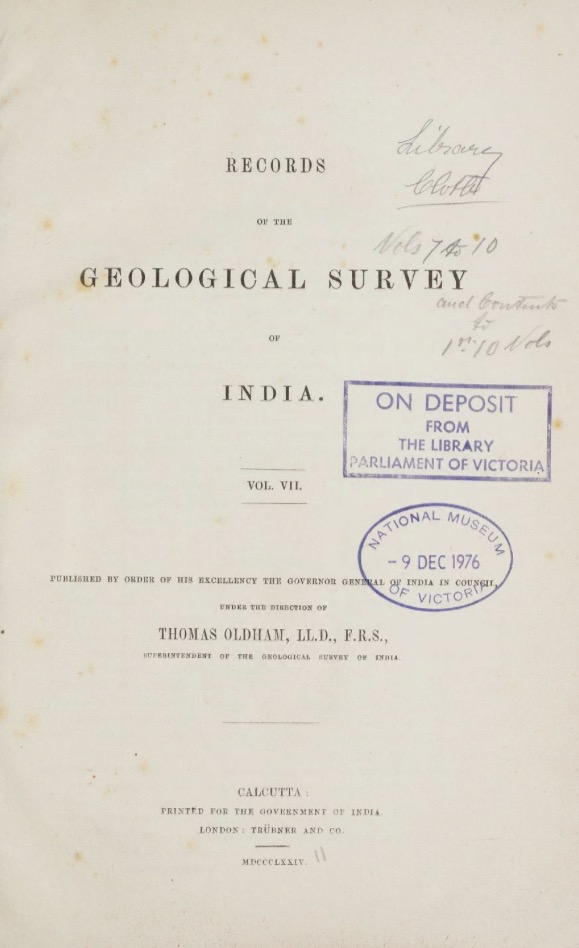
Review of the mineral production of India during the years 1898 to 1903
Journal Article
Holland, T.H. (1905) Review of the mineral production of India during the years 1898 to 1903. Records, Geological Survey of India, Vol. 32, Part 1, pp. 77–78, 105–109.
Record No. 998  |  Sinkankas/Born No.: NIS/NIB  |  RWHL
Holland reviews the mineral production of India from 1898 to 1903, summarizing the principal mineral industries and changes in output and value during the period. Of particular gemological interest are his discussions of precious stones, including diamonds, rubies, sapphires, and other gem materials. The ruby industry of Upper Burma receives attention, with production centered on the Mogok Stone Tract and conducted both through organized mining enterprises and native workings; Holland comments on production, values, and the difficulties of assessing an industry in which much material passed through private channels. Sapphire production in Kashmir is also discussed, including the famous deposits and their comparatively limited and irregular output. Diamond production remained small and was derived chiefly from traditional Indian workings. The review provides useful contemporary statistical and economic information on India’s gem-mining industries at the beginning of the twentieth century and places them within the broader mineral economy of British India.

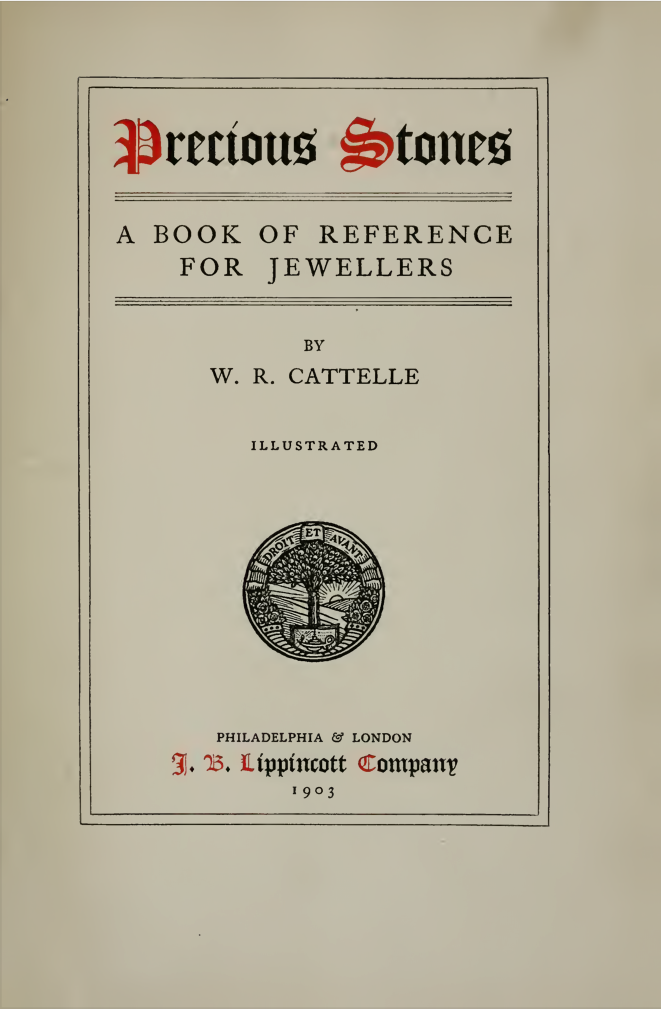
Precious Stones: A Book of Reference for Jewellers
Book
Catelle, W.R. (1903) Precious Stones: A Book of Reference for Jewellers. Philadelphia & London, J.B. Lippincott Co., 224 + 19 pp.
Record No. 16327  |  Sinkankas/Born No.: NIS/NIB  |  RWHL
Cattelle’s handbook was designed as a practical reference for jewelers rather than a systematic mineralogical treatise. It opens with general discussions of precious stones, famous gems, superstition and lore, desirable qualities, prices, cutting, weights and artificial coloring, followed by individual chapters on diamond and the principal colored stones. Particular attention is given to commercial qualities, sources, appearance, valuation and the distinctions useful to dealers, with less familiar gems included because of their growing importance in the American trade. Cattelle states that he drew heavily upon authorities including James D. Dana, George F. Kunz, Max Bauer and Edwin W. Streeter. The book reflects the concerns of the early twentieth-century jewelry trade, combining basic gemology with practical information on identification, manufacture, cutting and market value.

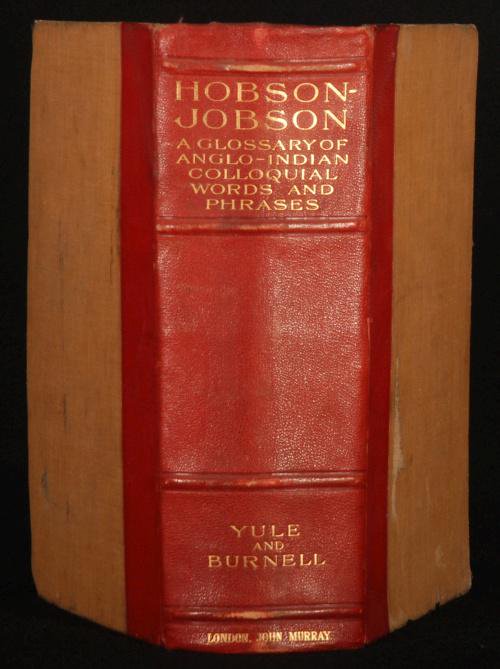
Hobson-Jobson

Book
Yule, H. and Burnell, A.C. (1903) Hobson-Jobson. London, Routledge & Kegan Paul, 1021 pp. (see Ava, pp. 40–41; Balass, p. 52; Capelan, p. 159; Ceylon, pp. 181–190; Coromandel, pp. 256–258; Corundum, p. 259; Tenasserim, p. 914)
Record No. 4674  |  Sinkankas/Born No.: NIS/NIB  |  RWHL
One of the most fascinating books about the Orient ever written. If you’ve ever wondered about the derivation of words like “pajamas,” “assassins” or “looters,” this is the book for you. A total classic and now quite scarce. A celebrated historical and etymological glossary of Anglo-Indian words, place names, and expressions, drawing extensively on early European and Asian travel literature. Of particular gemological interest are entries tracing the terminology and geography of the Asian gem trade. “Balass” is identified as the rose-red spinel and derived from Balakhshī/Badakhshī, referring to the celebrated spinel-producing region of Badakhshan on the upper Oxus; quotations from Ibn Battuta, Clavijo, Barbosa, Frederick, Hawkins, Fryer, and others document the term’s changing forms and usage. “Capelan” preserves early European accounts of the Burmese ruby-mining region, with quotations from Ca’ Masser, Varthema, Barbosa, and Tavernier showing the confused geographical knowledge surrounding the sources of Pegu and Ava rubies; the editors associate the name tentatively with the Mogok-area mines. The entry on “Corundum” discusses the Indian origin of the word, comparing Hindustani, Deccani, Telugu, Tamil, and Sanskrit forms and noting its historical use for non-gem corundum. Other entries on Ava, Ceylon, Coromandel, and Tenasserim provide detailed historical geography valuable for interpreting early accounts of the Southeast Asian gem trade; notably, Ceylon is discussed as the ancient Ratnadvīpa, “Isle of Gems,” and in Arabic tradition as an “Isle of Rubies.” The work remains an important source for understanding how gem names, mining localities, and trade terminology were transmitted and often distorted in European literature on India and Southeast Asia.

Agni Puranam

Edited Book
Dutt, M.N., editor (1903, 1904) Agni Puranam.. Calcutta, Elysium Press, 2 Vols., 676 pp..
Record No. 686  |  Sinkankas/Born No.: NIS/NIB  |  RWHL
The Agni Purana, (Sanskrit: अग्नि पुराण, Agni Purāṇa) is an English prose translation of one of the major Sanskrit Purāṇas and an encyclopedic compilation covering mythology, ritual, cosmology, medicine, architecture, statecraft, astronomy and numerous practical arts. Of particular gemological importance is the section on ratna-parīkṣā (“testing of gems”), which lists stones appropriate for royal use, including diamond, emerald, ruby, pearl, sapphire, lapis lazuli, crystal and several less readily identifiable materials. Good gems are characterized generally by internal lustre, purity and well-formed shape, while dull, cracked or included stones are rejected. Diamond is praised when pure, unbreakable, bright and exhibiting rainbow-like lustre; emerald should possess a parrot-green hue, gloss and radiance; rubies are classified partly according to their supposed sources and colors; and pearls are valued for roundness, whiteness, transparency and weight, with both naturalistic and legendary origins being recorded. Sapphire is described in terms of its strong color and lustre, while lapis lazuli is recommended for necklaces and other ornaments. The passage is valuable less as mineralogy in the modern sense than as evidence for early Indian systems of gem classification, quality assessment, auspiciousness and the close association of precious stones with kingship and personal fortune.

The Struggle for Persia

Book
Stuart, D. (1902) The Struggle for Persia. London, Methuen, 336 pp.
Record No. 29086  |  Sinkankas/Born No.: NIS/NIB  |  RWHL
Stuart devotes much of his chapter on Meshed and Bushire to a detailed description of the Nishapur turquoise mines, drawing explicitly on information supplied by General Schindler. He locates the mines in the Bâr-i-Meidan district northwest of Nishapur and describes their geography, villages, population, individual workings, mining conditions, production, classification, cutting, valuation, and trade. Numerous named mines are discussed, including workings that were dangerous, flooded, poorly ventilated, collapsed, or exhausted, together with differences in the quality and color stability of their turquoise. Of particular gemological interest is his description of material from the Sar-i-Reîsh and Anjîrî mines, which could possess an attractive color while moist but faded on drying, becoming greenish, spotted, or eventually nearly white. Such stones were reportedly shipped to Europe in damp earthenware vessels, and Stuart attributes declining European confidence in turquoise and falling prices partly to the influx of this unstable material. He contrasts these deposits with the Khâkî workings in accumulated mine debris and alluvium, which were then producing many of the finest stones, including valuable ring-quality turquoise. Mining employed picks, crowbars, and increasingly gunpowder, although blasting was considered detrimental because it shattered turquoise that older hand-working methods might have recovered intact. Stuart gives an unusually detailed contemporary classification of Nishapur turquoise into three commercial categories: Angushtarî, comprising fine, stable-colored stones suitable for rings and sold individually; Bârkhaneh, divided into grades and sold by weight; and Arabî, encompassing inferior pale, greenish, spotted, or otherwise undesirable material. Deep sky blue was most prized, but value also depended upon shape, freedom from flaws, permanence of color, and an indefinable quality termed zât, which Stuart compares with the “water” of a diamond or the luster of a pearl. He describes several traditional cuts, including the high peikânî form reserved for fine deep-colored stones, cabochons, and flat slabs, and notes the practice of disguising flaws in large stones with gold scrollwork or strategically positioned inscriptions. The account also traces the commercial chain from miners through village Rîsh-i-Safîds and commission agents to Meshed dealers and ultimately European markets, particularly Moscow, showing how a stone could increase enormously in value after cutting and successive resale. Annual production from the mines, mountains, and surface diggings is estimated at 25,000 tomans at mine value, perhaps tripling by the time the turquoise reached its final purchasers. Stuart’s chapter thus provides an exceptionally detailed early twentieth-century account of Nishapur turquoise mining, quality grading, color stability, cutting, valuation, marketing, and the economic organization of the trade.

The Eldorado of the Ancients

Book
Peters, C. (1902) The Eldorado of the Ancients. London, C. Arthur Pearson, 447 pp.
Record No. 26448  |  Sinkankas/Born No.: NIS/NIB  |  RWHL
In publishing this detailed account of the explorations and researches that occupied me from 1896 to 1902, my aim is to demonstrate that the most ancient civilizations sourced their gold, ivory, and other precious goods from South Africa. My discoveries suggest that the biblical “Ophir” of Solomon’s time corresponds to the region between the Lower Zambesi and the Limpopo River, and they also support the view that the Egyptian “Punt” expeditions for gold, copper, frankincense, and other commodities were directed to the same area. To understand the evidence I present, the reader must accompany me from the Lower Zambesi to the Upper Pungwe, through Macombe’s country—likely the empire of the legendary Monomotapa of the sixteenth century—and then south to the Sabi River. Throughout this region, we encounter the ruins of an ancient gold-mining civilization and vestiges of Punic Baal-Ashera worship that survive to this day. I am confident that three to four thousand years ago, South Africa maintained regular contact with the Erythrean and Mediterranean worlds, forming part of a vast Punic trade network stretching from the Baltic and the Scilly Isles to the Canaries, from Malacca to Bulawayo, from Madagascar to Corsica, encompassing the Indian Ocean, the Mediterranean, and the Atlantic. In presenting this theory, I acknowledge the many explorers and scholars whose work has laid the foundation for my conclusions—Karl Mauch, Theodore Bent and Mr. Swan, Dr. Eduard Glaser, Professor A. H. Keane, Messrs. Hall and Neal, among others mentioned herein—who have all helped to substantiate the South African Ophir theory. Finally, I feel it necessary to explain to a British readership why my focus shifted from German colonial activity in Central East Africa, which engaged me from 1884 to 1896, to this new quest in South Africa. It was not a voluntary departure from my previous work, nor one made lightly, but a path I was ultimately compelled to take. LT: Unreliable reference. Some interesting maps.

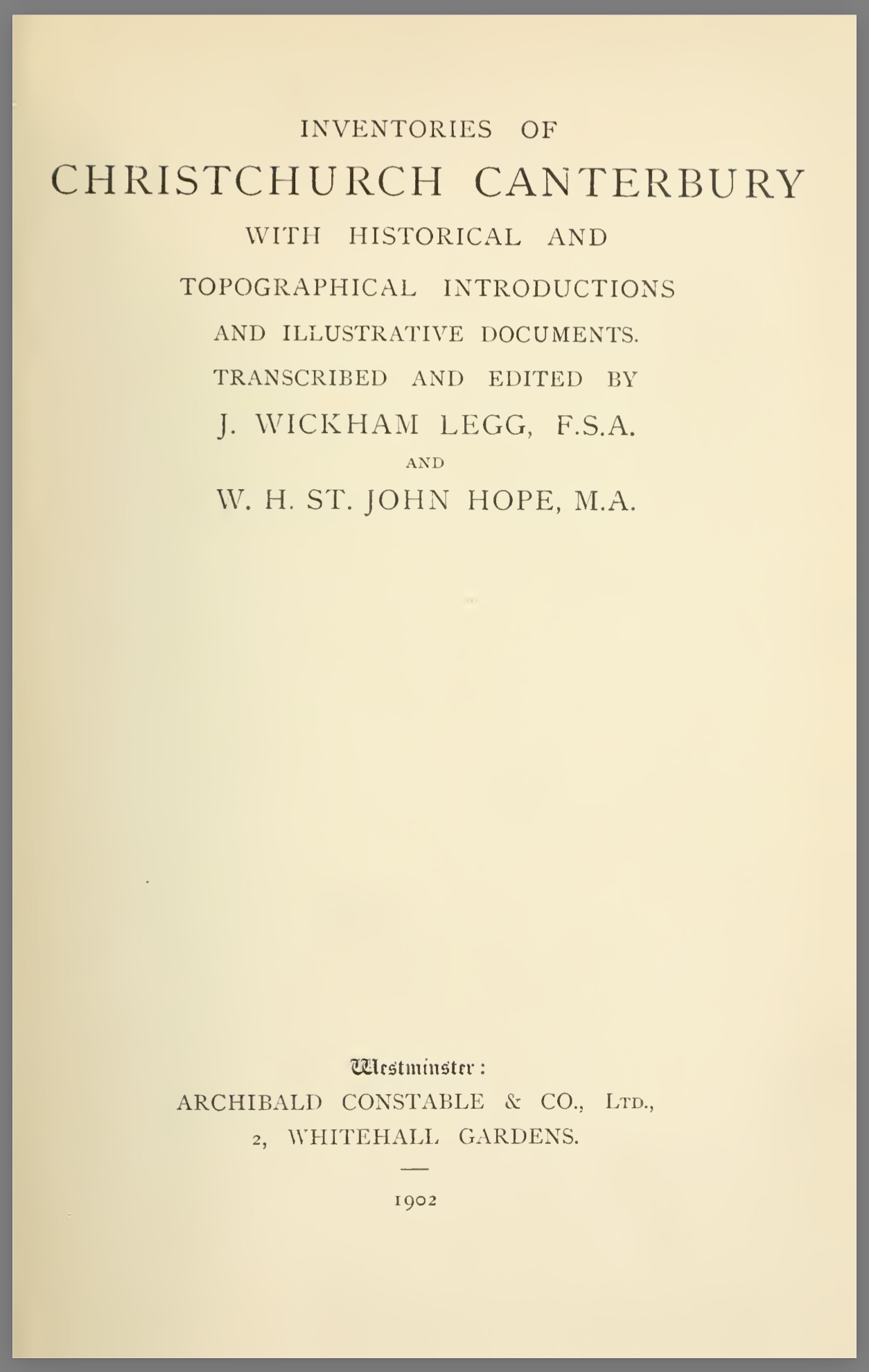
Inventories of Christchurch Canterbury; With Historical and Topographical Introductions and Illustrative Documents
Book
Legg, J.W. and Hope, W.H.S.J. (1902) Inventories of Christchurch Canterbury; With Historical and Topographical Introductions and Illustrative Documents. Westminster, Archibald Constable & Co., 379 pp.
Record No. 17077  |  Sinkankas/Born No.: NIS/NIB  |  RWHL
Legg and Hope publish and annotate inventories relating to Christ Church, Canterbury, accompanied by historical and topographical introductions and supporting documents. The records describe the cathedral’s ecclesiastical possessions, including vestments, plate, reliquaries, ornaments, and other treasures, preserving detailed evidence for their materials, decoration, and use. Of particular gemological interest are references to jewels and precious stones set in liturgical and ceremonial objects, providing documentary evidence for the use and terminology of gems in medieval English ecclesiastical treasures.

Precious stones

Book Section
Kunz, G.F. (1902) Precious stones. In: Mineral Resources of the United States | Calendar Year 1901, Washington: Govt. Printing Office, pp. 729–771.
Record No. 17014  |  Sinkankas/Born No.: 3617; NIB  |  RWHL
A comprehensive review of the precious-stone industry and important gemological developments during 1901, which Kunz describes as the most successful year yet in the history of the American trade. U.S. production was valued at $289,060, led by Montana sapphires, turquoise, rhodolite garnet, tourmaline, quartz, and other ornamental stones, while imports of diamonds and other precious stones reached about $22.8 million. Notable developments included a diamond from Lee County, Georgia; expanding sapphire mining at Yogo, Montana; an output of about 200,000 carats of rhodolite from Cowee Valley, North Carolina; colored tourmalines at Mesa Grande, California; chrysoprase near Visalia; new turquoise deposits in Colorado and Nevada and continued major production in New Mexico; large epidote crystals from Alaska; and a jade-like compact idocrase from California. Kunz gives detailed accounts of South African, Guianan, and Bornean diamond mining, Montana sapphire geology and recovery, American corundum deposits, the improving fortunes of the Burma Ruby Mines Company, emerald and beryl occurrences, garnet, quartz varieties, opal, turquoise, apatite, and other gem materials. He also discusses contemporary gem cutting and jewelry fashions and comments extensively on Chinese jade objects reaching Western markets following the looting associated with recent conflicts in China. The report concludes with statistical tables of U.S. precious-stone production from 1896–1901 and imports from 1867–1901.

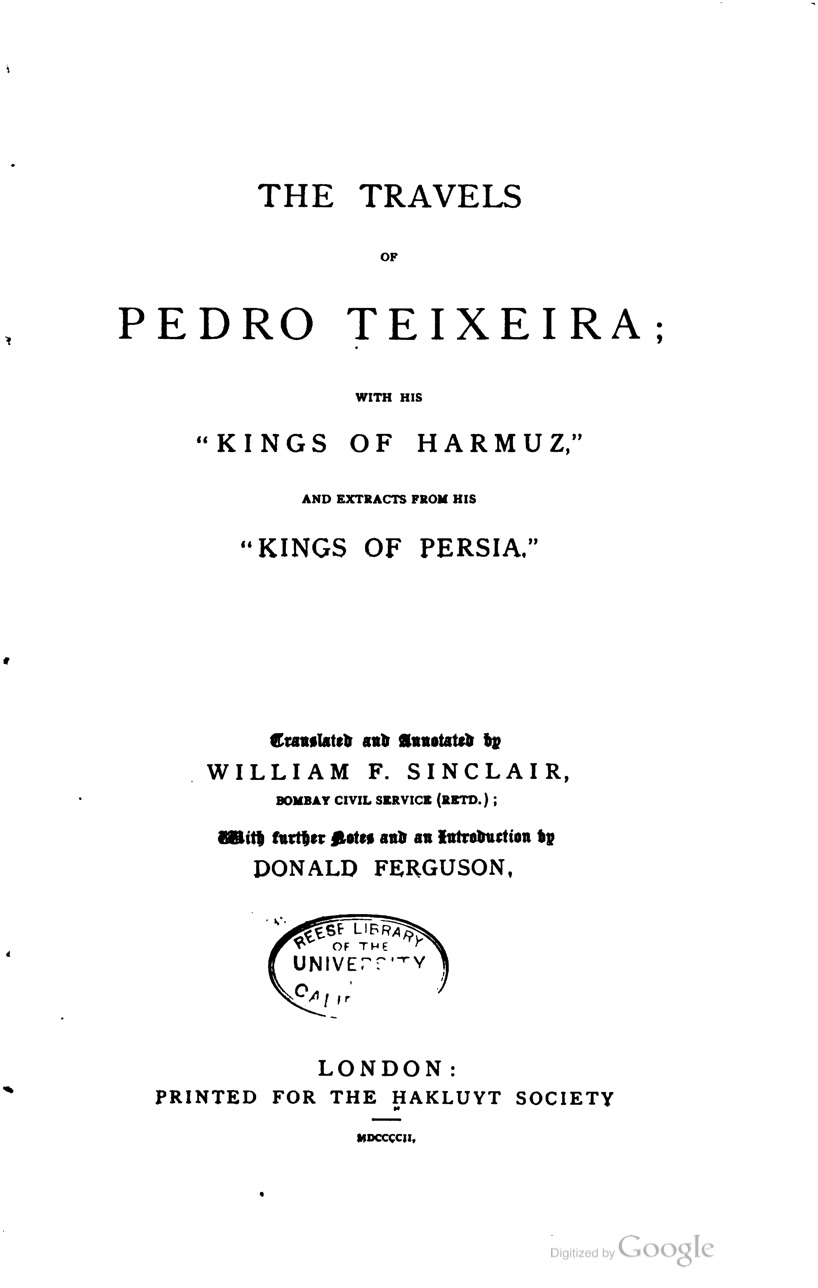
The Travels of Pedro Teixeira

Edited Book
Sinclair, W.F. and Ferguson, D., editor (1902) The Travels of Pedro Teixeira.. London, Hakluyt Society, Second Series, No. 9 , 292 pp.. Reprinted by Kraus, 1967.
Record No. 4653  |  Sinkankas/Born No.: NIS/NIB  |  RWHL
An English translation of portions of Pedro Teixeira’s Relaciones, combining his own travels with his historical accounts of the kings of Hormuz and Persia. Teixeira, a Portuguese traveller active around 1600, journeyed extensively through India and the Persian Gulf and later returned to Europe overland by way of Basra, Baghdad, Aleppo and the Mediterranean. Of particular gemological importance is his detailed description of the Bahrain pearl fishery, which he observed firsthand. He records that fishing normally began in July and continued through August, involving a fleet of roughly 200 vessels from Bahrain, Julfar and Nihhelu, with much of the fishing conducted near Qatar. Oysters were opened immediately after recovery and the pearls removed; Teixeira considered the pearls of the Persian Gulf superior in quality and weight to those from other regions. His descriptions provide valuable early evidence for the organization, geography and commercial importance of Gulf pearling and for Hormuz’s role as an entrepôt linking the trade of Persia, Arabia and India. The volume also contains historical material on the rulers of Hormuz and Persia and extensive editorial notes placing Teixeira’s observations within the broader literature of early European travel in Asia.

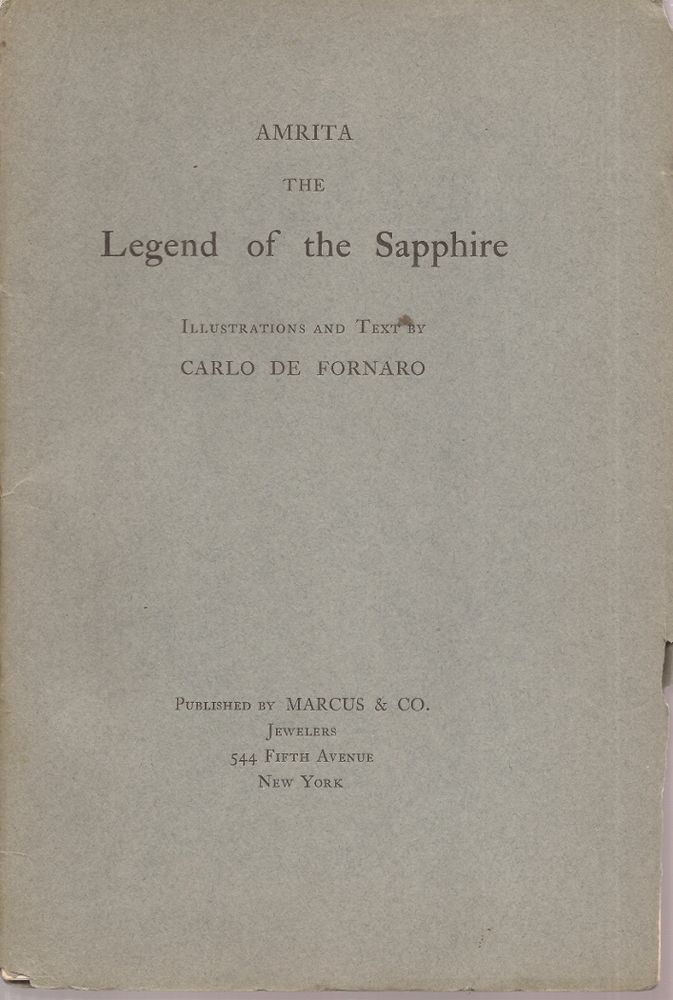
Amrita: The Legend of the Sapphire

Book
Fornaro, C., De (1902) Amrita: The Legend of the Sapphire. New York, Marcus & Co., 18 pp.
Record No. 2761  |  Sinkankas/Born No.: 2180E; NIB  |  RWHL
De Fornaro presents a short literary legend centered on Amrita and a sapphire, using the gemstone as a central element in a romantic and exotic tale. Rather than a scientific or gemological work, the story reflects contemporary cultural and symbolic associations of sapphire and is of interest to gemological bibliography as an example of the treatment of precious stones in popular literature at the beginning of the twentieth century.

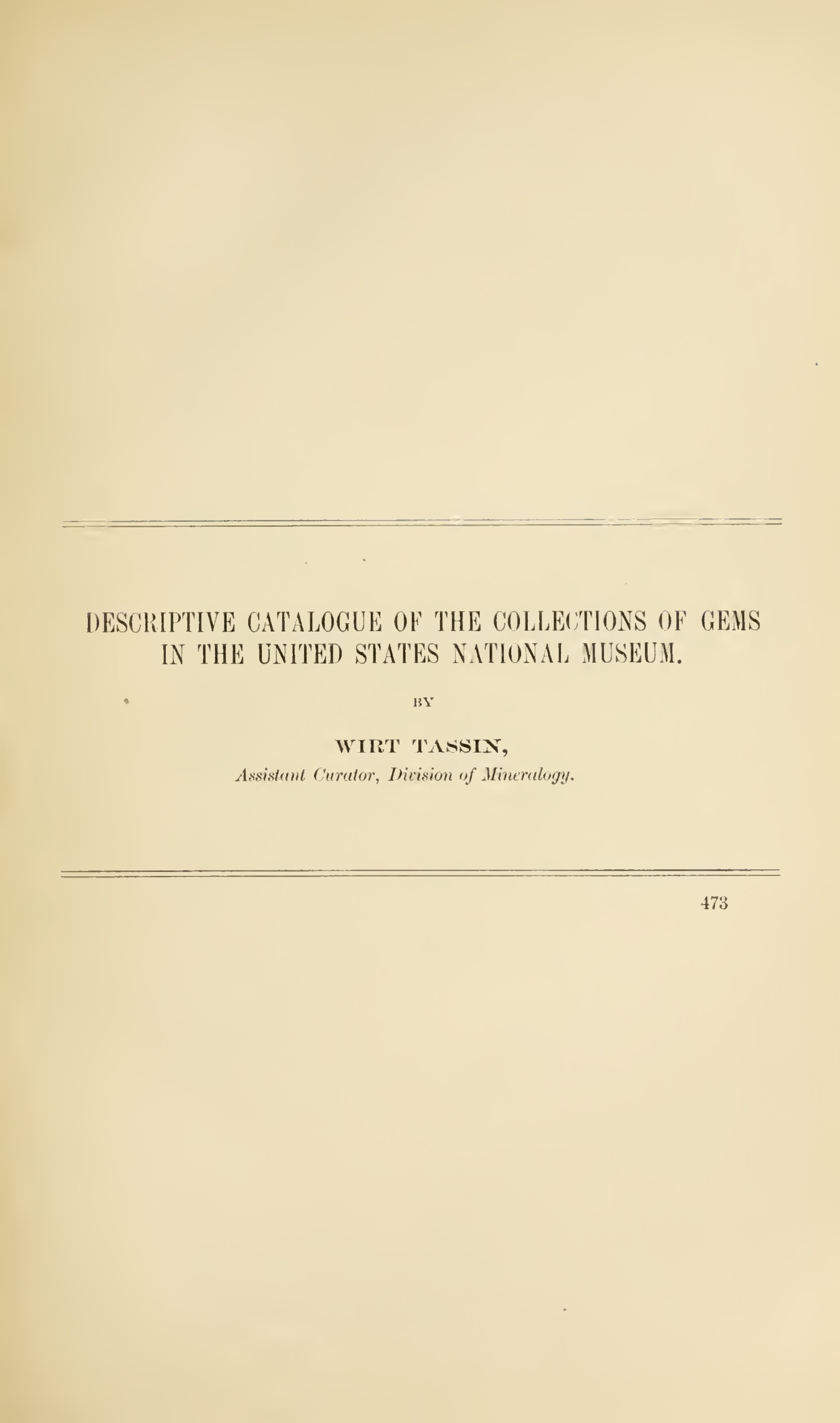
Descriptive catalogue of the collection of gems in the U.S. National Museum
Journal Article
Tassin, W. (1902) Descriptive catalogue of the collection of gems in the U.S. National Museum. Report of the United States National Museum for the year ending June 30, 1900, pp. 473–670.
Record No. 1680  |  Sinkankas/Born No.: 6498; NIB  |  RWHL
Sinkankas: Tassin’s work is considerably more than a catalogue, amounting to a compact treatise on gemology. It opens with the general properties of gemstones, followed by an extensive alphabetical account of individual gems and varieties with brief notes on their characteristics. Further sections provide identification tables based on color and optical effects, a glossary of gem names, discussions of lapidary work and manufactured gemstones, and substantial treatments of gems mentioned in the Bible and of traditional gem lore, making the book a useful guide to ancient and historical gem literature. Only in the ninth section does Tassin present the catalogue proper, describing the Isaac Lea gem collection with dimensions, color, weight and provenance. The volume concludes with a large bibliography, apparently derived from or expanded beyond Harry Emanuel’s earlier work, though it contains incomplete citations, missing pagination and numerous errors.

Prince Tissa: The Legend of the Ruby

Book
Fornaro, C., De (1901) Prince Tissa: The Legend of the Ruby. New York, Marcus & Co., 16 pp.
Record No. 2760  |  Sinkankas/Born No.: 2180B; NIB  |  RWHL
De Fornaro presents a short literary legend centered on Prince Tissa and a ruby, using the gemstone as a central element in a tale of royalty, desire, and fate. Rather than a scientific or gemological study, the work reflects the cultural and symbolic associations attached to ruby at the beginning of the twentieth century and is of interest chiefly as an example of the gemstone’s treatment in popular literature.

An onyx jar from Mexico, in process of manufacture
Journal Article
Saville, M.H. (1900) An onyx jar from Mexico, in process of manufacture. Bulletin of the American Museum of Natural History, Vol. 13, No. 11, pp. 105–107.
Record No. 28624  |  Sinkankas/Born No.: NIS/NIB  |  RWHL
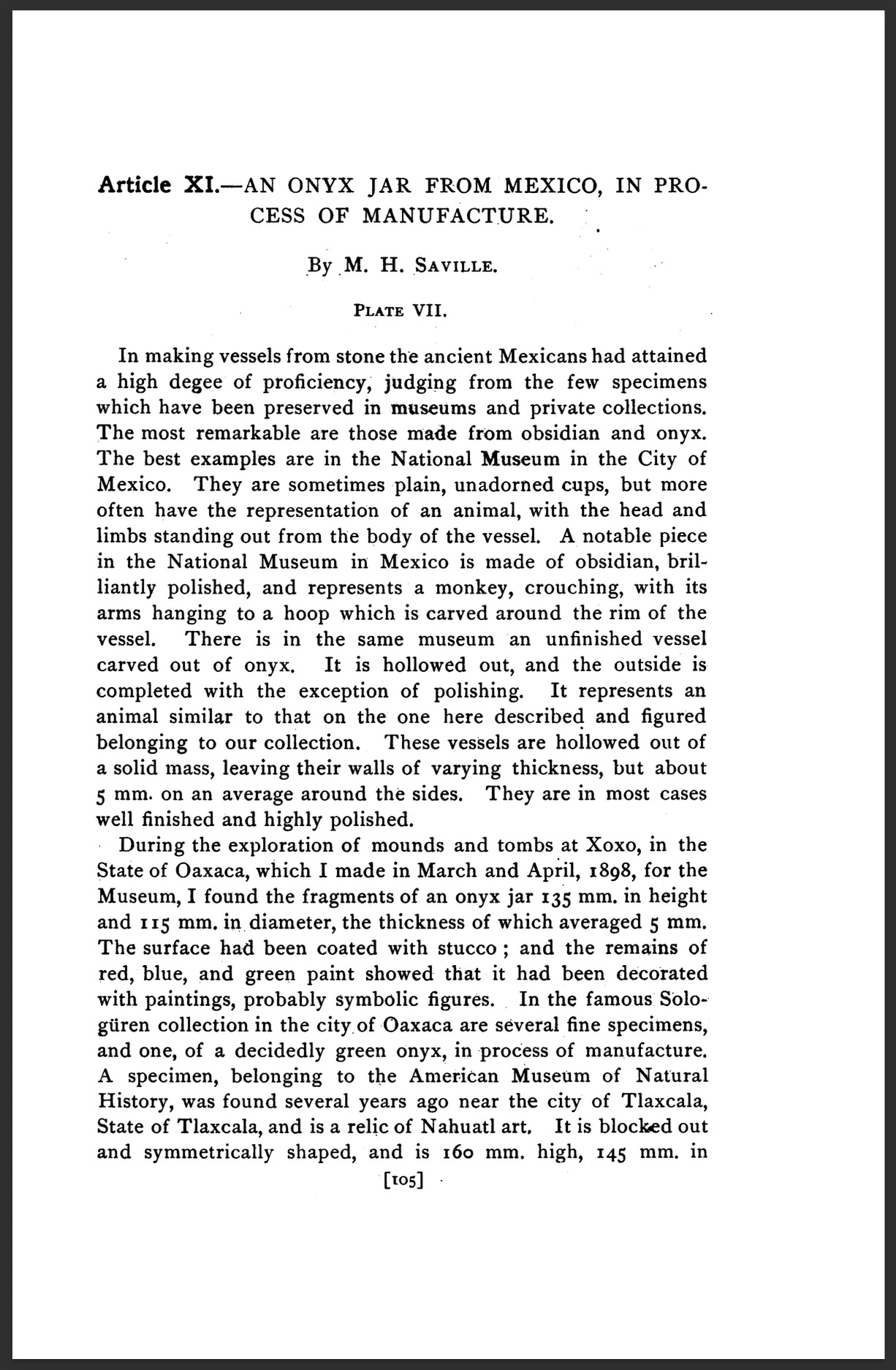
In making vessels from stone, the ancient Mexicans attained a high degree of proficiency, judging from the few specimens that have been preserved in museums and private collections. The most remarkable are those made from obsidian and onyx. Some of the finest examples are housed in the National Museum in Mexico City. These vessels are sometimes plain, unadorned cups, but more often incorporate representations of animals, with the head and limbs projecting from the body of the vessel. One notable example in the museum is carved from brilliantly polished obsidian and depicts a crouching monkey, its arms hanging from a hoop carved around the rim. The same museum also possesses an unfinished vessel carved from onyx. Hollowed out but not yet polished, it represents an animal similar to that depicted on the example described and illustrated from the present collection. Such vessels were carved from a single solid block of stone, leaving walls of varying thickness, averaging about 5 mm around the sides. In most cases they are finely finished and highly polished.

Jade in America

Conference Paper
Wilson, T. (1900) Jade in America. Congrès International de Américanistes, Paris pp. 141–187.
Record No. 28503  |  Sinkankas/Born No.: 7274; NIB  |  RWHL
Sinkankas: One of the most valuable papers published in North America on jade and little known because of being embodied in a relatively obscure journal. Thomas Wilson commences with a review of all that was known of jade, its nomenclature, its sources, etc., from the earliest mentions that he could find in the literature, citing such authors as Pliny the Elder, Georgius Agricola, John Mandeville, Ulisse Aldrovandi and others, especially those who wrote of the jade of Mexico and the confusing terminology which was applied to green stones and therefore embracing nephrite, turquoise, and even emerald. The use of jades in Mexico is especially treated, and then, passing on to the jade of the Pacific Northwest & Alaska, we find a true bibliographical rarity indeed when Wilson states “No official report has been published [on Alaskan jade], but the following statement of the expedition, including the discovery of Jade Mountain, has been furnished me by Lieutenant-Commander George M. Stoney: … [p. 157–162].” In his account, Stoney tells of his travels in Alaska, his excursions up the Kobuk River, and his discovery of the deposits and collections of specimens, over a time span of three expeditions in 1881, 1883, and 1885–1886. For another account by Stoney, see elsewhere under his own name. Wilson then passes on to a discussion of nephrite and jadeite, then other places where nephrite occurs in Canada, citing George Mercer Dawson in this regard. From p. 171, Wilson now compares the two jades, their occurrences in Europe, the findings of Auguste Damour and Horace-Bénédict de Saussure, mineralogical composition, with a plate of thin-section photographs, and the great Jade Question or “Migration” as Wilson captions this section. An invaluable work which must be consulted by anyone researching the jades of the Western Hemisphere.

Gazetteer of Upper Burma and the Shan States
Book
Scott, J.G. and Hardiman, J.P. (1900–1901) Gazetteer of Upper Burma and the Shan States. Rangoon, Government Printing, Burma, 5 Vols., Vol. 2, Part 1, Section 7, Geology and economic mineralogy; Vol. 2, Part 2, Mogok , 560 pp.
Record No. 4671  |  Sinkankas/Born No.: NIS/NIB  |  RWHL
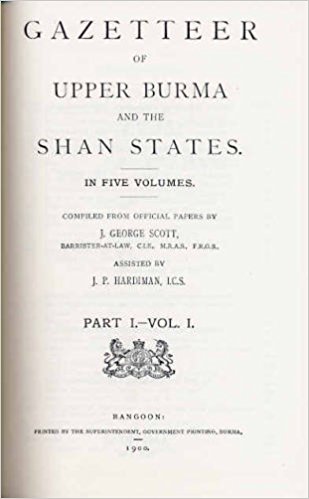
Scott and Hardiman’s Gazetteer of Upper Burma and the Shan States provides an extensive geographical, historical, administrative, ethnographic, and economic survey of Upper Burma and the Shan States at the beginning of the twentieth century. Of particular gemological importance are the sections on geology and economic mineralogy and the detailed account of Mogok, including information on the region’s mineral resources, ruby and other gemstone deposits, mining localities, methods of extraction, and the organization and economic significance of the gem industry. The work preserves valuable contemporary observations on the celebrated Mogok ruby-mining district and provides important historical context for the exploitation and trade of Burmese gemstones under British colonial administration.

A comparative study of etch-figures: The amphiboles and pyroxenes

Journal Article
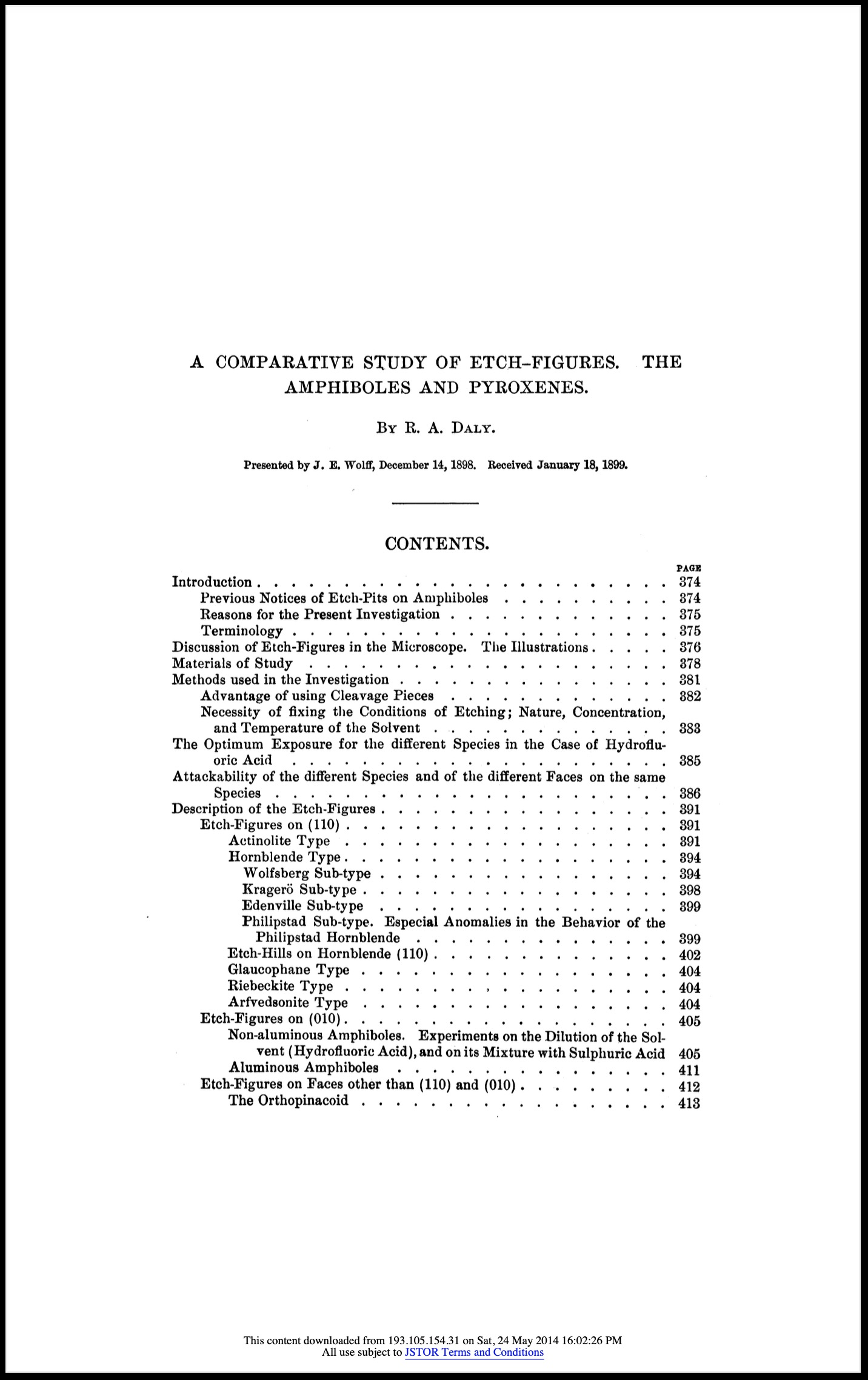
Daly, R.A. (1899) A comparative study of etch-figures: The amphiboles and pyroxenes. Proceedings of the American Academy of Arts and Sciences, Vol. 34, No. 15, March, pp. 373–430.
Record No. 6920  |  ISBN/ISSN: 1999818  |  DOI: https://dx.doi.org/10.2307/20020908  |  Sinkankas/Born No.: NIS/NIB  |  RWHL
Daly presents an experimental comparative study of etch figures produced on amphiboles and pyroxenes, using the forms developed by chemical attack on crystal surfaces to investigate the internal symmetry and structural relationships of these closely related mineral groups. He examines etched surfaces on a range of amphibole and pyroxene species, recording the orientation, shape, symmetry, and distribution of the resulting microscopic figures on different crystallographic faces. By comparing these features with the crystallographic properties of the minerals, Daly explores similarities and differences within and between the two groups and considers the significance of etch figures for determining crystal symmetry, orientation, twinning, and structural relationships. The study demonstrates the usefulness of controlled chemical etching as a supplementary method of crystallographic investigation and contributes to the contemporary discussion of the close morphological and chemical relationships between amphiboles and pyroxenes. The paper is relevant to gemology through its treatment of mineral groups that include jade constituents such as tremolite and jadeite.

Building a Gemological Library

Gemological books range from general identification manuals and textbooks to specialized works on individual gems, mineralogy, jewelry, treatments, synthesis, history and gem-producing regions.

For a curated selection of particularly useful books, read The Gemologist's Core Library — Classic Books on Gemology, Jewelry and Mineralogy.

About Four Treasures

Four Treasures is Lotus Gemology's freely accessible gemological reference database. Use the full database to search by author, title or keyword and explore literature on gemology, mineralogy, jewelry and related fields. Where available, hyperlinks on titles may lead directly to the full publication.

Search the Complete Four Treasures Database