Gemology Books Bibliography

Gemology Books Bibliography

Explore books on gems, gemology, jewelry and mineralogy in Four Treasures, the Lotus Gemology reference database. This bibliography brings together matching book records from the collection, with publication details, abstracts and cover images where available.

Gemology Book References

The list below matches books concerning gemology and related subjects in the database's searchable fields. Some works cover several branches of gems, jewelry or mineralogy.
2,821–2,840 of 3,464 matching references

The Dacoit’s Mine

Book
Kenyon, C.R. (1899) The Dacoit’s Mine. London, John Hogg, viii + 382 pp.
Record No. 2799  |  Sinkankas/Born No.: NIS/NIB  |  RWHL
Kenyon’s The Dacoit’s Mine: A Tale of Adventure in Burma is a juvenile adventure novel set in British Burma and centered on a search for mineral wealth amid the dangers posed by dacoits, or armed bandits. The story follows its protagonists through the Burmese interior, combining exploration, travel, encounters with local peoples, and conflict with the dacoits with the discovery and exploitation of a valuable mine. The mineral deposit and the prospect of obtaining precious stones provide an important motive for the action, placing the novel within the late nineteenth-century genre of imperial adventure fiction in which remote Asian mineral wealth figures prominently. Descriptions of the Burmese landscape, mining, gems, and the hazards of travel provide contemporary popular-literary context for European perceptions of Burma as a source of extraordinary mineral riches. Although fictional rather than a scientific or historical account, the book is of gemological interest for its representation of gemstone mining and the popular fascination with the precious-stone resources of Burma at the end of the nineteenth century.

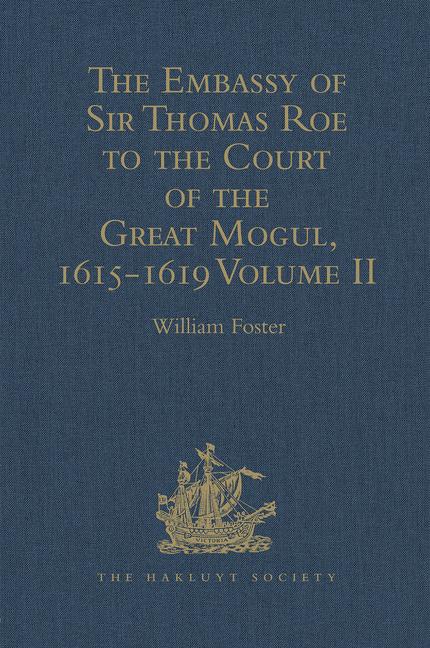
The Embassy of Sir Thomas Roe to the Court of the Great Mogul
Edited Book
Foster, W., editor (1899) The Embassy of Sir Thomas Roe to the Court of the Great Mogul.. London, Hakluyt Society, 2 Vols., Vols 1–2 , 586 pp.. Reprinted by Kraus, 1967.
Record No. 2763  |  Sinkankas/Born No.: NIS/NIB  |  RWHL
Foster’s edition of The Embassy of Sir Thomas Roe to the Court of the Great Mogul, 1615–1619 presents Roe’s journal and correspondence from his mission as ambassador of James I to the Mughal emperor Jahangir. The narrative records Roe’s travels in India, his experiences at the imperial court, negotiations concerning English commercial privileges, and his observations of Mughal government, ceremonies, society, and trade. Of particular gemological interest are his descriptions of Jahangir’s court and treasury, where precious stones, pearls, jeweled weapons, ornaments, and lavish imperial gifts figured prominently in displays of wealth and authority. Roe records exchanges of jewels and other valuables, comments on their appraisal and desirability, and provides firsthand evidence for the importance of gems within Mughal diplomatic and court culture. Foster supplements the seventeenth-century documents with an introduction and extensive notes identifying people, places, events, and historical circumstances, making the two-volume edition an important primary source for the study of Mughal India and its commerce in precious objects.

The Book of the Thousand Nights and a Night
Book
Burton, R.F. (1899) The Book of the Thousand Nights and a Night. Denver, CO, Burton Society of Denver, Vol. 5, pp. 340–343; Vol. 6, pp. 16–23, 64–69
Record No. 2724  |  Sinkankas/Born No.: NIS/NIB  |  RWHL
Burton’s The Book of the Thousand Nights and a Night, his translation of the Arabian Nights, contains numerous references to precious stones, jewelry, and fabulous treasures reflecting the luxury and gem lore of the medieval Islamic world. The cited passages in Vols. 5 and 6 include descriptions of gems and jeweled objects embedded in tales of merchants, rulers, magical adventures, and extraordinary wealth. Diamonds, rubies, emeralds, pearls, and other precious materials appear both as commodities of immense value and as components of magnificent ornaments and treasures, while some passages preserve traditional beliefs concerning the sources and properties of stones. Burton’s extensive notes supplement the tales with linguistic, historical, geographical, and ethnographic commentary, often explaining Arabic and Persian names for gems and contemporary practices connected with their trade and valuation. For gemological research, these passages are valuable primarily as literary and cultural evidence for the terminology, symbolism, commerce, and popular conceptions surrounding precious stones in the Arabic and Persian traditions transmitted through the Thousand Nights and a Night.

Ralph Fitch, England’s Pioneer to India and Burma: his Companions and Contemporaries, with his Remarkable Narrative Told in his Own Words
Book
Ryley, J.H. (1899) Ralph Fitch, England’s Pioneer to India and Burma: his Companions and Contemporaries, with his Remarkable Narrative Told in his Own Words. London, T. Fisher Unwin, 264 pp. (see pp. 172–173)
Record No. 1518  |  Sinkankas/Born No.: NIS/NIB  |  RWHL
Ryley reconstructs the life and travels of Ralph Fitch, one of the earliest English merchants to journey extensively through India and Burma, placing Fitch’s own sixteenth-century narrative within a biographical and historical account of his companions and contemporaries. Fitch left England in 1583 and travelled through the eastern Mediterranean and Persian Gulf to India, visiting Portuguese Goa, the Mughal territories, Bengal, Pegu in Burma, and other commercial centers before returning to England in 1591. His observations provide early English evidence for Asian trade, commodities, cities, courts, religious practices, and commercial routes shortly before the foundation of the English East India Company. Of particular gemological interest, [172–173] describe Pegu and its commerce, including the trade in rubies, sapphires, and spinels and the importance of precious stones among the valuable commodities associated with Burma. Ryley supplements Fitch’s narrative with explanatory notes and historical material, making the volume a useful source for the early European history of the Burmese gemstone trade.

The Babylonian Expedition of the University of Pennsylvania. Series A: Cuneiform Texts
Book
Hilprecht, H.V. and Clay, A.T. (1898) The Babylonian Expedition of the University of Pennsylvania. Series A: Cuneiform Texts. Philadelphia, University of Pennsylvania
Record No. 17075  |  ISBN/ISSN: 9781510000000  |  Sinkankas/Born No.: NIS/NIB  |  RWHL
Hilprecht and Clay’s The Babylonian Expedition of the University of Pennsylvania, Series A: Cuneiform Texts forms part of the publication of tablets and inscriptions recovered principally by the University of Pennsylvania expedition to Nippur. The series presents cuneiform texts in facsimile, transcription, and, where appropriate, translation and commentary, encompassing religious, literary, lexical, mathematical, administrative, legal, and economic documents from ancient Mesopotamia. Individual volumes provide primary evidence for the Sumerian and Akkadian languages and for Babylonian religion, commerce, law, science, and everyday life. Of gemological interest are texts and lexical materials containing names for stones, minerals, metals, and manufactured objects, which contribute to the identification of ancient Mesopotamian terminology for precious and ornamental materials and to understanding their trade and use. The series is therefore an important primary source for the study of Babylonian material culture and the terminology and historical uses of stones in the ancient Near East.

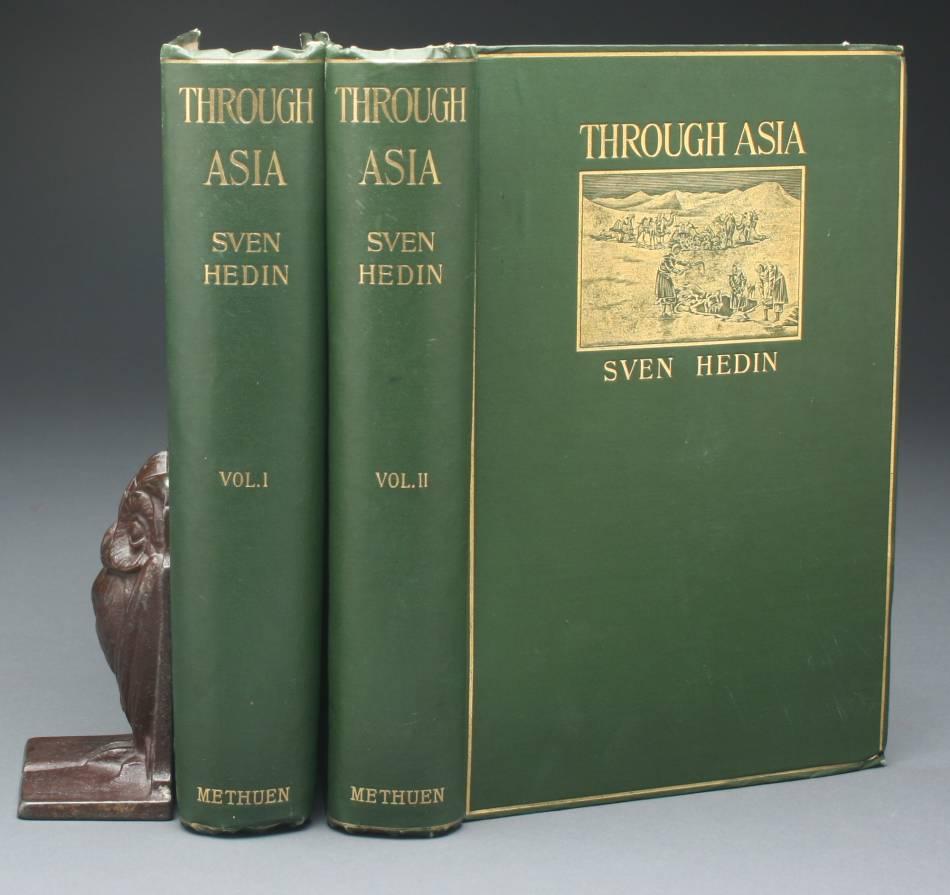
Through Asia

Book
Hedin, S. (1898) Through Asia. London, Methuen & Co., 2 Vols., 1278 pp.
Record No. 3575  |  Sinkankas/Born No.: NIS/NIB  |  RWHL
Hedin’s Through Asia recounts his extensive travels of 1893–1897 through Russian Turkestan, the Pamirs, the Tarim Basin, the Taklamakan Desert, and adjoining regions of Chinese Central Asia. Combining travel narrative with geographical and scientific observation, he describes journeys through Kashgar, Yarkand, Khotan, and other Central Asian centers, hazardous desert crossings, exploration of rivers and lakes, mountain routes, settlements, peoples, trade, and political conditions. His observations provide detailed information on the geography and ethnography of regions then imperfectly known to Europeans. Of particular gemological interest are his visits to the Khotan region and references to its celebrated jade industry, including the recovery of nephrite from rivers and mountain deposits and its importance in local commerce and trade with China. The two volumes, extensively illustrated and supplied with maps, established Hedin as one of the foremost European explorers of Central Asia and provide valuable contemporary observations on the traditional jade-producing districts of Chinese Turkestan.

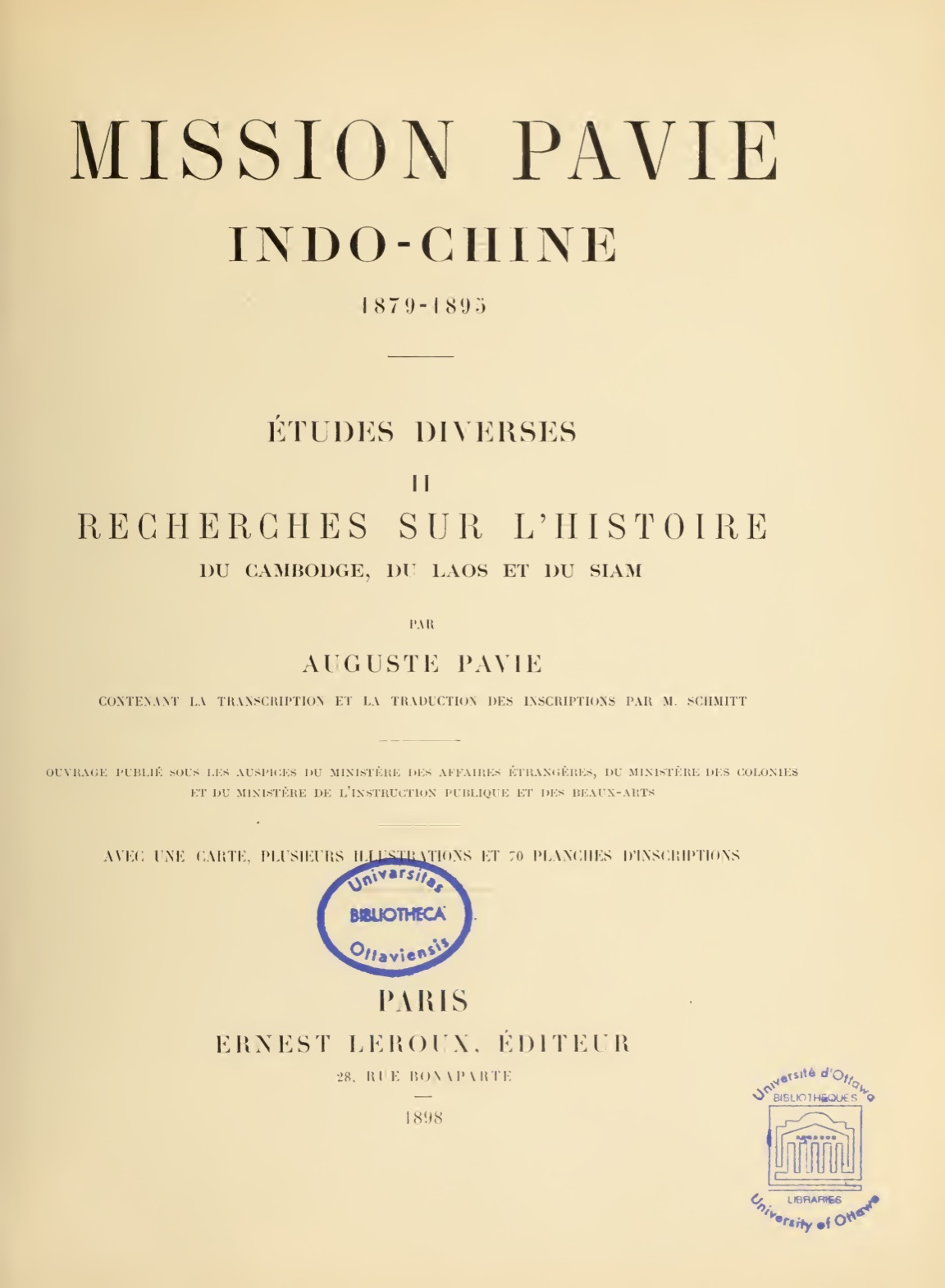
Mission Pavie Indo-Chine 1879–1895: 1. Exposé des travaux de la mission (1879-1889), par A Pavie.- 2. Exposé des travaux de la mission (1889–1895), par A. Pavie.- 3. Voyages au Laos, par Cap. Cupet.- 4. Voyages au centre de l'Annam et du Laos, par le Cap. de Malglaive et par le Cap. Rivière.- 5. Voyages dans le haut Laos, par P. Lefèvre-Pontalis.- 6. Passage du Mé-Khong au Tonkin (1887–1888) par Auguste Pavie.- Vol. 7. Journal de marche (1888-1889); Événements du Siam (1891–1893)

Pavie Mission Indo-China 1879–1895
Book
Pavie, A. (1898–1919) Mission Pavie Indo-Chine 1879–1895: 1. Exposé des travaux de la mission (1879-1889), par A Pavie.- 2. Exposé des travaux de la mission (1889–1895), par A. Pavie.- 3. Voyages au Laos, par Cap. Cupet.- 4. Voyages au centre de l'Annam et du Laos, par le Cap. de Malglaive et par le Cap. Rivière.- 5. Voyages dans le haut Laos, par P. Lefèvre-Pontalis.- 6. Passage du Mé-Khong au Tonkin (1887–1888) par Auguste Pavie.- Vol. 7. Journal de marche (1888-1889); Événements du Siam (1891–1893). [Pavie Mission Indo-China 1879–1895] Paris, Éditions Ernst Leroux, 7 Vols.
Record No. 3355  |  Sinkankas/Born No.: NIS/NIB  |  Language: in French  |  RWHL
Pavie’s monumental Mission Pavie Indo-Chine 1879–1895 records the geographical, political, ethnographic, and scientific work of the French expeditions led by Auguste Pavie through Laos, Cambodia, Siam, Annam, Tonkin, and neighboring regions. The seven volumes contain Pavie’s own narratives together with accounts by members of the mission, including Captains Cupet, de Malglaive, and Rivière and Pierre Lefèvre-Pontalis, documenting journeys through the Mekong basin, central and northern Laos, and routes connecting the Mekong with Vietnam. They describe geography, river systems, mountain routes, peoples, commerce, natural resources, communications, and political conditions, accompanied by maps and other illustrations. The later narratives also document the diplomatic and territorial conflicts between France and Siam culminating in the events of 1893. For gemological and mineralogical research, the work provides contemporary observations on the natural resources, trade, and local products of regions of mainland Southeast Asia that included important gem-producing and gem-trading areas, while preserving detailed geographical information from a period when much of the interior was still poorly documented by Europeans.

Aperçu sur les gîtes minéraux de l'Indochine centrale connus en 1897
Journal Article
Bel, J.-M. (1898) Aperçu sur les gîtes minéraux de l'Indochine centrale connus en 1897. Bulletin de la Société de l’Industrie Minerale, Third Series, Vol. 7, pp. 381–407.
Record No. 451  |  Sinkankas/Born No.: NIS/NIB  |  RWHL
Bel provides a firsthand survey of the mineral resources known in central Indochina in 1897, based largely on his scientific and industrial missions of 1893, 1895, and 1897. Of particular gemological interest is his account of the ruby and sapphire deposits of eastern Siam. In the Chantaboun massif, an English company had for several years worked the region’s precious stones, principally rubies with some sapphires; Bel states that the gems of Chantaboun were reported to be of mediocre quality, although he had not personally visited the deposits. [391–392] Near Luang Prabang, he reports additional precious-stone deposits, particularly sapphires, noting that Auguste Pavie had shown him fine specimens obtained following his mission in Upper Laos. [392] Bel concludes that the mountainous divide between the Menam and Mekong offered considerable scope for further exploration and might contain precious stones of good value. [392–393] Elsewhere he notes the possibility of gems in Cambodia, although the region remained unexplored. [394] The paper also gives extensive firsthand information on gold deposits and mining in Siam, Lower Laos, the Khas country, and Annam, together with occurrences of silver-bearing galena, copper, iron, coal, and tin, providing a valuable contemporary overview of mineral exploration in mainland Southeast Asia at the end of the nineteenth century. [384–407]

The Aethiopica

Book
Heliodorus (1897) The Aethiopica. Athens, The Athenian Society, 417 pp.
Record No. 17074  |  Sinkankas/Born No.: NIS/NIB  |  Language: in Greek and English  |  RWHL
The Aethiopica is a novel written by the Greek writer Heliodorus in the 3rd century AD. The story is set in ancient Ethiopia and follows the adventures of two young lovers, Charicleia and Theagenes, as they navigate through a series of trials and tribulations. The novel is known for its intricate plot, which involves mistaken identities, kidnappings, battles, and divine interventions. It also explores themes of love, loyalty, and the conflict between different cultures and religions. The 1897 edition of the novel, translated by Thomas Underdowne, includes an introduction that provides historical and literary context for the work. The text is presented in English, with occasional footnotes to clarify obscure references and provide additional information.

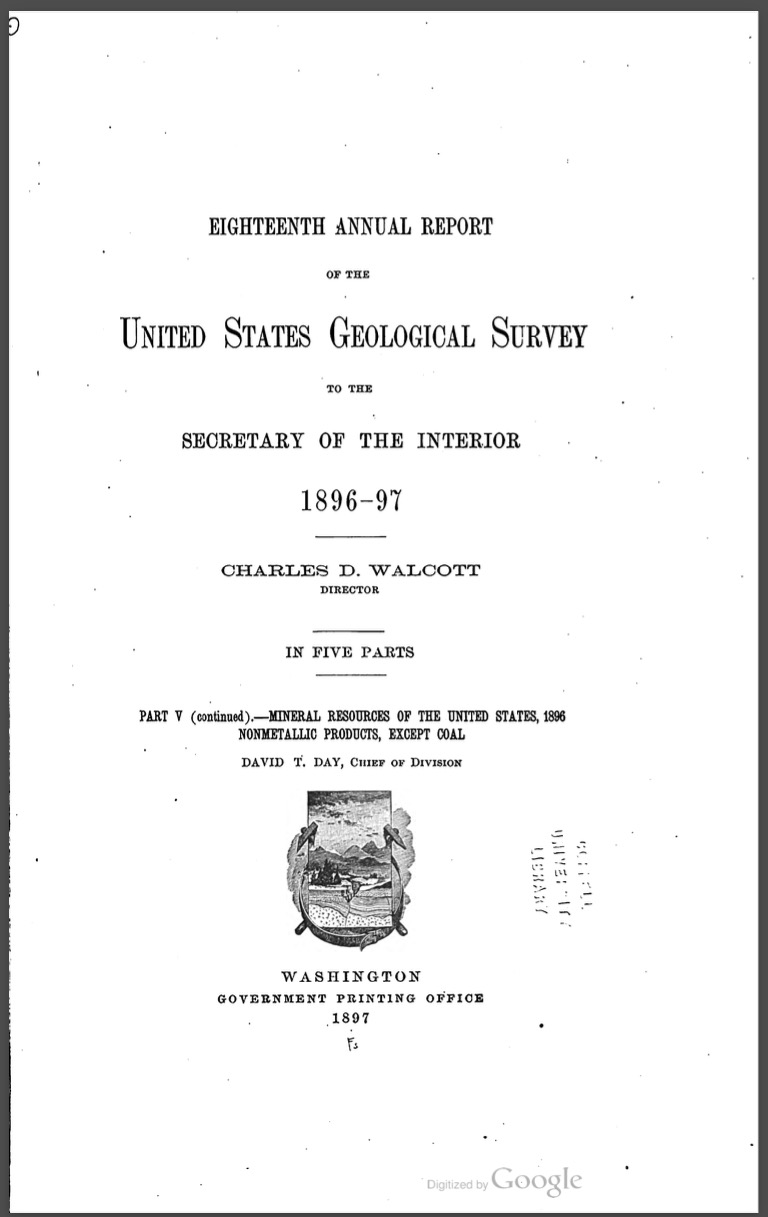
Precious stones

Book Section
Kunz, G.F. (1897) Precious stones. In: Eighteenth Annual Report of the United States Geological Survey, Washington: Govt. Printing Office, 5 Vols., Part 5.—Mineral Resources of the United States, 1896, Nonmetallic Products, Except Coal , pp. 1183–1218.
Record No. 17034  |  Sinkankas/Born No.: 3611; NIB  |  RWHL
Kunz surveys developments in precious stones during 1896, beginning with notable discoveries and events of the year and then treating diamonds in considerable detail, including American occurrences, the South African mines and their production, mining methods, trade, cutting, import duties, and the growing diamond-cutting industry in the United States. He discusses the occurrence and artificial production of ruby, with descriptions of the ruby mines of Siam and Burma, and gives particular attention to new sapphire discoveries in Montana, including the Yogo/Fergus County deposits. Other sections record American occurrences of andalusite, kyanite, tourmaline, turquoise, garnet, quartz and rock crystal, amethyst, chrysoprase, chalcedony, plasma, moss agate, and opal, together with new mineral discoveries. Kunz also discusses gem collections and exhibitions, experiments on the behavior of gems under Röntgen rays, and contemporary work on artificial production of precious stones. The report concludes with statistical tables of United States gem production, valued at $113,621 for 1896, historical production figures, and imports of diamonds and other precious stones, providing a detailed picture of both the scientific and commercial state of gemology at the end of the nineteenth century.

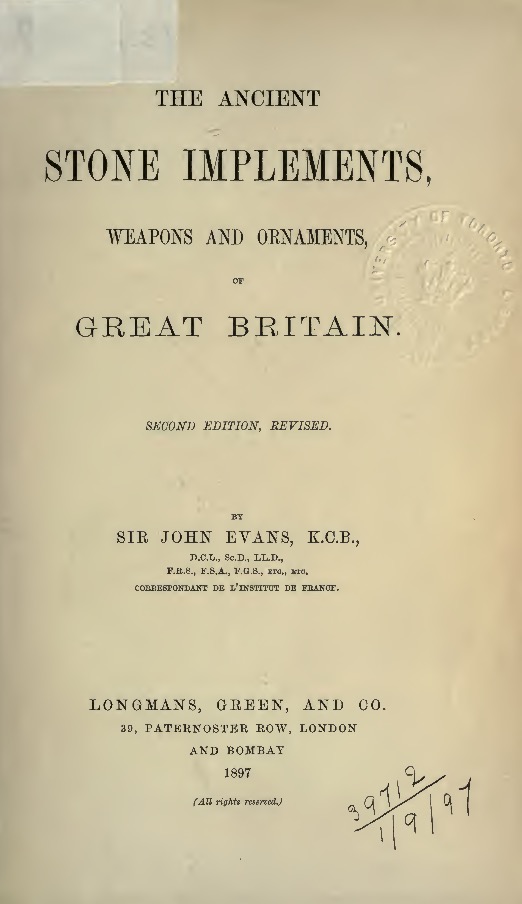
The ancient stone implements, weapons, and ornaments of Great Britain
Book
Evans, J. (1897) The ancient stone implements, weapons, and ornaments of Great Britain. London, Longmans, 747 pp.
Record No. 7954  |  Sinkankas/Born No.: NIS  |  RWHL
Evans’s substantially revised second edition of The Ancient Stone Implements, Weapons, and Ornaments of Great Britain provides a comprehensive survey of prehistoric stone artifacts found in Britain, incorporating discoveries made since the first edition of 1872. He describes and classifies chipped and polished axes and celts, adzes, chisels, hammers, mace-heads, perforated implements, flint knives, scrapers, arrow- and spear-heads, and personal ornaments, discussing their forms, manufacture, distribution, probable uses, and archaeological contexts. Particular attention is given to the lithic materials from which implements were fashioned and to techniques of flaking, grinding, polishing, boring, and sawing. Evans compares British specimens with related objects from continental Europe and other regions and considers questions of chronology, trade, and the movement of desirable stone materials. Of gemological interest are discussions of jade and other exceptionally tough green stones used for polished implements and ornaments, including the nineteenth-century debate over the provenance of European nephrite and jadeite artifacts.

The Topographia Christiana of Cosmas Indicopleustes
Book
Cosmas Indicopleustes (1897) The Topographia Christiana of Cosmas Indicopleustes. London, Hakluyt Society, First Series, No. 99
Record No. 2741  |  Sinkankas/Born No.: NIS/NIB  |  RWHL
Ravenstein’s translation of the Christian Topography of Cosmas Indicopleustes presents the sixth-century account of a merchant and traveler who had extensive knowledge of the Red Sea, northeastern Africa, Arabia, India, and the Indian Ocean trade. Although primarily a Christian cosmographical and theological work, it contains valuable geographical and commercial information derived from Cosmas’s travels and mercantile experience. Of particular gemological interest are his references to precious stones and their sources and trade, including sapphires associated with Ceylon (Taprobane), which he describes as an important entrepôt receiving merchandise from India, Persia, Ethiopia, and other regions and redistributing it through the Indian Ocean trading network. Cosmas also records products such as pearls, spices, silk, and other valuable commodities and provides evidence for the extensive maritime commerce connecting the Mediterranean and Red Sea worlds with India and Ceylon in late antiquity. Ravenstein’s edition includes an introduction, notes, and geographical commentary that place Cosmas’s observations within the historical geography of early Indian Ocean trade.

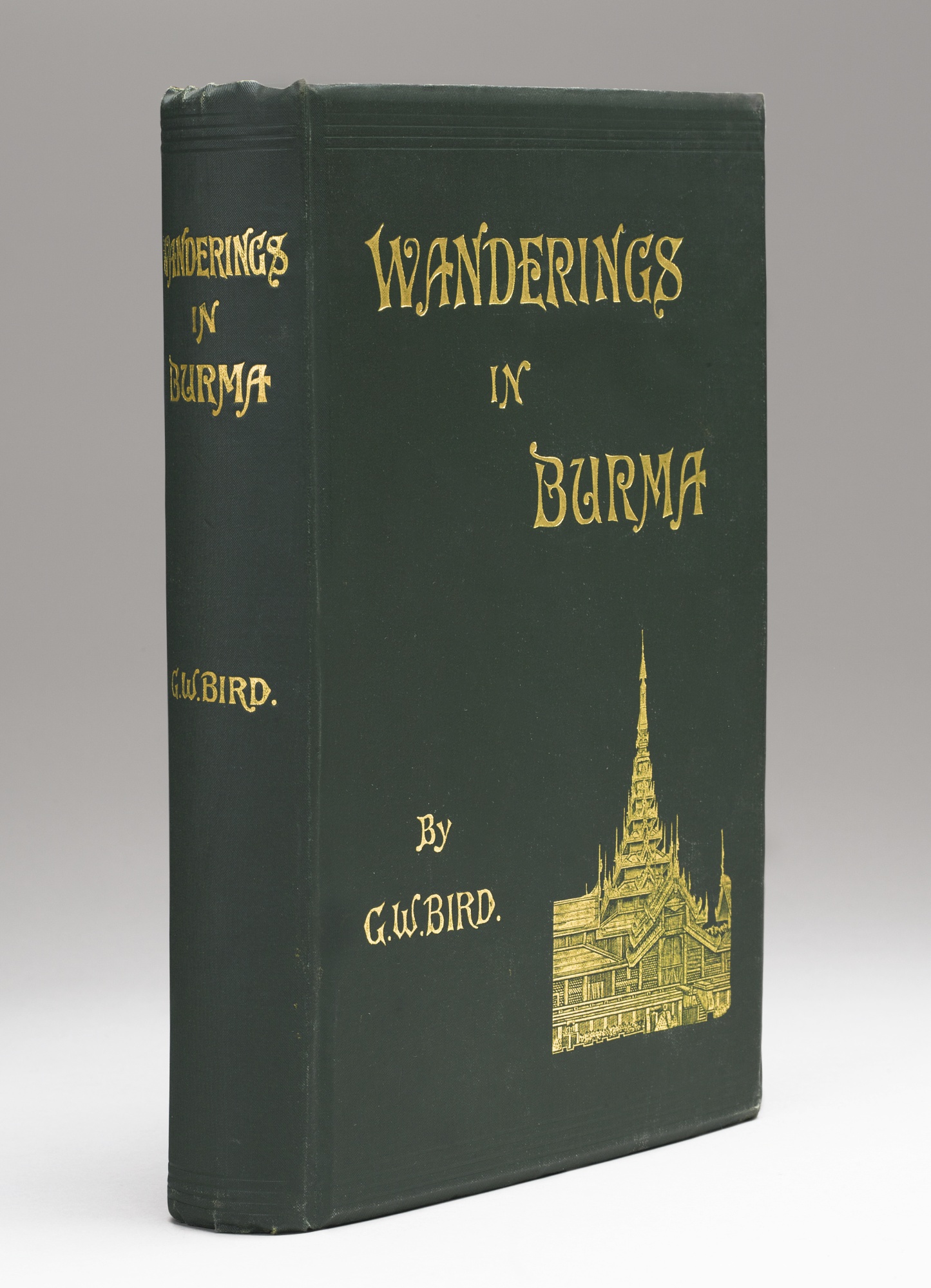
Wanderings in Burma

Book
Bird, G.W. (1897) Wanderings in Burma. Bournemouth, F.J. Bright & Son, 410 pp.; see pp. 365–368
Record No. 2713  |  Sinkankas/Born No.: NIS/NIB  |  RWHL
Bird’s Wanderings in Burma is a travel account describing journeys through Burma, with observations on the country’s scenery, peoples, customs, towns, monuments, natural resources, and economic life. Of particular gemological interest are pp. 365–368, where Bird discusses the ruby mines of Upper Burma and the celebrated Mogok mining district. She describes the search for rubies in the gem-bearing ground, the washing and sorting of the material, and the conditions under which the mines were worked, together with the importance and value of the stones recovered. The account places ruby mining within the broader landscape and society of Upper Burma and reflects contemporary European interest in the mines following the British annexation of the region. Although written as a travel narrative rather than a geological study, Bird’s firsthand descriptions provide a useful late nineteenth-century view of the Burmese ruby industry and the methods by which the famous Mogok gems were obtained.

Gems and Precious Stones

Book
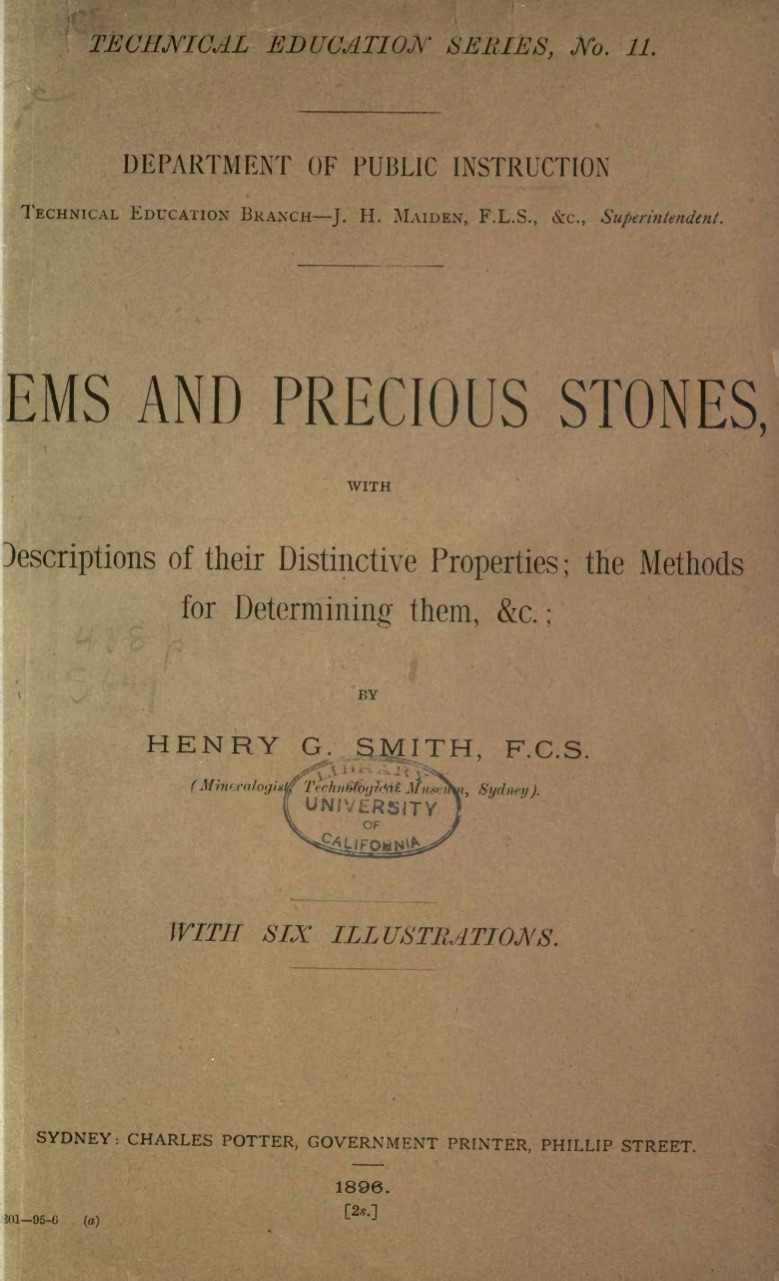
Smith, H.G. (1896) Gems and Precious Stones. Sydney, Charles Potter, 87 pp.
Record No. 3143  |  Sinkankas/Born No.: 6174; NIB  |  RWHL
Smith’s Gems and Precious Stones, published as No. 11 of the Technical Education Series of the New South Wales Department of Public Instruction, is a practical introductory handbook devoted to the identification and properties of gemstones. Its full title, Gems and Precious Stones: With Descriptions of Their Distinctive Properties, the Methods for Determining Them, &c., reflects its emphasis on distinguishing gem materials by observable and measurable characteristics. Smith treats the principal precious and ornamental stones and explains the properties used in their determination, providing a concise guide intended for students, collectors, jewelers, and others requiring a practical introduction to gem identification. Published in Sydney by Charles Potter, Government Printer, the work is significant as an early Australian gemological manual and as part of the colony’s program of technical education.

Jewel Mysteries I Have Known — From a Dealer's Notebook
Book
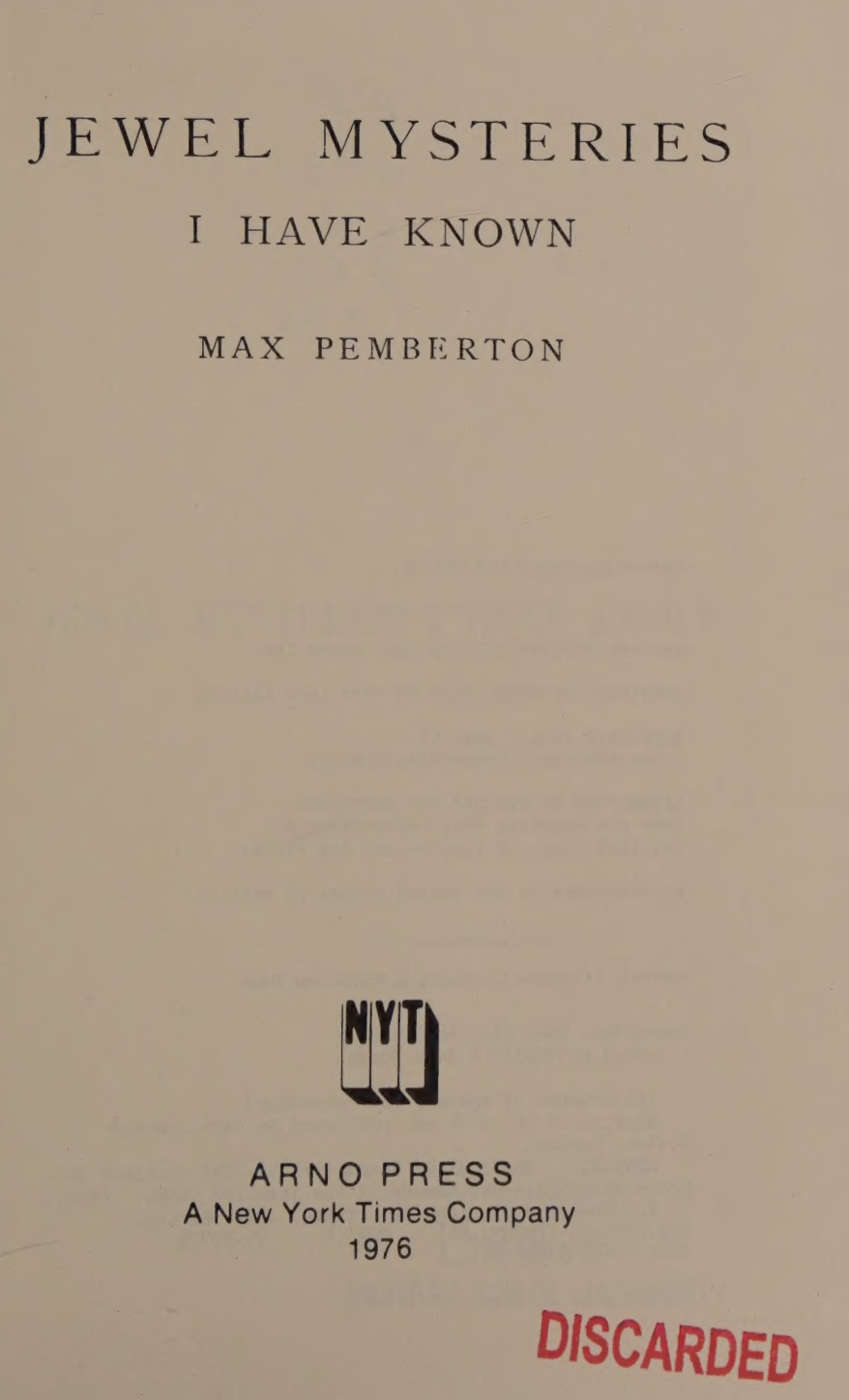
Pemberton, M. (1894) Jewel Mysteries I Have Known — From a Dealer's Notebook. London, Ward, Lock & Bowden, 269 pp.
Record No. 29977  |  Sinkankas/Born No.: 5061; NIB  |  RWHL
Sinkankas: The author assumes the name of “Sutton,” a London jeweler, for the purpose of recounting a series of fictitious but highly interesting stories involving gems, jewels, and the gem trade. The gemological information is accurate and carries the ring of authority. A popular work in its day, at least one identical reprint was issued. A later issue, in maroon cloth, gold lettering on cover with blind logo in a box, and gold spine title, beveled boards, plain endpapers, measured 22.6 × 14.6 cm (8 7/8 × 5 3/4 in.). Uncut. The front illustration fitted with tissue; the advertisements are different and the pages for same are numbered. Price 5s.

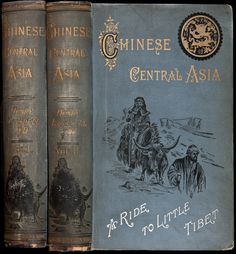
Chinese Central Asia: A Ride to Little Tibet
Book
Lansdell, H. (1894) Chinese Central Asia: A Ride to Little Tibet. New York, Charles Scribner’s Sons, 2 Vols., 456, 512 pp.
Record No. 3384  |  RWHL
Lansdell recounts an extensive journey through Russian and Chinese Central Asia to the western approaches of Tibet, combining personal travel narrative with geographical, ethnographic, historical, and commercial observations. His route takes him through the Russian Turkestan region and across Chinese Turkestan, including Kashgar, Yarkand, and Khotan, before reaching the high country toward Ladakh and “Little Tibet.” He describes local peoples, religions, agriculture, markets, communications, political conditions, and natural resources, drawing upon both firsthand observations and contemporary geographical literature. Of particular gemological interest is his account of Khotan and its celebrated jade industry, including the collection of nephrite from the rivers and the extraction of material from the surrounding mountains, its preparation and trade, and its importance as a commodity exported eastward to China. The work provides a valuable late nineteenth-century description of the traditional Khotan jade-producing region and the Central Asian trade routes through which its nephrite circulated.

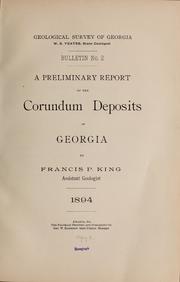
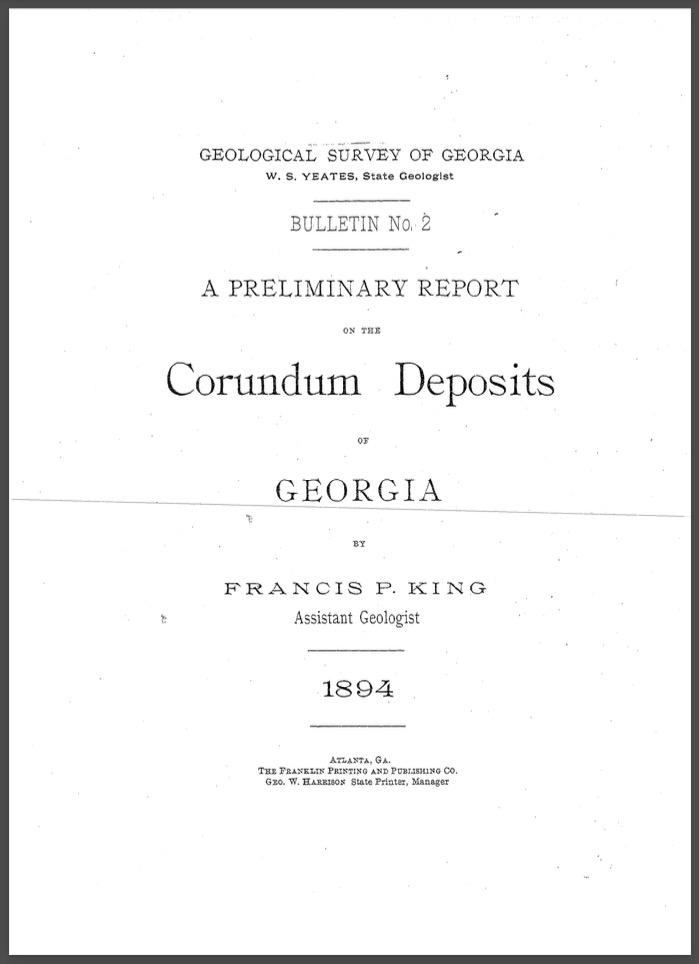
A preliminary report on the corundum deposits of Georgia
Book
King, F.P. (1894) A preliminary report on the corundum deposits of Georgia. Atlanta, Ga.,, The Franklin Printing and Publishing Co., 133, 4 p.
Record No. 2804  |  Sinkankas/Born No.: NIS/NIB  |  RWHL
King presents a detailed preliminary survey of the corundum deposits of Georgia, describing their geographical distribution, geological occurrence, mineral associations, methods of mining, and economic importance. He examines the principal deposits of northern Georgia, where corundum occurs chiefly in association with peridotite and its altered products, and provides descriptions of individual mines and prospects, the character and quantity of their corundum, and the rocks and minerals accompanying it. Particular attention is given to the origin and geological relationships of the deposits, prospecting and extraction methods, preparation of corundum for market, production, and its principal use as an abrasive. The report also records variations in the color and quality of Georgia corundum and occurrences of material of potential gemological interest. Illustrated with geological and locality information, the bulletin provides an important late nineteenth-century account of Georgia’s corundum industry and the geology upon which its commercial exploitation depended.

Corundum deposits of Georgia

Journal Article
King, F.P. (1894) Corundum deposits of Georgia. Bulletin, Geological Survey of Georgia, No. 2, 133 pp..
Record No. 1096  |  RWHL
King presents a detailed study of the corundum deposits of Georgia, describing their geographic distribution, geological occurrence, mineral associations, mining, and economic prospects. He examines the principal corundum localities along the crystalline belt of northern Georgia and describes deposits associated particularly with peridotite and related altered rocks, recording the character, size, color, and quality of the corundum found at individual workings. The report discusses prospecting and mining methods, preparation of corundum for abrasive use, production and markets, and the factors affecting the commercial value of deposits. King also records accessory minerals and varieties of corundum encountered in the field, including material of potential gemological interest, although the industry was directed principally toward supplying corundum as an abrasive. The bulletin provides an important late nineteenth-century account of the geology and exploitation of one of the principal corundum-producing regions of the United States. Contains a good history of corundum.

Precious stones

Book Section
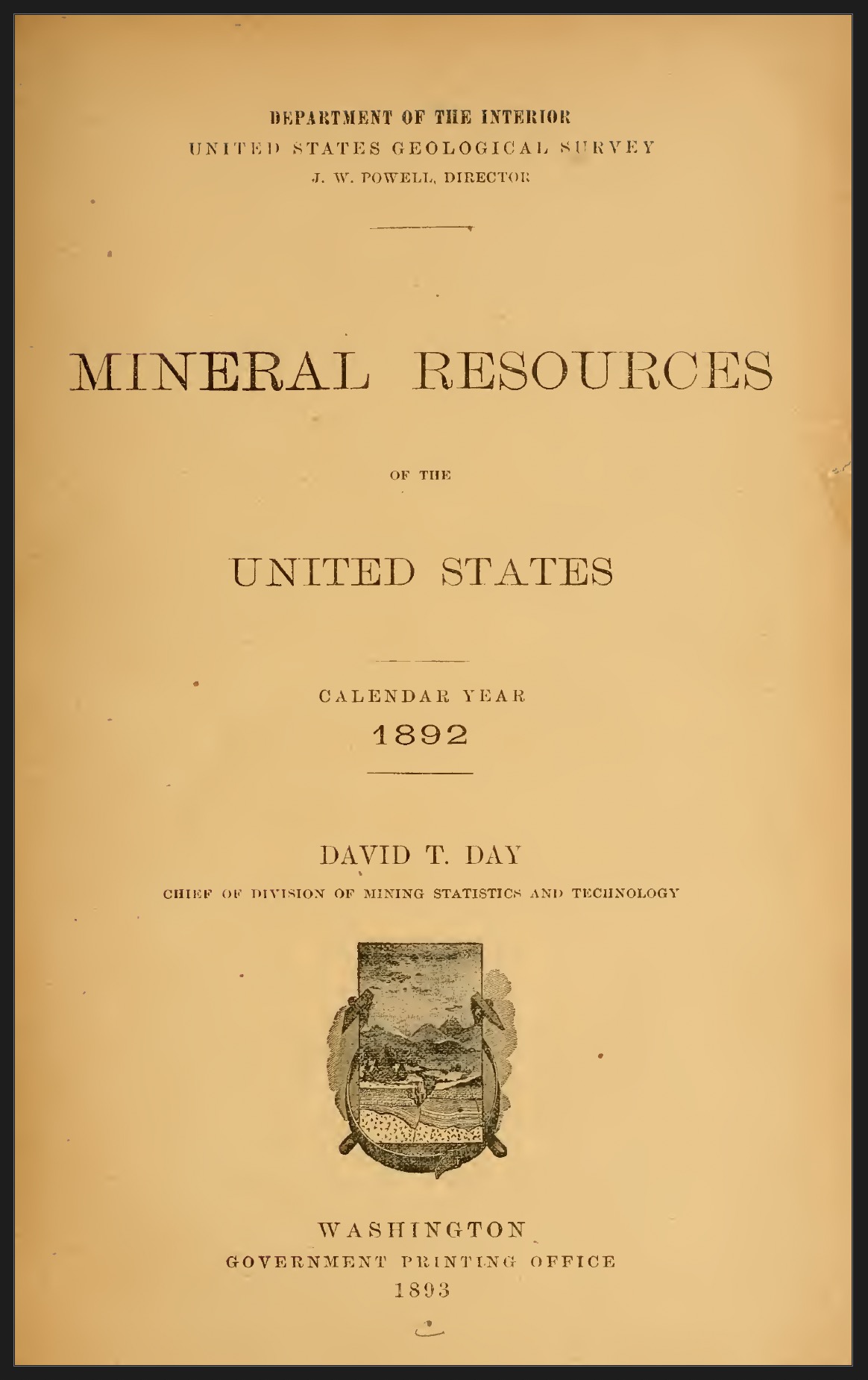
Kunz, G.F. (1893) Precious stones. In: Mineral Resources of the United States | Calendar Year 1892, Washington: Govt. Printing Office, pp. 756–781.
Record No. 17003  |  Sinkankas/Born No.: 3607; NIB  |  RWHL
Kunz reviews the production, occurrence, mining, and trade of precious stones during 1892, with particular attention to developments in the United States. He records American gem production and discusses diamonds and a wide range of colored and ornamental stones, including sapphire, turquoise, tourmaline, garnet, beryl, quartz, opal, and other materials. The turquoise deposits of the southwestern United States receive specific attention [763–764], while the report also describes contemporary American sapphire occurrences and other newly developed or investigated gem localities. A substantial section is devoted to diamonds, including American occurrences and developments in the South African industry, with discussion of diamond-bearing rocks, mining, production, and contemporary ideas concerning diamond genesis. As in Kunz’s earlier annual reports, economic information is combined with mineralogical and gemological observations, making the paper an important contemporary record of the rapidly developing American gem industry and of the international precious-stone trade at the end of the nineteenth century.

Les cachets d’oculistes et les lapidaires de l’Antiquité et du haut Moyen Âge

The Lapidaries of Antiquity and Oculists’ Stamps
Journal Article
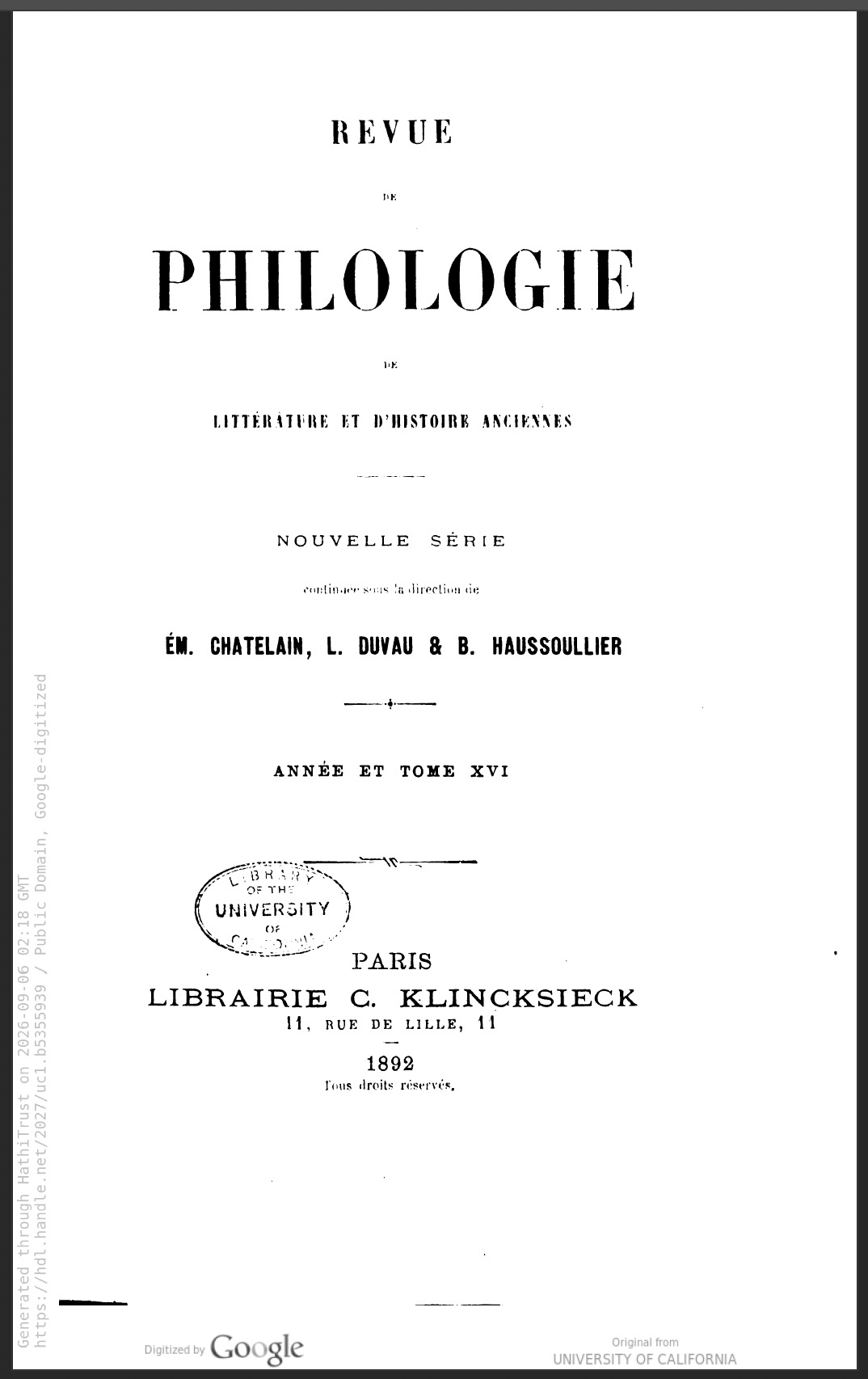
Mély, F.d.S., de (1892) Les cachets d’oculistes et les lapidaires de l’Antiquité et du haut Moyen Âge. [The Lapidaries of Antiquity and Oculists’ Stamps] Revue de Philologie, Series 2, Vol. 16, pp. 81–95.
Record No. 29439  |  Sinkankas/Born No.: NIS/NIB  |  Language: in French  |  RWHL
Mély examines ancient lapidary literature in relation to the inscribed stone stamps used by Greco-Roman oculists for marking medicinal preparations. By comparing the names and supposed properties of mineral substances recorded in medical and lapidary texts with the inscriptions preserved on these oculists’ stamps, he attempts to clarify obscure terminology and trace the transmission of mineral-based medical recipes from Antiquity into the early Middle Ages. The study is particularly relevant to the history of gemstones and mineralogy because it treats ancient stone names not simply as literary curiosities but as part of practical pharmacological traditions, illustrating the close historical relationship between lapidaries, medicine, and materia medica.

Building a Gemological Library

Gemological books range from general identification manuals and textbooks to specialized works on individual gems, mineralogy, jewelry, treatments, synthesis, history and gem-producing regions.

For a curated selection of particularly useful books, read The Gemologist's Core Library — Classic Books on Gemology, Jewelry and Mineralogy.

About Four Treasures

Four Treasures is Lotus Gemology's freely accessible gemological reference database. Use the full database to search by author, title or keyword and explore literature on gemology, mineralogy, jewelry and related fields. Where available, hyperlinks on titles may lead directly to the full publication.

Search the Complete Four Treasures Database