
Gemology Books Bibliography

Gemology Books Bibliography

Explore books on gems, gemology, jewelry and mineralogy in Four Treasures, the Lotus Gemology reference database. This bibliography brings together matching book records from the collection, with publication details, abstracts and cover images where available.

Gemology Book References

The list below matches books concerning gemology and related subjects in the database's searchable fields. Some works cover several branches of gems, jewelry or mineralogy.
3,221–3,240 of 3,451 matching references

Los lapidarios de Isidoro de Sevilla y Bartolomé Ánglico

The lapidaries of Isidore of Seville and Bartholomaeus Anglicus
Book Section
Feáns Landeira, J. (2002) Los lapidarios de Isidoro de Sevilla y Bartolomé Ánglico. [The lapidaries of Isidore of Seville and Bartholomaeus Anglicus] In: Actas. III Congreso Hispánico de Latín Medieval. León, 26–29 Sept. 2001, León: Maurilio Pérez González, 2 Vols., Vol. 1 , pp. 127–139.
Record No. 27892  |  ISBN/ISSN: 8497730062  |  Sinkankas/Born No.: NIS/NIB  |  Language: in Spanish  |  not seen
Nontraditional genetic classification of gem corundum deposits

Nontraditional genetic classification of gem corundum deposits

Journal Article
Melnikov, E.P., Vasiliev, A.V. and M.A., V. (2002) Nontraditional genetic classification of gem corundum deposits. Gemological Bulletin (Gemological Society of Russia), No. 5, pp. 7–18.
Record No. 7749  |  not seen
Based on mineralogic and geologic research on corundum occurrences in Russia, and published data on corundum localities occurring elsewhere, it is emphasized that regional metamorphism of different rock types (e.g., marble, gneiss) is the major factor controlling the formation of corundum deposits and determining the quality of the gems they contain. The chemical and physical properties of the metamorphic host rocks ultimately determine the characteristics of gem corundum. The sapphires from Kashmir and rubies from Myanmar, which formed in metamorphic environments, are cited as examples. The superb gems from these deposits had the appropriate chromophoric elements available during their formation, under the proper metamorphic conditions. Characteristic mineral inclusions are considered indicative of specific genetic types of corundum, and, for alluvial stones, the inclusions can be used to infer the origin of the gem corundum. Gem corundums originating from other geologic sources (e.g., igneous or metasomatic) are likely to be of lower quality than those of metamorphic origin.
Ruby and sapphire provinces [and belts] of the world
Ruby and sapphire provinces [and belts] of the world

Journal Article
Melnikov, E.P. and Viktorov, M.A. (2002) Ruby and sapphire provinces [and belts] of the world. Gemological Bulletin, No. 3, pp. 18–25.
Record No. 7740  |  not seen
Russian geologists have classified gem corundum deposits into 12 genetic types based on their worldwide geographic occurrence and the geology of these areas (e.g., tectonic features, igneous and metamorphic events, volcanism, rock types, ages of major rock units, and geologic origin of economic gem deposits) on global, regional, and local scales. Three are “provinces” (covering hundreds of thousands to millions of square kilometers): (1) Southeast Asia—China, Vietnam, Laos, Cambodia, Thailand; (2) South Asia—Myanmar, India, Nepal, Pakistan, Tajikistan; and (3) Karelia-Kola in Russia. Six are “belts,” which are smaller, and usually elongate with folded and faulted rocks; they are found in Australia, China, Russia (e.g., the Ural Mountains), East Africa (also including Madagascar and South Africa), West Africa, and Brazil. Three are “areas,” which are even smaller units (measured in thousands of square kilometers): Nigeria, Colombia, and the U.S. (North Carolina and Montana). All deposits described in this paper are grouped into “monogenic” and “polygenic” types. Monogenic deposits are magmatic, pegmatitic, or metasomatic, whereas polygenetic deposits have a metamorphic or metamorphic-metasomatic origin. All 12 types of gem corundum deposits are described with details and, where possible, using a representative deposit. For example, historical data, a description of the corundum crystals, production figures, future economic potential, geologic origin, and a geologic cross-section are presented for the Koltashi deposit in the Urals, which is representative of the Ural belt. Such information is of practical value to anyone who is searching for gem corundum deposits.

Orange treated sapphire—towards finding a name for a new product
Journal Article
Hänni, H.A. (2002) Orange treated sapphire—towards finding a name for a new product. Journal of the Gemmological Association of Hong Kong, Vol. 23, pp. 23–28.
Record No. 3198  |  not seen

Writings on Geology and Mineralogy: Scientific Papers and Comments
Book
Coomaraswamy, A.K. (2001) Writings on Geology and Mineralogy: Scientific Papers and Comments. New Delhi, Indira Gandhi National Centre for the Arts and Manohar Publishers & Distributors, xxix + 319 pp.
Record No. 29511  |  ISBN/ISSN: 9788170000000  |  Sinkankas/Born No.: NIS/NIB  |  not seen
A posthumous collection of Ananda K. Coomaraswamy’s writings on the geology and mineralogy of Ceylon, bringing together his scientific papers, official reports, and related comments from the period when he served as Director of the Mineralogical Survey of Ceylon. The volume documents his geological and mineralogical investigations of the island, including studies of rocks, minerals, ore deposits, and economically important mineral resources, and reprints his Ceylon Administrative Reports for 1903–1906. Of particular gemological interest are his observations on Ceylon’s gem deposits and gem-mining industry, including the occurrence, recovery, and distribution of precious stones. The collection preserves the early scientific work of Coomaraswamy before his subsequent career as an influential historian of Indian and Asian art and provides an important contemporary source for the geology, mineralogy, and gemology of early twentieth-century Ceylon.

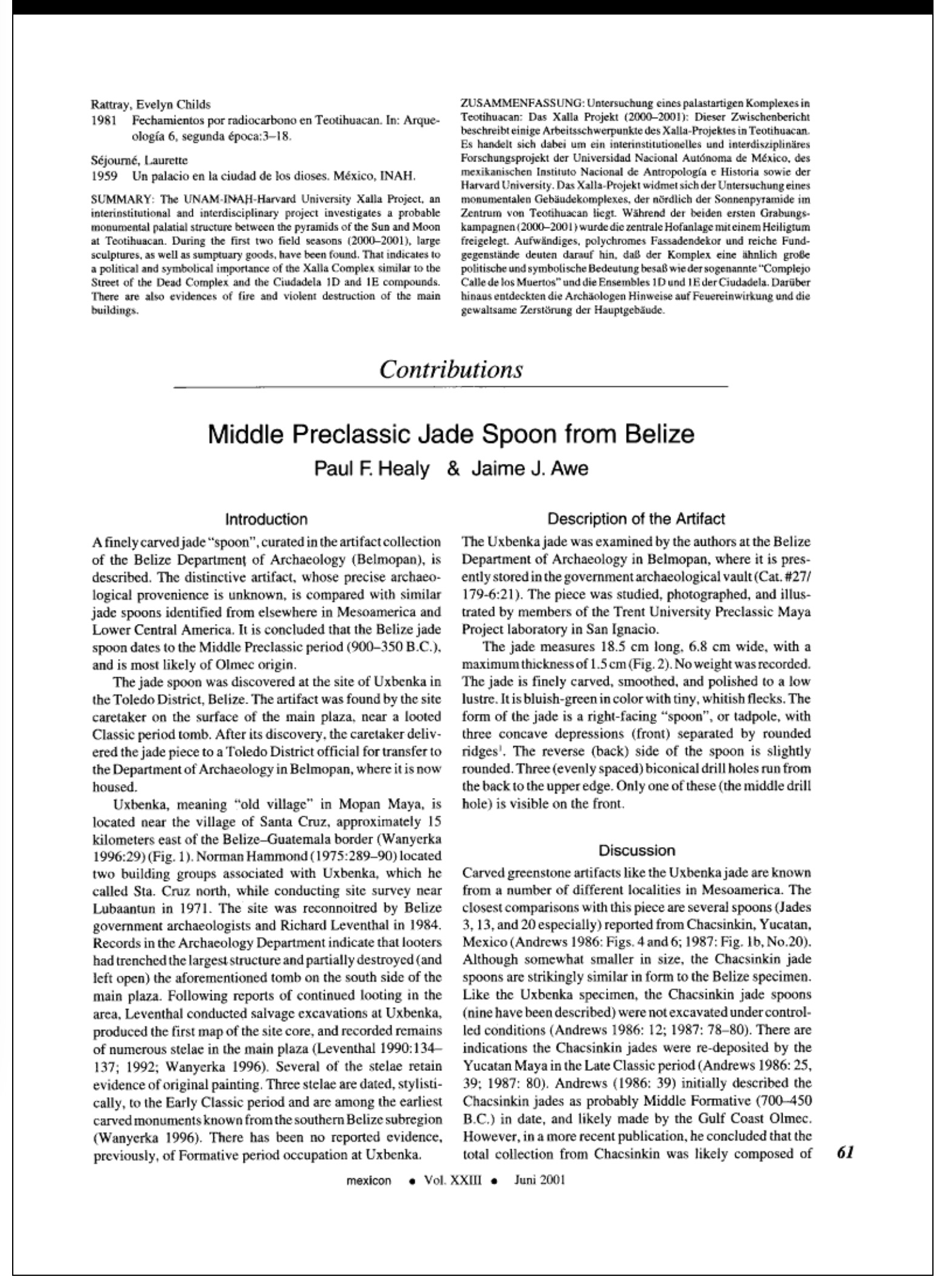
Middle Preclassic jade spoon from Belize
Journal Article
Healy, P.F. and Awe, J.J. (2001) Middle Preclassic jade spoon from Belize. Mexicon, Vol. 23, No. 3, June, pp. 61–64.
Record No. 28717  |  Sinkankas/Born No.: NIS/NIB  |  not seen
A finely carved jade “spoon,” curated in the artifact collection of the Belize Department of Archaeology in Belmopan, is described. The distinctive artifact, whose precise archaeological provenience is unknown, is compared with similar jade spoons identified elsewhere in Mesoamerica and Lower Central America. It is concluded that the Belize jade spoon dates to the Middle Preclassic period (900–350 BC) and is most likely of Olmec origin. The jade spoon was discovered at the site of Uxbenka in the Toledo District of Belize. The artifact was found by the site caretaker on the surface of the main plaza, near a looted Classic-period tomb. After its discovery, the caretaker delivered the jade piece to a Toledo District official for transfer to the Belize Department of Archaeology in Belmopan, where it is now housed. Uxbenka, meaning “old village” in Mopan Maya, is located near the village of Santa Cruz, approximately 15 kilometres east of the Belize–Guatemala border. Norman Hammond located two building groups associated with Uxbenka, which he called Sta. Cruz North, while conducting a site survey near Lubaantun in 1971. The site was reconnoitred by Belize government archaeologists and Richard Leventhal in 1984. Records in the Archaeology Department indicate that looters had trenched the largest structure and partially destroyed, while leaving open, the aforementioned tomb on the south side of the main plaza. Following reports of continued looting in the area, Leventhal conducted salvage excavations at Uxbenka, produced the first map of the site core, and recorded the remains of numerous stelae in the main plaza. Several of the stelae retain evidence of original painting. Three stelae are dated stylistically to the Early Classic period and are among the earliest carved monuments known from the southern Belize subregion. Prior to the discovery of the jade spoon, there had been no reported evidence of Formative-period occupation at Uxbenka. The Uxbenka jade was examined by the authors at the Belize Department of Archaeology in Belmopan, where it is presently stored in the government archaeological vault (Cat. No. 27/179-6:21). The piece was studied, photographed, and illustrated by members of the Trent University Preclassic Maya Project laboratory in San Ignacio. The jade measures 18.5 cm in length, 6.8 cm in width, and has a maximum thickness of 1.5 cm. No weight was recorded. The artifact is finely carved, smoothed, and polished to a low lustre. It is bluish-green in colour with tiny whitish flecks. The form is that of a right-facing “spoon,” or tadpole, with three concave depressions on the front separated by rounded ridges. The reverse side is slightly rounded. Three evenly spaced biconical drill holes run from the back to the upper edge, although only the central drill hole is visible on the front.

Looking for the southern frontier of the Garamantes
Journal Article
Liverani, M. (2001) Looking for the southern frontier of the Garamantes. Sahara, Vol. 12, May, pp. 31–44.
Record No. 27350  |  not seen
The Joint Italo-Libyan Mission to the Tadrart Acacus and Messak of the CIRSA (University of Rome «La Sapienza») is investigating new avenues of research, including the archaeology of the protohistoric and historical periods. The Garamantian citadel Aghram Nadharif, near the Barkat oasis and dating back to the third and fourth centuries, is being excavated and is already the most important Garamantian site outside the Germa area. Moreover, other testimonials of the Garamantes period have been found at Fehwet and in the Irlarlaren pass. A detailed reconstruction is made of the southern frontier of the Garamantes kingdom and the caravan network that connects Fezzan with the central and western Sudanese regions (the Chad basin and the Niger bend). The transition from the Late Pastoral horizon to the Garamantes period, with the related questions regarding the domestication of the camel, the working of iron and the salt trade, is becoming more and more clear.

Rich gemstone potentials discovered in Somaliland
Journal Article
Kinnaird, J.A. (2001) Rich gemstone potentials discovered in Somaliland. Jewellery News Asia, No. 197, January, pp. 58, 60, 62–63.
Record No. 26743  |  not seen
Recent geological surveys indicate that Somaliland has abundant deposits of gemstones, from emerald to aquamarine, ruby and sapphire as well as vast amounts of garnet, quartz and opal, and lesser-known minerals such as titanite and vesuvianite. Somaliland in northern Africa appears to be the new potential gemstone-bearing area comparable to Madagascar or Tanzania. In addition to pegmatite, which are the host rocks of emerald and other kinds of beryl such as aquamarine, Somaliland has metamorphic rocks that hold nodules of ruby and sapphire. There is little understanding of its mineral deposits, but villagers in Somaliland use primitive tools to dig out a range of gemstones that they offer for sale to dealers locally. When aid officials at the European Community (EC) office in the capital, Hargeisa, first saw the gemstones, they believed they had been stolen from graves. To determine whether these stones came out of the ground or were stolen, EC invited Dr. Judith Kinnaird, a consultant geologist and gemmologist from the University of Witwatersrand in Johannesburg, to investigate. Dr. Kinnaird visited the country twice and, in addition to identifying gem minerals, she helps local miners distinguish among similar coloured minerals and is working with Progressive Interventions (supported by EC funding) to help set up a gemmological association and marketing channels. Somaliland is part of the Mozambique Belt and was formerly part of the same landmass as Madagascar, Tanzania, Sri Lanka and India prior to continental drift. Recovery of gemstones began only in 1988 and is still carried out in a primitive and haphazard manner. The gem-producing belt is a narrow strip between 30 and 80 km wide and 200 to 300 km long, running roughly parallel to the Gulf of Aden. The country, once a British protectorate, suffered a nine-year civil war from 1982, leaving infrastructure like roads and bridges in disrepair. Dr. Kinnaird described access to gem deposits as difficult and hazardous. The terrain includes high mountains and coastal regions with temperatures reaching up to 50°C. Two emerald-producing areas, Alihiley and Simodi, occur at the contact of pegmatite and chromium-bearing schist. Patchy colour development and dual-colour zoning were observed in crystals. At Simodi, pegmatite is visible across the hillsides, and emerald is being mined again after years of inactivity, despite dangerous pit conditions and lack of equipment. In Alihiley, rudimentary mechanical tools like a compressor are used. East of the emerald belt, aquamarine and other beryls occur in pegmatite intruding granite, giving rise to large but often cracked crystals coloured by iron or titanium. Reports also mention yellow beryl (heliodor). Ruby and sapphire are found in metamorphic rocks, not pegmatite. Ruby has been found in red corundum cores with green zoisite, while sapphire occurs in nodules, greenish-blue near the surface and better-quality blue material at depth. Unlike other African countries, ruby and sapphire are not found together. Garnet is extremely abundant, in red to orange colours and of multiple types, including pyrope and almandine, and some green garnets initially mistaken for Tsavorite were identified as vesuvianite. Orange to yellow opals lacking play-of-colour have been found, but high-quality reddish opal with good play-of-colour also occurs, possibly in both lava and gypsum/anhydrite strata. Quartz is widespread, including high-purity rock crystal, smoky quartz, banded forms, and deep purple amethyst. Additional minerals include red spinel, watermelon tourmaline, colourless topaz, blue and green vesuvianite, titanite, apatite, and zircon. Some locals mistake quartz for diamond, though Dr. Kinnaird clarified there are no diamonds in Somaliland.

The infrared spectra of Type-B jadeite jades and significance in their identification
B货翡翠的红外光谱特征及鉴定意义
Journal Article
Chen, B., Qui, Z., Wang, M. and Gong, S. (2001) The infrared spectra of Type-B jadeite jades and significance in their identification. [B货翡翠的红外光谱特征及鉴定意义] Acta Mineralogica Sinica, Vol. 21, No. 3, pp. 525–527.
Record No. 26429  |  Sinkankas/Born No.: NIS/NIB  |  Language: in Chinese  |  not seen
Based on the conventional gemmological characterization of nine B-type jadeite samples, infrared spectroscopy was conducted. The results show that the primary absorption peaks of B-type jadeite are a group at 2,959 (or 2,966), 2,931 (or 2,924), and 2,895 cm⁻¹. Additionally, two other spectral bands—at 1,510, 1,581, and 1,609 cm⁻¹, and at 3,040 and 3,060 cm⁻¹—can serve as auxiliary indicators for identifying B-type jadeite, though they are not essential. These findings provide further data for the accurate identification of B-type jadeite.

A study of blue nephrite

Journal Article
Liu, S. and Jing, P. (2001) A study of blue nephrite. Journal of the Gemmological Association of Hong Kong, Vol. 22, pp. 22–30.
Record No. 7838  |  not seen

LRM spectrum characteristic of filled glass in heat-treatment [sic] rubies
Journal Article
Xi, B., Xu, R., Gao, H. and Guan, X. (2001) LRM spectrum characteristic of filled glass in heat-treatment [sic] rubies. Journal of Gems & Gemmology, Vol. 3, No. 4, pp. 5–7.
Record No. 7752  |  not seen
Natural rubies are usually enhanced by heat treatment in a flux, and secondary glasses may be formed that then remain in the gems. These fluxes are commonly similar in appearance to glass inclusions found in flux-grown synthetic rubies. To differentiate between these two types of glasses, the chemical compositions and structural characteristics of both types were determined using electron microprobe and laser Raman microspectrometry (LRM) techniques.. Four types of glasses were found in the heat-treated natural rubies: sodic aluminosilicate glass, Na-P-Al glass, B-Na-Al glass, and aluminosilicate glass. Chemically, these glasses are significantly different from flux inclusions found in synthetic rubies. They differ not only in major elements, but also in trace elements. For example, Pb, W, Mo, and Bi present in synthetic rubies were not detectable in the glasses. The Raman spectra of the two materials also are distinct.TL

Comparison of inclusions in corundum from the new mines in Tanzania and on Madagascar
Conference Paper
Gübelin, E.J. (2001) Comparison of inclusions in corundum from the new mines in Tanzania and on Madagascar. XXVIII International Gemmological Conference, Madrid, Spain
Record No. 3107  |  not seen

Anwendung der UV-Strahlung in der Gemmologie
Application of UV radiation in gemology
Journal Article
Gübelin, E.J. (2001) Anwendung der UV-Strahlung in der Gemmologie. [Application of UV radiation in gemology] Deutsche Goldschmiede-Zeitung, No. 11, pp. 96–100.
Record No. 3106  |  Language: in German  |  Not seen

Los yacimientos de jade en el Valle de Motagua, Guatemala
Jade deposits in the Motagua Valley, Guatemala
Journal Article
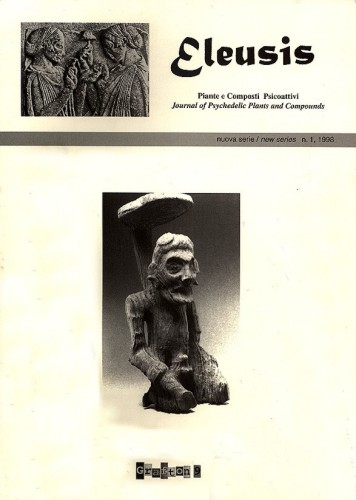
Aguilar Hernández, B.A. (2000) Los yacimientos de jade en el Valle de Motagua, Guatemala. [Jade deposits in the Motagua Valley, Guatemala] Actualidades Arqueológicas, Vol. 4, No. 21, April, pp. 4–9.
Record No. 28415  |  Sinkankas/Born No.: NIS/NIB  |  Language: in Spanish  |  not seen
In Mesoamerica, various raw materials were used for the manufacture of tools and utensils, among which jade stands out, being used primarily for the production of luxury objects. The Motagua Valley in Guatemala is the only place known in Mesoamerica where jade was extracted. This region has been little studied; in this work, the aspects that have been investigated, as well as descriptions and the locations of jade outcrops, will be presented. Likewise, a definition of objectives for the study and protection of this mineral and cultural resource of Guatemala will be proposed.

Magie und Alchemie im mittelalterlichen Denken – Zur Magie der Mineralien und kostbaren Steine und ihrer Kritik bei Augustin, Albertus Magnus und Roger Bacon
Magic and alchemy in medieval thought – On the magic of minerals and precious stones and its critique by Augustine, Albertus Magnus, and Roger Bacon
Journal Article
Jeck, U.R. (1999) Magie und Alchemie im mittelalterlichen Denken – Zur Magie der Mineralien und kostbaren Steine und ihrer Kritik bei Augustin, Albertus Magnus und Roger Bacon. [Magic and alchemy in medieval thought – On the magic of minerals and precious stones and its critique by Augustine, Albertus Magnus, and Roger Bacon] Eleusis, Vol. 54, No. 1, pp. 27–37.
Record No. 27921  |  Sinkankas/Born No.: NIS/NIB  |  Language: in German  |  not seen

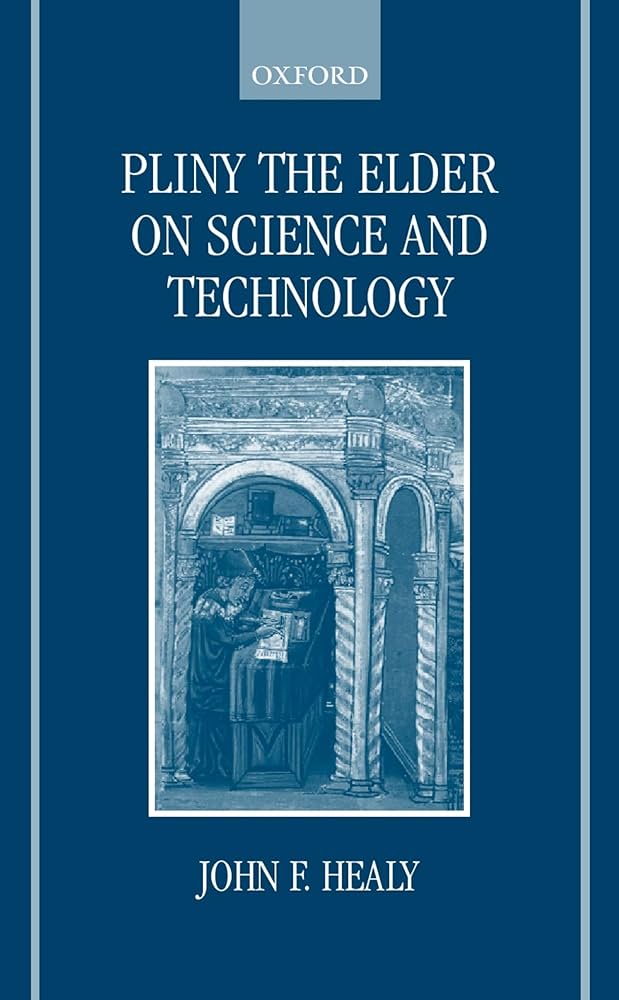
Pliny the Elder on Science and Technology

Book
Healey, J.F. (1999) Pliny the Elder on Science and Technology. Oxford, Oxford University Press, 484 pp.
Record No. 17221  |  ISBN/ISSN: 9780200000000  |  Sinkankas/Born No.: NIS/NIB  |  not seen
The Elder Pliny's Natural History provides a wide-ranging account of human achievement in the arts and sciences in the first century AD. This book re-examines Pliny's work for the first time since the 1920s. Modern experiments, simulating the techniques described by Pliny, and an in-depth study of his development of a technical language, confirm his unique contribution to our knowledge of science in early imperial Rome.
Albert der Grosse über die Natur der Steine

Albert der Grosse über die Natur der Steine

Albert the Great on the nature of stones
Journal Article
Jeck, U.R. (1998) Albert der Grosse über die Natur der Steine. [Albert the Great on the nature of stones] Zeitschrift, Vol. 47, No. 4, pp. 206–211.
Record No. 27920  |  Sinkankas/Born No.: NIS/NIB  |  Language: in German  |  not seen
Le lapis-lazuli dans l’Orient ancien : Gisements, production, circulation, des origines au début du IIᵉ millénaire avant J.-C.
Le lapis-lazuli dans l’Orient ancien : Gisements, production, circulation, des origines au début du IIᵉ millénaire avant J.-C.

Thesis
Casanova, M. (1998) Le lapis-lazuli dans l’Orient ancien : Gisements, production, circulation, des origines au début du IIᵉ millénaire avant J.-C. Paris 1 University, 327, 357 pp.
Record No. 27758  |  not seen
Lapis lazuli was the true precious stone of the ancient Near East—a key symbolic element in both the Near East and Egypt—its possession was a mark of political and religious power. Its history, which began as early as the Neolithic period (in the 7th millennium), continued into the Bronze Age up to the 2nd millennium B.C. and beyond. It is attested at sites more than 3,000 km apart, from Central Asia to Mesopotamia, and from Syria to Egypt. It is a rare rock, difficult to obtain due to its origin in very high mountains with access limited by natural conditions. The lapis lazuli worked in the ancient Near East came from the Badakhshan mines (Afghanistan), from Gorno-Badakhshan in the Pamirs (Tajikistan), and possibly from the Chagai Hills (Pakistan). Lapis lazuli saw its greatest use in the mid-3rd millennium, as shown by the fabulous wealth of the Royal Cemetery tombs at Ur. The study of manufacturing debris and tools indicates the existence of a shared sequence of production steps for making lapis lazuli ornaments. Regional styles emerged depending on whether the adornments came from Egypt, Syro-Mesopotamia and Susiana, or from Iran (outside Elam) or Central Asia. The hierarchical city-states of Syro-Mesopotamia were major consumers of symbolic goods, which also served their propaganda. Craftsmen worked within workshops dependent on palaces or temples. The Epic of Gilgamesh shows the gods equipping favored beings with lapis lazuli or providing them with protections before entering the underworld. Lapis lazuli symbolizes the life force that is the source of divine power. It is both agent, sign, and manifestation of the circulation of goods, ideas, and cultural representations, as well as of relationships of influence, domination, and exchange among the centers of Near Eastern civilization from the 4th to the 2nd millennia B.C.

Gem corundums and zircons from the Primorye placers
Journal Article
Ananyev, S.A., Ananyeva, T.A., Garanin, V.K. and Kudryavtseva, G.P. (1998) Gem corundums and zircons from the Primorye placers. Zapiski RMO (Proceedings of the Russian Mineralogical Society), Vol. 127, No. 4, pp. 120–124.
Record No. 7758  |  not seen
Descriptions are given of gem-quality sapphire and “hyacinth” zircon—and the associated chrome spinel, magnetite, and enstatite—found at Primorye in heavy-mineral concentrates that were ultimately derived from alkali basalts. Transparent blue, blue-green, green, and occasional multicolored sapphires are found as rounded pebbles (2 to 30 mm in size); some star sapphires are recovered. Chemical analyses and visible absorption spectra show that the sapphire coloration is related to the presence of Fe (0.72–1.75 wt.% FeO) and Ti (0.02–0.20 wt.% TiO₂). Inclusions of hercynite and ferrocolumbite were identified in some of these corundums. The zircon also is found as rounded pebbles (1 to 25 mm in size). They are transparent orange, orange-yellow, or brown-red, and become colorless on heating. Their chemical compositions correspond to those of the rare zircon variety naegite, with 4.59–6.14 wt.% Ta₂O₅, 3.22–3.59 wt.% Nb₂O₅, and 3.98–4.09 wt.% ThO₂. [Editor’s note: The terms hyacinth and naegite are not used in most modern gemology and mineralogy references in English.]

Tairus hydrothermal synthetic ruby

Journal Article
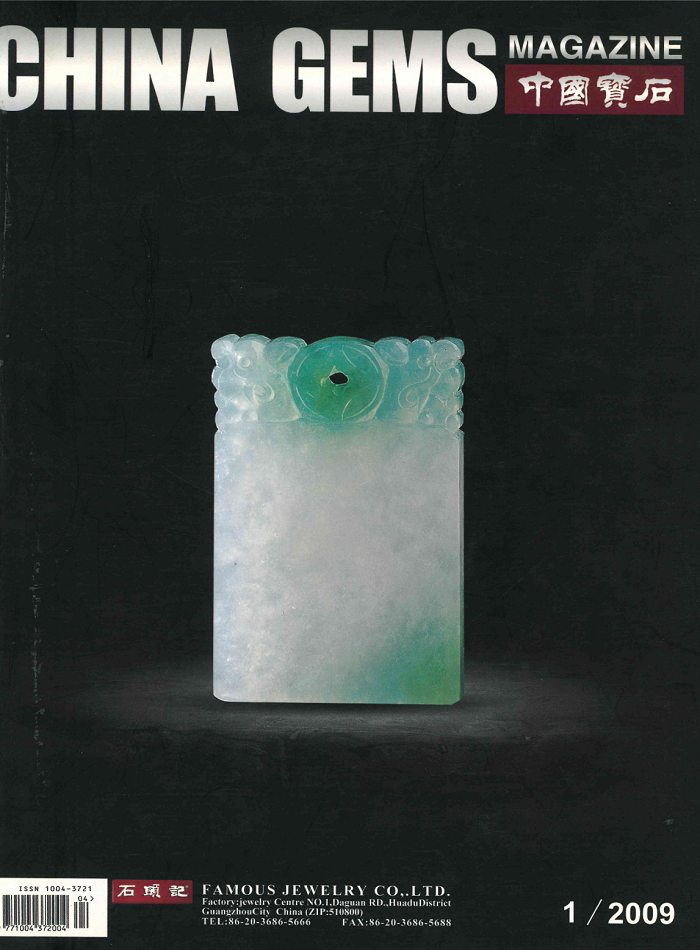
Qi, L. and Lin, S. (1998) Tairus hydrothermal synthetic ruby. China Gems, Vol. 7, No. 1, pp. 122–124.
Record No. 7757  |  not seen
Gemological investigations of Tairus hydrothermal synthetic ruby revealed characteristic microscopic features, including solid alloy inclusions consisting mainly of copper–iron alloys and wavy growth lines. Chemical analysis by microprobe showed that the chromium concentration in the area of the growth lines averaged 3.81 wt.% Cr₂O₃, as compared to 1.53 wt.% Cr₂O₃ in the remainder of the stone. Characteristic infrared absorption peaks are 3308, 3233, and 3186 cm⁻¹.

Building a Gemological Library

Gemological books range from general identification manuals and textbooks to specialized works on individual gems, mineralogy, jewelry, treatments, synthesis, history and gem-producing regions.

For a curated selection of particularly useful books, read The Gemologist's Core Library — Classic Books on Gemology, Jewelry and Mineralogy.

About Four Treasures

Four Treasures is Lotus Gemology's freely accessible gemological reference database. Use the full database to search by author, title or keyword and explore literature on gemology, mineralogy, jewelry and related fields. Where available, hyperlinks on titles may lead directly to the full publication.

Search the Complete Four Treasures Database