Explore books on gems, gemology, jewelry and mineralogy in Four Treasures, the Lotus Gemology reference database. This bibliography brings together matching book records from the collection, with publication details, abstracts and cover images where available.
Gemology Book References
The list below matches books concerning gemology and related subjects in the database's searchable fields. Some works cover several branches of gems, jewelry or mineralogy.
3,441–3,452 of 3,452 matching references
Notes on the productive capacities of the Shan countries, North and East of Ava, their arts and manufactures; with a short account of the town of Bamo, as seen in January, 1836, and its trade with China and the lower Irrawaddy
Book Section
Hannay, S.F., Capt. (1857) Notes on the productive capacities of the Shan countries, North and East of Ava, their arts and manufactures; with a short account of the town of Bamo, as seen in January, 1836, and its trade with China and the lower Irrawaddy. In: Selections from the Records of the Bengal Government, Calcutta, 1853–1900, Calcutta: Calcutta Gazette Office, pp. 9–19, jade see p. 11.
Record No. 29475 | Sinkankas/Born No.: NIS/NIB | not seen
An account of the economic resources, arts, manufactures, and commerce of the Shan territories north and east of Ava in Burma (Myanmar), based on Captain S. F. Hannay’s travels and observations, including his visit to Bhamo in January 1836. Hannay describes local products, industries, trade routes, and the important commerce between Bhamo, China, and the lower Irrawaddy. Of particular gemological interest is the reference on p. 11 to precious stones and mineral products among the commodities and resources of the region. The paper provides valuable firsthand evidence for nineteenth-century trade networks linking the mineral- and gem-producing regions of northern Burma with China and the wider Burmese economy.
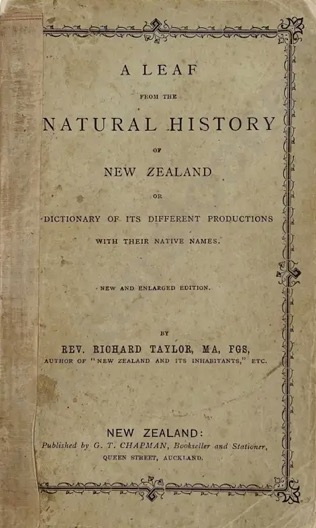
Taylor, R. and Victoria University of, W. (1848)A Leaf from the Natural History of New Zealand, or, A Vocabulary of its Different Productions, &c., &c., with their Native Names. Wellington, N.Z., Robert Stokes
Record No. 7847 | Sinkankas/Born No.: NIS/NIB | not seen
Reference copied to clipboard!
gems, jade, amphibole jade, nephrite, New Zealand, punamu, Maori, Fischer
A compact natural-history vocabulary of New Zealand, listing plants, animals, minerals, and other natural productions together with their Māori names and brief descriptive notes. Taylor intended the work as a practical reference to the country’s indigenous natural resources and terminology. Of gemological interest are entries concerning New Zealand stones and minerals, including materials used by Māori for tools, ornaments, and other objects, making the work useful for the early documentation of native mineral names and the cultural use of stone in New Zealand.
Farsistan – Persische Scenen und Legenden aus dem Tagebuche eines Britischen Touristen
Book
Guttenstein, B.F. (1841)Farsistan – Persische Scenen und Legenden aus dem Tagebuche eines Britischen Touristen. Karlsruhe, Druck und Verlag von C. Macklot, pp. 169
Record No. 29062 | Sinkankas/Born No.: NIS/NIB | not seen
Reference copied to clipboard!
gems, turquoise, Iran, Persia, Persian turquoise
Farsistan is a literary travel account presenting scenes, observations, and legends from Persia, framed as extracts from the diary of a British traveller. The work combines descriptions of Persian landscapes, cities, customs, society, and historical associations with stories and traditions connected with the places visited. Of particular gemological interest is a section on the turquoise mines (pp. 68–76), providing an early nineteenth-century account of this important Persian gemstone resource.
Dissertatio inauguralis medica de lapide amazonico in epilepsiae sanatione adhibendo
Inaugural medical dissertation on the Amazonian stone to be used in the treatment of epilepsy
Book
Schroeder, E.L. (1818)Dissertatio inauguralis medica de lapide amazonico in epilepsiae sanatione adhibendo. [Inaugural medical dissertation on the Amazonian stone to be used in the treatment of epilepsy] Göttingen, see pp. 8–9
Record No. 7090 | Sinkankas/Born No.: NIS/NIB | Language: in Latin | not seen
Reference copied to clipboard!
gems, jade, Fischer-Book
An early nineteenth-century medical dissertation concerned with the so-called Amazonian stone (lapis amazonicus) and its supposed use in the treatment of epilepsy. Schroeder discusses the material within the older medical tradition in which certain stones and minerals were credited with therapeutic powers, especially against convulsive disorders. Of particular interest to gemological history, the work preserves the historical medicinal associations attached to the “Amazon stone,” a term whose exact mineralogical identification in this context should not be assumed without examining the dissertation itself. The study is useful as evidence for the persistence of lapidary medicine into the early nineteenth century, even as mineralogy was becoming increasingly scientific.
Neuer Vollkommener Natur- und Kunst mäßiger Unterricht von Edelgesteinen
New Complete Natural and Practical Instruction on Precious Stones
Book
Gemma, A., (Förster, Nicolaus) (1719)Neuer Vollkommener Natur- und Kunst mäßiger Unterricht von Edelgesteinen. [New Complete Natural and Practical Instruction on Precious Stones] Hanover, Nicolaus Förster, 121 pp.
Record No. 29003 | Sinkankas/Born No.: 2334–2335 | Language: in German | not seen
Reference copied to clipboard!
gems, gemology, lapidary
Sinkankas: An extremely rare work on gemstones that emphasizes practical aspects of lapidary treatment and other matters that would be of value to the tradesman and jewelry maker. It is further remarkable for including a chapter on the methods by which Indian lacquerware is manufactured, which of course has nothing to do with gems. Gemma discusses the origin of gemstones in the first chapter, considering at length Robert Boyle’s statements on the same as given in his Exercitatio de Origine et Viribus Gemmarum, supporting some and disputing others. Other citations and quotations from authorities appear throughout the text. Other topics treated include the magical and curative powers of gemstones, physical properties, color and its enhancement by use of foils, the pricing of gems, the manufacture of doublets, artificially colored and imitation gems, and substitutes. One chapter is devoted to “figures” in stones, that is, clouds or swarms of inclusions, banding, and other markings which resemble human or other figures, shells in fossiliferous limestones, insects in amber, and stars in star stones. All of these are treated soberly as natural manifestations and are not thought to be magical or miraculous in nature as had been done not too long before Gemma’s time. Another chapter treats petrification due to mineralized waters. From the practical viewpoint, this work is especially rich in details on the cutting of gemstones and the equipment required to do so, including the art of gem engraving. Gem-cutting equipment then in use is described in minute detail, as well as a process for classifying raw tripoli to make it useful as a polishing agent. In all respects this admirable, reasoned work deserves greater recognition.
Histoire moderne du pays d’Ararad
Modern History of the Country of Ararad
Book
Tauriz, A.h., de [Aṙakʿel of Tabrīz] (1668)Histoire moderne du pays d’Ararad. [Modern History of the Country of Ararad] Amsterdam, (see p. 561)
Record No. 7096 | Sinkankas/Born No.: NIS/NIB | Language: in French | not seen
Reference copied to clipboard!
gems, jade, Fischer-Book, Abel-Rémusat
Arakʿel of Tabriz’s Histoire moderne du pays d’Ararad is a 17th-century Armenian chronicle describing Armenia and neighboring regions during the turbulent period of Ottoman–Safavid conflict, particularly the reign of Shah ʿAbbās I and its aftermath. Written by the Armenian cleric and historian Aṙakʿel Dawrižecʿi (Arakʿel of Tabriz), the work records wars, forced migrations, famines, political and religious affairs, Armenian communities and monasteries, trade, and relations with Persia and the Ottoman Empire. It is especially valuable because the author was close in time to many of the events described and incorporated eyewitness testimony and contemporary documentary information. Of gemological interest, the passage cited on p. 561 contains information concerning precious stones or their trade, contributing evidence for the circulation and appreciation of gems within the commercial networks linking Persia, Armenia, and neighboring regions in the 17th century.
Niẓāmī’s Gem Treatise
Jawāhir-nāmah-i Niẓāmī (جواهرنامه نظامی)
Edited Book
al-Nīshābūrī, M.i.A.l.-B.a.-J., Afshar, I. and Daryagasht, M.R., editor (1383)Niẓāmī’s Gem Treatise. [Jawāhir-nāmah-i Niẓāmī (جواهرنامه نظامی)]. Tehran
Record No. 27001 | Language: in Persian | not seen
Reference copied to clipboard!
gems, Arabic mineralogy, early lapidaries
Jawāhir-nāmah-i Niẓāmī [جواهرنامه نظامی; Niẓāmī’s Gem Treatise], composed by Muḥammad ibn Abī al-Barakāt al-Jawharī al-Nīshābūrī, is an important medieval Persian treatise on precious stones, minerals, and related substances. The work describes numerous gems and ornamental materials, discussing their names, varieties, geographical sources, physical characteristics, desirable and defective qualities, methods of identification, and medicinal or other properties attributed to them. It also preserves information concerning the valuation and commerce of precious stones and draws upon earlier Arabic and Persian lapidary traditions while incorporating observations relevant to contemporary practice. The treatise is particularly valuable to historians of gemology for its Persian gemological terminology and its evidence for the identification, provenance, testing, grading, and use of gemstones in the medieval Islamic world. The modern Tehran edition was edited by Iraj Afshar and Mohammad Rasul Daryagasht.
Ratna Pariksha
Gem Testing
Book
Pheru, T. (1316)Ratna Pariksha. [Gem Testing] Jodhpur, Institute of Oriental Research
Record No. 3123 | Language: in Sanskrit | not seen
Reference copied to clipboard!
corundum, history.1, India.12, gems, Indian lapidary
Ratna Pariksha [रत्नपरीक्षा; Gem Testing], composed in 1316 by the Jain scholar and administrator Thakkura Pheru, is a medieval Indian treatise devoted to the identification, classification, evaluation, and valuation of precious stones. Written in Apabhraṃśa, it discusses important gems encountered in the Indian trade, including diamonds, pearls, rubies, sapphires, emeralds, and other precious materials, describing their varieties, desirable and undesirable qualities, defects, weights, and commercial values. The work is particularly important to the history of gemology because Pheru drew upon practical experience with gems, weights, measures, and monetary calculations rather than treating precious stones solely within the religious and astrological traditions characteristic of many earlier Indian lapidaries. It consequently provides valuable evidence for the terminology, testing practices, grading criteria, and economics of the gem trade in early 14th-century India.
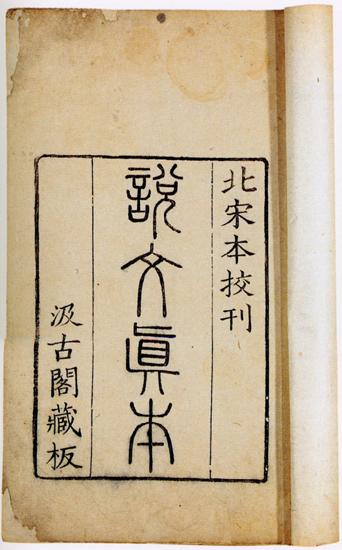
Xu, S. (121 CE; Eastern Han)Explaining Graphs and Analyzing Characters. [说文解字]
Record No. 16544 | Sinkankas/Born No.: NIS/NIB | Language: in Chinese | not seen
Reference copied to clipboard!
gems, jade, China, Adam, Chinese jade books, jade lore, Fischer-Chinese
The Shuowen Jiezi [說文解字; Explaining Graphs and Analyzing Characters], compiled by Xu Shen during the Eastern Han dynasty and presented to the imperial court in 121 CE, is the earliest surviving systematic dictionary of Chinese characters and a fundamental source for the historical study of Chinese writing. The work analyzes approximately 9,350 characters, with more than 1,100 variant forms, arranging them under 540 graphic radicals and explaining their forms, meanings, and, where appropriate, pronunciations. Xu Shen classified characters according to traditional principles of character formation and frequently drew upon ancient scripts and early textual usage. Of particular interest to gemologists is the extensive treatment of characters associated with jade, minerals, stones, metals, colors, and other natural substances, particularly those grouped under the jade radical 玉. These definitions provide important evidence for the terminology, classification, and perceived properties of jade and related materials in early China and are invaluable for interpreting mineralogical and gemological terms occurring in ancient Chinese texts.
Ploy
Gems
Book
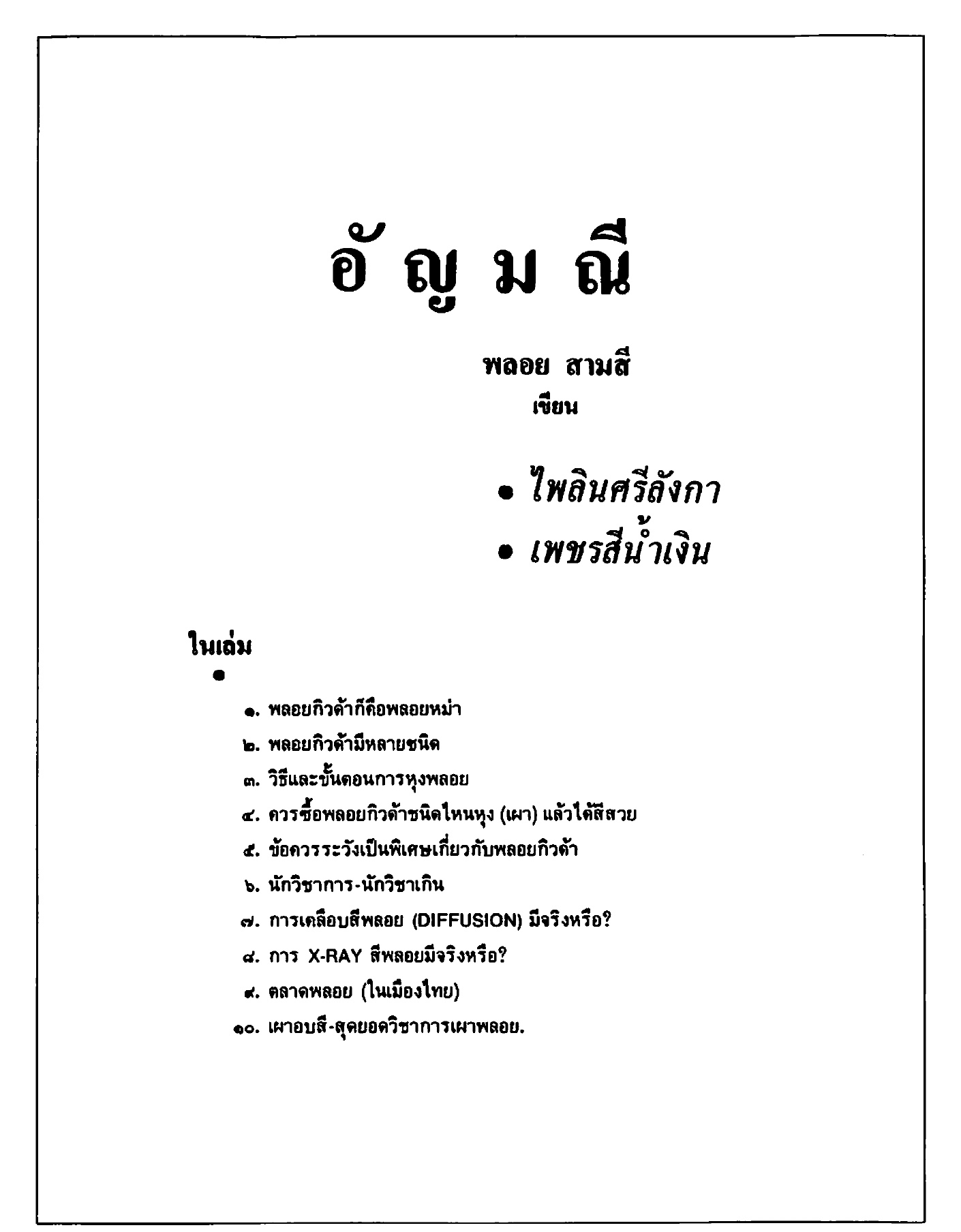
Anonymous (n.d., ca. 1990)Ploy. [Gems]
Record No. 2699 | Sinkankas/Born No.: NIS/NIB | Language: in Thai | seen
Reference copied to clipboard!
gems, corundum, treatments.6
Anonymous Thai pamphlet attacking a Thai gemological institute, and including information on heat treatments (with letters to and from the head of a major world gemological institute). This pamphlet was created in response to the Thai lab correctly identifying titanium diffusion in sapphire.
Tansukhnamah-i Ilkhani
The Book of the Ilkhanids
Book
Tusi, al- ([1201–1274])Tansukhnamah-i Ilkhani. [The Book of the Ilkhanids] Iran, 53, 358 pp.
Record No. 1742 | Sinkankas/Born No.: NIS/NIB | Language: in Persian | not seen
Reference copied to clipboard!
corundum, history.1, gems, Arabic mineralogy, early lapidaries
Tansūkh-nāmah-i Īlkhānī [تنسوخنامه ایلخانی] is a Persian treatise on mineralogy, gemstones, metals, and aromatic substances by Naṣīr al-Dīn al-Ṭūsī, apparently composed during the reign of Hülegü Khan (1256–1265). The work is divided into four principal sections: the formation and causes of minerals; precious and semiprecious stones and their properties; the seven metals; and perfumes and aromatic substances. The gemstone section discusses the characteristics, varieties, properties, defects, and uses of numerous stones and is particularly important as a source for medieval Persian gemological terminology and knowledge. The modern edition was critically edited by Sayyid Muḥammad Taqī Mudarris Raḍawī from five manuscripts and includes extensive notes, glossaries, and indexes of gemstones, minerals, colors, plants, places, and technical terms.
Corundum Treatments
Film or Broadcast
Koivula, J.I. (n.d., ca. 1984)Corundum Treatments. Santa Monica, CA: Gemological Institute of America, ~45 minutes.
Record No. 1124 | seen
Reference copied to clipboard!
corundum, treatments.6, inclusions.5, gems
Building a Gemological Library
Gemological books range from general identification manuals and textbooks to specialized works on individual gems, mineralogy, jewelry, treatments, synthesis, history and gem-producing regions.
Four Treasures is Lotus Gemology's freely accessible gemological reference database. Use the full database to search by author, title or keyword and explore literature on gemology, mineralogy, jewelry and related fields. Where available, hyperlinks on titles may lead directly to the full publication.