Gemstone Inclusions Bibliography

Gemstone Inclusions Bibliography

Explore books, articles and historical sources on inclusions in gemstones in Four Treasures, the Lotus Gemology reference database. This bibliography brings together matching records from the collection, with publication details, abstracts and cover images where available.

Gemstone Inclusion References

The list below matches the terms inclusion or inclusions in the database's searchable fields. Some references discuss inclusions as part of a broader subject.
321–340 of 1,121 matching references

Induced fingerprints

Journal Article
Koivula, J.I. (1983) Induced fingerprints. Gems & Gemology, Vol. 19, No. 4, Winter, pp. 220–227.
Record No. 1115  |  ISBN/ISSN: 0016626X  |  RWHL*
Over the past few years, numerous Verneuil-type (flame fusion) synthetic sapphires and rubies w i t h somewhat natural-appearing induced fingerprint in-clusions have surfaced i n the trade. This article reports the results of a series of experiments conducted t o explain the phenomenon of induced fingerprints and h o w they are produced i n gemstones generally and i n flame-fusion synthetic corundum specifically.

The rubies of Burma: A review of the Mogok Stone Tract
Journal Article
Keller, P.C. (1983) The rubies of Burma: A review of the Mogok Stone Tract. Gems & Gemology, Vol. 19, No. 4, Winter, pp. 209–219.
Record No. 1090  |  ISBN/ISSN: 0016626X  |  RWHL*
Production from the 'tract', located approx 700 km N of Rangoon, is largely from alluvial deposits. Topics covered include: history and production, geology, mining methods, gemmology of the ruby, and famous rubies from the tract. -R.V.D.

Identification of the new synthetic and treated sapphires
Journal Article
Gübelin, E.J. (1983) Identification of the new synthetic and treated sapphires. Journal of Gemmology, Vol. 18, No. 8, October, pp. 677–706.
Record No. 901  |  ISBN/ISSN: 221252  |  Sinkankas/Born No.: 2594  |  RWHL*
Gübelin examines the identification of newly introduced Chatham flux-grown blue and orange synthetic sapphires and of natural sapphires whose color has been altered by heat treatment or surface diffusion. The physical properties of the Chatham synthetics differ little from those of natural sapphire, making microscopic examination particularly important. Blue Chatham sapphires may show irregular blue, yellow, and colorless zoning, straight or angular growth structures, polysynthetic twinning, coarse or delicate flux residues forming feathers, veils, nets, lace-like patterns, and misleading “fingerprints,” together with black platinum platelets, rods, splinters, and needles that reflect with a characteristic silvery metallic lustre; X-ray analysis confirmed the metallic inclusions as platinum. Some blue specimens also fluoresce intense pale green under long-wave ultraviolet radiation. Chatham orange sapphires range from brownish orange through orange-red to pinkish-orange “padparadschah” colors and likewise contain flux residues and platinum inclusions that provide important evidence of synthetic origin; ultraviolet absorption and electron-spin-resonance measurements are also investigated as possible means of separation from natural stones. Gübelin then discusses heat-treated natural sapphires, in which high temperatures may produce pockmarked surfaces, altered or melted mineral inclusions, circular tension fractures with lace-like rims, enhanced cloudy or phantom-like zoning, and fine exsolved particles producing turbidity. Diffusion-treated sapphires may additionally show strongly colored surface-reaching fissures and inclusions, irregular surface coloration, and concentrations of color along facet junctions and the girdle; immersion in a highly refractive liquid makes these features particularly conspicuous. Gübelin emphasizes that no single characteristic is universally diagnostic and recommends careful comparison of macroscopic appearance, physical properties, ultraviolet response, spectra, and especially microscopic inclusions when distinguishing natural, synthetic, heat-treated, and diffusion-treated sapphires.

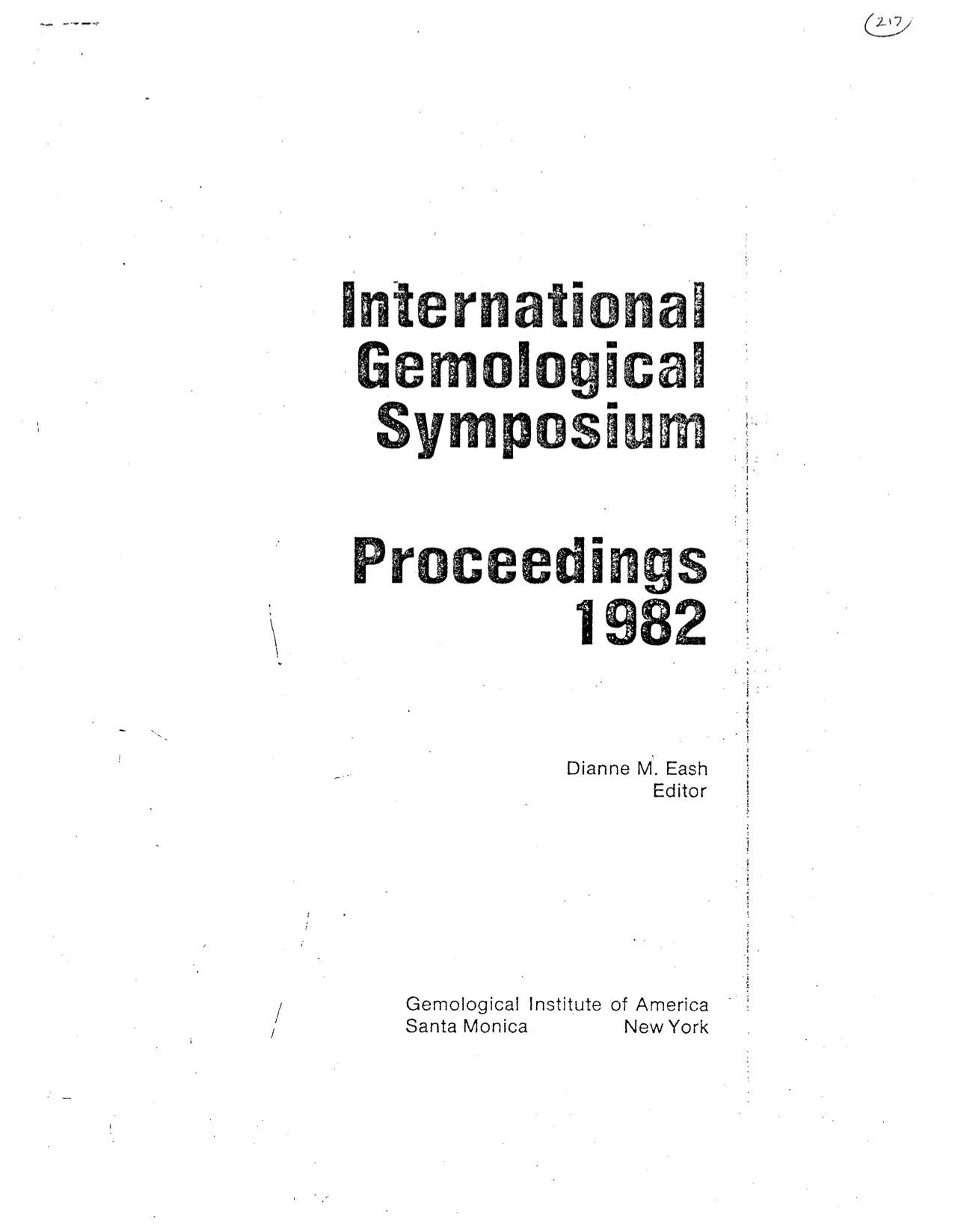
International Gemological Symposium Proceedings
Edited Book
Eash, D.M., editor (1982) International Gemological Symposium Proceedings.. Santa Monica, CA., Gemological Institute of America, 568 pp..
Record No. 28077  |  ISBN/ISSN: 9780870000000  |  Sinkankas/Born No.: 3128; NIB  |  RWHL*
This substantial volume collects the papers presented at the Gemological Institute of America’s 1982 International Gemological Symposium, bringing together research and practical observations from gemologists, mineralogists, scientists, dealers, and other specialists. The proceedings provide a broad survey of gemology at the beginning of the 1980s, covering natural and synthetic gemstones, gemstone identification, inclusions and microscopy, treatments and their detection, diamond research, colored stones, pearls, mining and geographic sources, instrumentation, cutting, and developments affecting the gem trade. Particular attention is given to the rapidly developing problems created by synthetic and treated materials and to the analytical and observational techniques required to distinguish them from their natural counterparts. Individual contributions also document important gem deposits and varieties and demonstrate the increasing application of mineralogical, chemical, spectroscopic, and microscopic methods to practical gem identification. As a whole, the proceedings provide a useful snapshot of the state of gemological research and laboratory practice in the early 1980s and record a period in which treatment detection, synthetic gem identification, and increasingly sophisticated scientific instrumentation were becoming central concerns of professional gemology.

Ein Smaragdvorkommen in Madagaskar

An emerald deposit in Madagascar
Journal Article
Hänni, H. and Klein, H.H. (1982) Ein Smaragdvorkommen in Madagaskar. [An emerald deposit in Madagascar] Zeitschrift der Deutschen Gemmologischen Gesellschaft, Vol. 31, No. 1/2, pp. 71–77.
Record No. 6050  |  Language: in German  |  RWHL*
Emeralds from a new deposit in Madagascar are described. The emeralds originating from a mica schist in the south-east of the island are sim ilar to Zambian emeralds, mainly as to their blue-green colour and optical constants. However, mlnor chemlcal dlfferences and the observation of incluslons may allow a dlstinction. The worklng of thls new deposit is at present sporadlcal and carrled out wlth only simple technical means.

Fluid inclusions in gemstones: Valuable defects
Book Section
Roedder, E. (1982) Fluid inclusions in gemstones: Valuable defects. In: International Gemological Symposium Proceedings 1982, Los Angeles: GIA, pp. 479–502.
Record No. 3753  |  RWHL*

Gemstones of Pakistan: Emerald, ruby and spinel
Journal Article
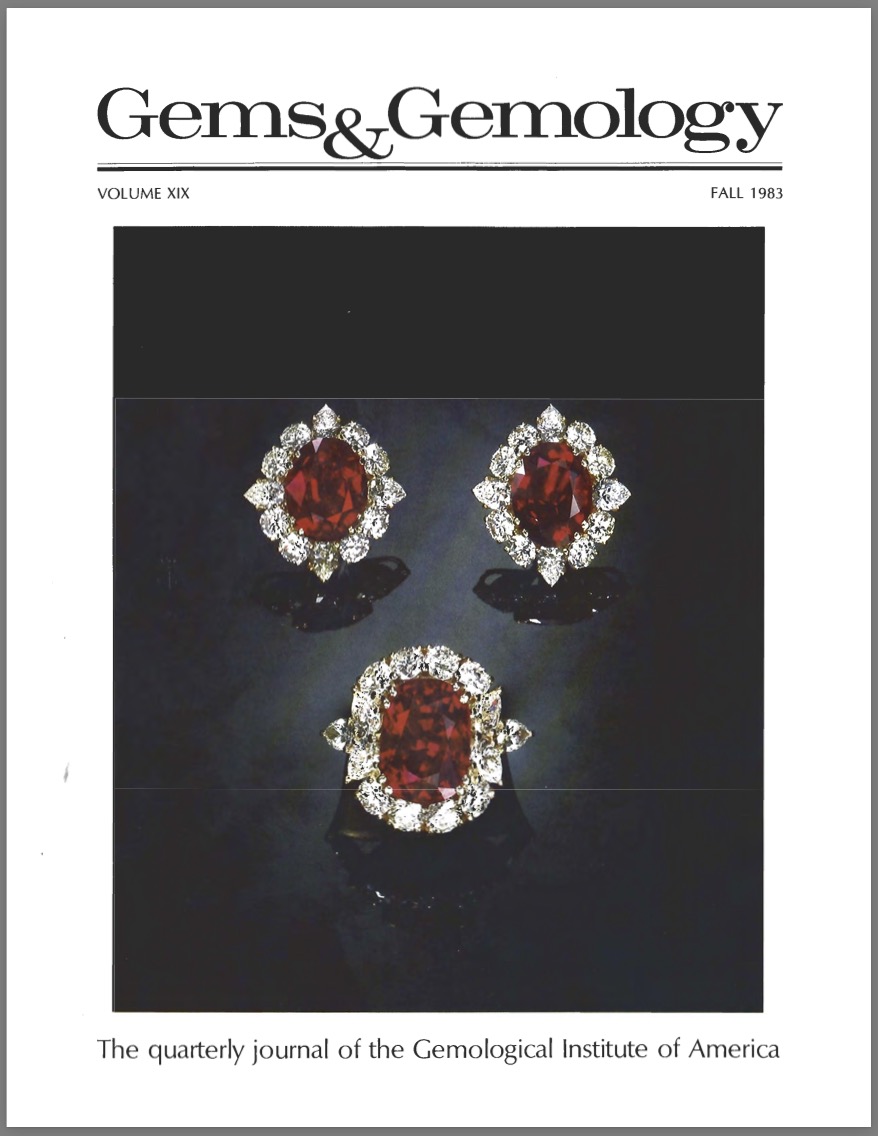
Gübelin, E.J. (1982) Gemstones of Pakistan: Emerald, ruby and spinel. Gems & Gemology, Vol. 18, No. 3, Fall, pp. 123–129.
Record No. 3183  |  ISBN/ISSN: 0016626X  |  RWHL*
Only during the last few years have the gem riches of Pakistan become known to the rest of the world. This article reports on three gem materials currently being mined: emerald, corundum (most importantly, ruby), and spinel. Intensely colored emerald crystals occur in dolomitic talc schists in the Swat Valley. Unusually high optical properties and density serve to distinguish these emeralds from those found elsewhere. Numerous gas-liquid inclusions are also typical. In the Hunza Valley, specimen-and gem-quality crystals of corundum and spinel occur in beds of marble enclosed in gneisses and mica schists. The gemological properties of the Pakistan rubies and sapphires vary only slightly within normal limits.

Inclusions in a better light

Conference Paper
Koivula, J.I. (1982) Inclusions in a better light. International Gemological Symposium Proceedings, Santa Monica, CA: Gemological Institute of America, pp. 471–476.
Record No. 3115  |  RWHL*

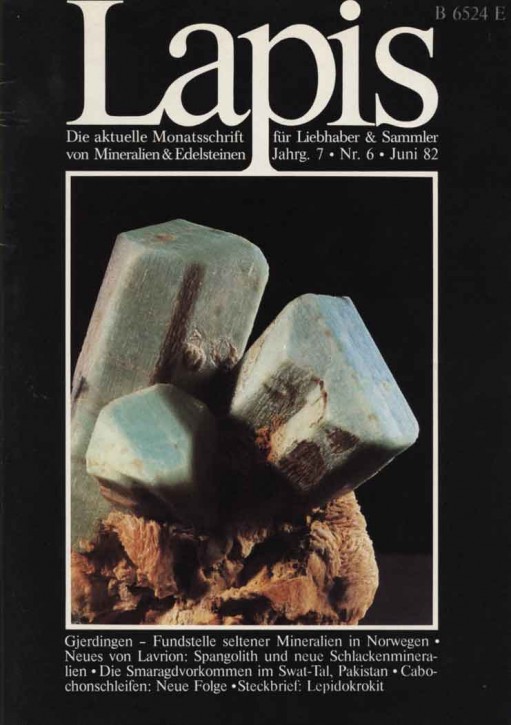
Die Edelstein-Vorkommen Pakistans: 2. Die Smaragde aus dem Swattal
The gemstone deposits of Pakistan: 2. The emeralds from the Swat Valley
Journal Article
Gübelin, E.J. (1982) Die Edelstein-Vorkommen Pakistans: 2. Die Smaragde aus dem Swattal. [The gemstone deposits of Pakistan: 2. The emeralds from the Swat Valley] Lapis, Vol. 7, No. 6, Juni, pp. 19–26.
Record No. 2163  |  Sinkankas/Born No.: 2591; NIB  |  Language: in German  |  RWHL*
Gübelin describes the emerald deposits of the Swat Valley in northern Pakistan, the second part of his survey of Pakistan’s gemstone occurrences. He discusses the geological setting and occurrence of the emeralds and examines their gemological properties and characteristic internal features. The Swat emeralds occur in metamorphic rocks and are notable for their rich green color. Microscopic examination reveals characteristic mineral and fluid inclusions useful in distinguishing the material from emeralds of other sources. The article considers the quality and appearance of the emeralds as well as the nature of the deposits and their significance as a Pakistani gemstone resource.

New synthetic rubies made by Professor P.O. Knischka
Journal Article
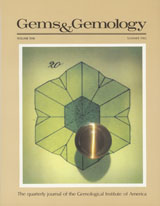
Gübelin, E.J. (1982) New synthetic rubies made by Professor P.O. Knischka. Gems & Gemology, Vol. 18, No. 3, Fall, pp. 165–168.
Record No. 2159  |  ISBN/ISSN: 0016626X  |  RWHL*
A new synthetic ruby, developed by Professor P.0. Knischka using a method of gradient techniqut (not yet disclosed) through supercooling and saturation, has distinct crystallographic and gemological characteristics. Particularly notable are the great number of faces on the finished crystals and the identifying inclusions.

Sri Lanka: The gem island

Journal Article
Zwaan, P.C. (1982) Sri Lanka: The gem island. Gems & Gemology, Vol. 18, No. 2, Summer, pp. 62–71.
Record No. 1929  |  ISBN/ISSN: 0016626X  |  RWHL*
Sri Lanka, formerly Ceylon, remains one of the single most important sources for fine gemstones. Especially notable are blue sapphire, pink sapphire or ruby, and yellow sapphire; alexandrite and cat's-eye chrysoberyl; and almandite and hessonile garnet. Spinel, tourmaline, zircon, moonstone, and quartz are also relatively common; they share their country of origin with several rarer gemstones as well. Most of the gem-quality material is found in alluvial deposits throughout the island, which are mined by primitive methods. In many instances, the Sri Lankan origin of the gemstone can be determined by characteristic inclusions, several of which are also discussed in this article

Shadowing: A new method of image enhancement for gemological microscopy
Journal Article
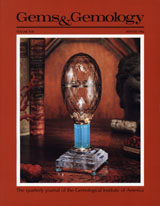
Koivula, J.I. (1982) Shadowing: A new method of image enhancement for gemological microscopy. Gems & Gemology, Vol. 18, No. 3, Fall, pp. 160–164.
Record No. 1113  |  ISBN/ISSN: 0016626X  |  RWHL*
The shadowing technique employs an opaque, black, nonreflecting light shield that is inserted gradually into the transmitted light path of a gemological microscope between the subject and the light source. Shadowing takes advantage of even very slight differences in refractive index between a gemstone host and its inclusions, casting shadows in certain areas of an inclusion scene and passing light to the microscope objectives in other areas of the image. Thus, shadowing produces a three-dimensionality that seems to lift the inclusion from its surroundings, revealing it in vivid contrast against the now-subdued background of the host. This increase in contrast adds much greater detail to growth zones, included crystals, color zones, and the like, thus greatly aiding the gemologist in his work with the microscope.

The Chanthaburi-Trat gem field, Thailand
Journal Article
Keller, P.C. (1982) The Chanthaburi-Trat gem field, Thailand. Gems & Gemology, Vol. 18, No. 4, Winter, pp. 186–196.
Record No. 1089  |  ISBN/ISSN: 0016626X  |  RWHL*
With the recent drastic decline in production from the classic ruby mines of Burma, Thailand has become the world's major source of gem ruby. The majority of the ruby production, as well as some significant sapphire production, comes from the provinces of Chantliabuti and Ttat in southeastern Thailand. This article reviews the geology of these alluvial deposits and describes the wide range of methods used to mine the corundum. Gemologically, the Thai rubies are distinguished by their violet overtone, inhibited fluorescence, and characteristic inclusions. Also discussed is the heat treatment of corundum to enhance color, which has become a major industry in Clianthaburi. The newest product, golden" sapphire, is examined, including the apparent stability of the color produced and clues to the det ection of the heat treatment."

Erkennungsmerkmale der neuen synthetischen Rubine
Identification features of the new synthetic rubies
Journal Article
Gübelin, E.J. (1982) Erkennungsmerkmale der neuen synthetischen Rubine. [Identification features of the new synthetic rubies] Deutsche Goldschmiede-Zeitung, May, Jahrgang 80, pp. 53–59.
Record No. 899  |  Language: in German  |  RWHL*
Gübelin discusses the identification of the newer flux-grown synthetic rubies, particularly those produced by Kashan, Chatham and Knischka. He emphasizes that traditional criteria for separating natural from synthetic ruby were becoming inadequate because the newer products could contain inclusions closely resembling those of natural stones. Particular attention is given to microscopic features, illustrated by 41 color photographs, including feather-, veil- and fingerprint-like inclusions, fine needle-like inclusions, and growth structures. Cryolite (Na₃AlF₆) was identified by X-ray analysis among the inclusions in flux-grown material. Knischka synthetics are described as containing rutile-like needles, negative crystals, two-phase inclusions and metallic platelets. Gübelin also considers ultraviolet fluorescence, phosphorescence and absorption spectra as supplementary identification criteria.

Die Edelsteinvorkommen Pakistans: 1. Die Rubine aus dem Hunzatal
The gemstone deposits of Pakistan: 1. The rubies from the Hunza Valley
Journal Article
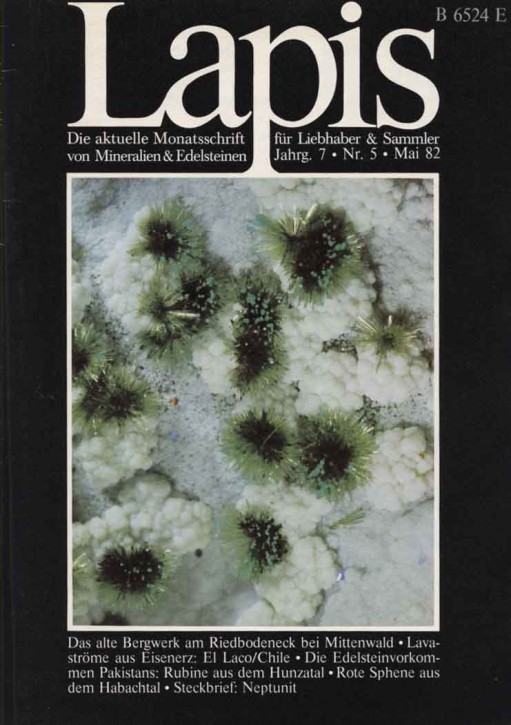
Gübelin, E.J. (1982) Die Edelsteinvorkommen Pakistans: 1. Die Rubine aus dem Hunzatal. [The gemstone deposits of Pakistan: 1. The rubies from the Hunza Valley] Lapis, Vol. 7, No. 5, Mai, pp. 19–31.
Record No. 898  |  Language: in German  |  RWHL*
Gübelin describes the ruby occurrence in the Hunza Valley of northern Pakistan, where ruby and red spinel occur in marble. He discusses the geology and mineral associations of the deposit and the gemological characteristics of the corundum. Inclusions identified in the rubies include calcite and pyrite, while apatite occurs in both ruby and spinel. Chemical analyses are compared with Burmese ruby; a Hunza ruby contained 0.81% chromium, compared with 1.30 and 1.81% in the Burmese specimens analyzed. The article is illustrated with geological maps and 22 color figures.

Hämatit als Einschluss im schwarzen Sternsaphir
Hematite as an inclusion in black star sapphire
Journal Article
Weibel, M. and Wessicken, R. (1981) Hämatit als Einschluss im schwarzen Sternsaphir. [Hematite as an inclusion in black star sapphire] Zeitschrift der Deutschen Gemmologischen Gesellschaft, Vol. 30, No. 3/4, pp. 170–176.
Record No. 5026  |  Sinkankas/Born No.: NIS/NIB  |  Language: In German  |  RWHL*
Weibel and Wessicken investigate hematite inclusions in black star sapphire, following earlier work in which the structures responsible for asterism in black sapphire from southeastern Thailand remained uncertain. They identify oriented hematite as an inclusion phase and examine its crystallographic relationship with the corundum host, considering its role in the dark coloration and optical appearance of black star sapphire. The study contributes to understanding the mineral inclusions and oriented exsolution phenomena characteristic of this material and their possible relationship to asterism.

The heat and diffusion treatment of natural and synthetic sapphires
Journal Article
Crowningshield, G.R. and Nassau, K. (1981) The heat and diffusion treatment of natural and synthetic sapphires. Journal of Gemmology, Vol. 17, No. 8, October, pp. 528–541.
Record No. 4744  |  ISBN/ISSN: 221252  |  RWHL*

Heat treating ruby and sapphire: Technical aspects
Journal Article
Nassau, K. (1981) Heat treating ruby and sapphire: Technical aspects. Gems & Gemology, Vol. 17, No. 3, Fall, pp. 121–131.
Record No. 1333  |  ISBN/ISSN: 0016626X  |  RWHL*
Ruby and sapphire of natural or synthetic origin can be heat treated to improve asterism; to remove asterism or silk; to improve, add, or remove color; and even to alter imperfections. At least nine distinct processes can be identified, although several m a y occur simultaneously. Some of these treatment methods correspond to natural processes and may not leave any evidence of their use; others do not correspond to natural processes and are readily identifiable.

Photographing inclusions

Journal Article
Koivula, J.I. (1981) Photographing inclusions. Gems & Gemology, Vol. 17, No. 3, Fall, pp. 132–142.
Record No. 1112  |  ISBN/ISSN: 0016626X  |  RWHL*
Although the general principles of photomicrography are easily learned and applied, high-quality photomicrography is an art that is mastered only with time and great patience. The microscope must be kept scrupulously clean, and the effects of light on the subject inclusion must be fully understood in order to determine what method(s) of illumination will yield the most useful photographic image. Specialized techniques that can save film and time, while producing top-quality photomicrographs, are usually learned only through long hours of experience. This article discusses some of these techniques, such as the importance of a properly prepared microscope and photographic subject, as well as the control of vibrations and exposure time. In addition, the various methods of illumination that are adaptable to a standard binocular gemological microscope are introduced.

Precipitation in star sapphire, I. Identification of the precipitate

Journal Article
Phillips, D.S., Heuer, A.H. and Mitchell, T.E. (1980) Precipitation in star sapphire, I. Identification of the precipitate. Philosophical Magazine, Series A, Vol. 42, No. 3, pp. 385–404.
Record No. 4943  |  RWHL*
The asterism in star sapphire is due to precipitation of needle-like particles in the basal plane of sapphire. These particles have now been identified as rutile (TiO,) by both electron diffraction and microchemical analysis. The rutile needles have tho following orientation relationship with the host sapphire :

Exploring the Literature of Gemstone Inclusions

The literature of gemstone inclusions covers identification, origin determination, treatments, synthesis, mineral inclusions, fluid inclusions and other internal features of natural and synthetic gems.

For a curated selection of important sources, read Inclusions in Gemstones — Hyperion Literature Sources.

About Four Treasures

Four Treasures is Lotus Gemology's freely accessible gemological reference database. Use the full database to search by author, title or keyword and explore literature on gemology, mineralogy, jewelry and related fields. Where available, hyperlinks on titles may lead directly to the full publication.

Search the Complete Four Treasures Database