Gemstone Inclusions Bibliography

Gemstone Inclusions Bibliography

Explore books, articles and historical sources on inclusions in gemstones in Four Treasures, the Lotus Gemology reference database. This bibliography brings together matching records from the collection, with publication details, abstracts and cover images where available.

Gemstone Inclusion References

The list below matches the terms inclusion or inclusions in the database's searchable fields. Some references discuss inclusions as part of a broader subject.
341–360 of 1,121 matching references

Carbon dioxide as a fluid inclusion

Journal Article
Koivula, J.I. (1980) Carbon dioxide as a fluid inclusion. Gems & Gemology, Vol. 16, No. 12, Winter, pp. 386–390.
Record No. 1111  |  ISBN/ISSN: 0016626X  |  RWHL*

“Thin films”: elusive beauty in the world of inclusions
Journal Article
Koivula, J.I. (1980) “Thin films”: elusive beauty in the world of inclusions. Gems & Gemology, Vol. 16, No. 9, Summer, pp. 326–330.
Record No. 1109  |  ISBN/ISSN: 0016626X  |  RWHL*

Fluid inclusions: Hidden trouble for the jeweler and lapidary
Journal Article
Koivula, J.I. (1980) Fluid inclusions: Hidden trouble for the jeweler and lapidary. Gems & Gemology, Vol. 16, No. 9, Spring, pp. 273–276.
Record No. 1108  |  ISBN/ISSN: 0016626X  |  RWHL*

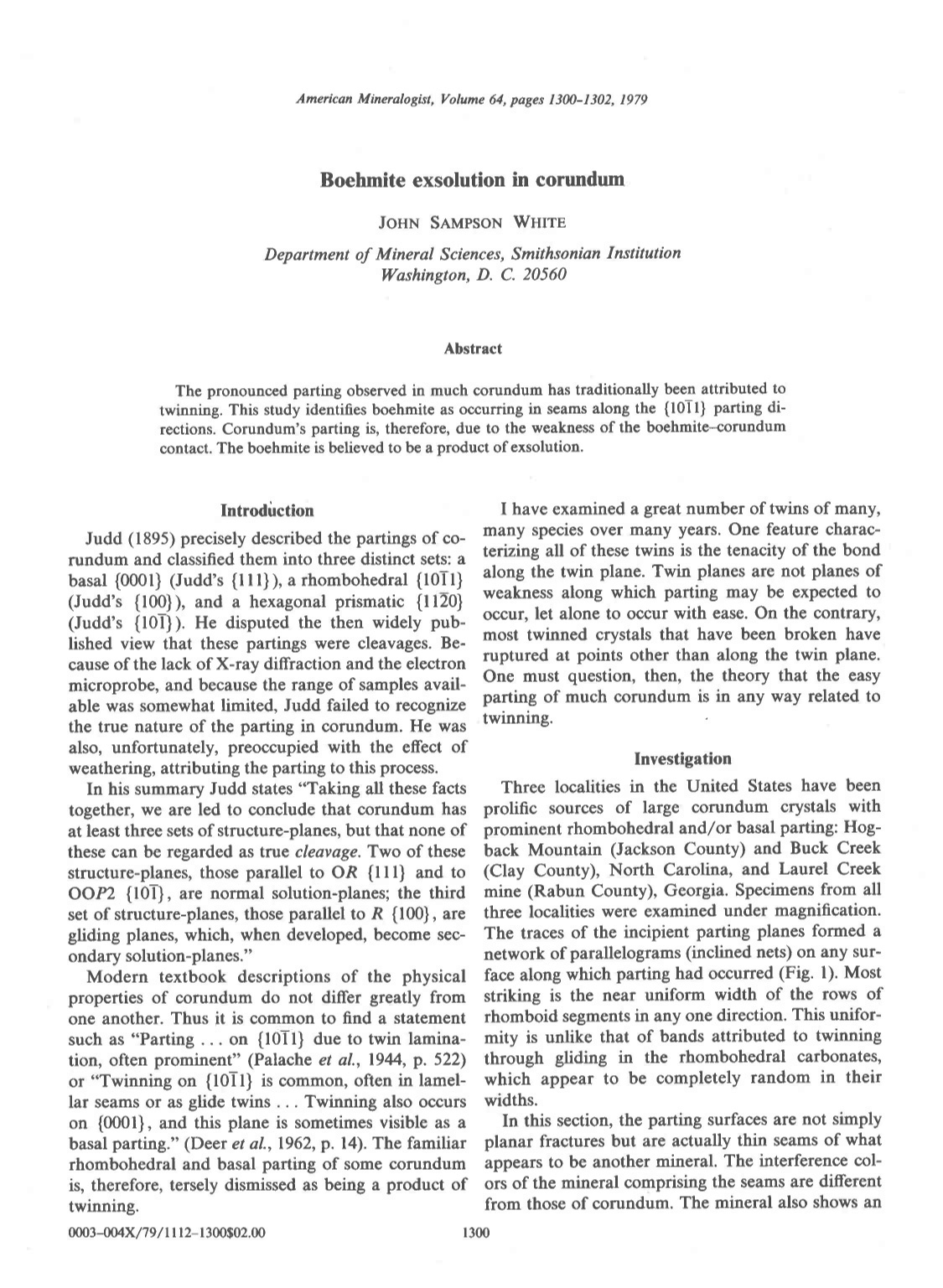
Boehmite exsolution in corundum

Journal Article
White, J.S. (1979) Boehmite exsolution in corundum. American Mineralogist, Vol. 64, Nos. 11–12, pp. 1300–1302.
Record No. 1843  |  RWHL*
The pronouncedparting observedin much corundumhastraditionally beenattributedto twinning. This studyidentiflesboehmiteasoccurringin seamsalongthe {IOTU Partingdi-rections.Corundum'sparting is, therefore,due to the weaknessof the boehmite-corundum contact.The boehmiteis believedto be a product of exsolution.

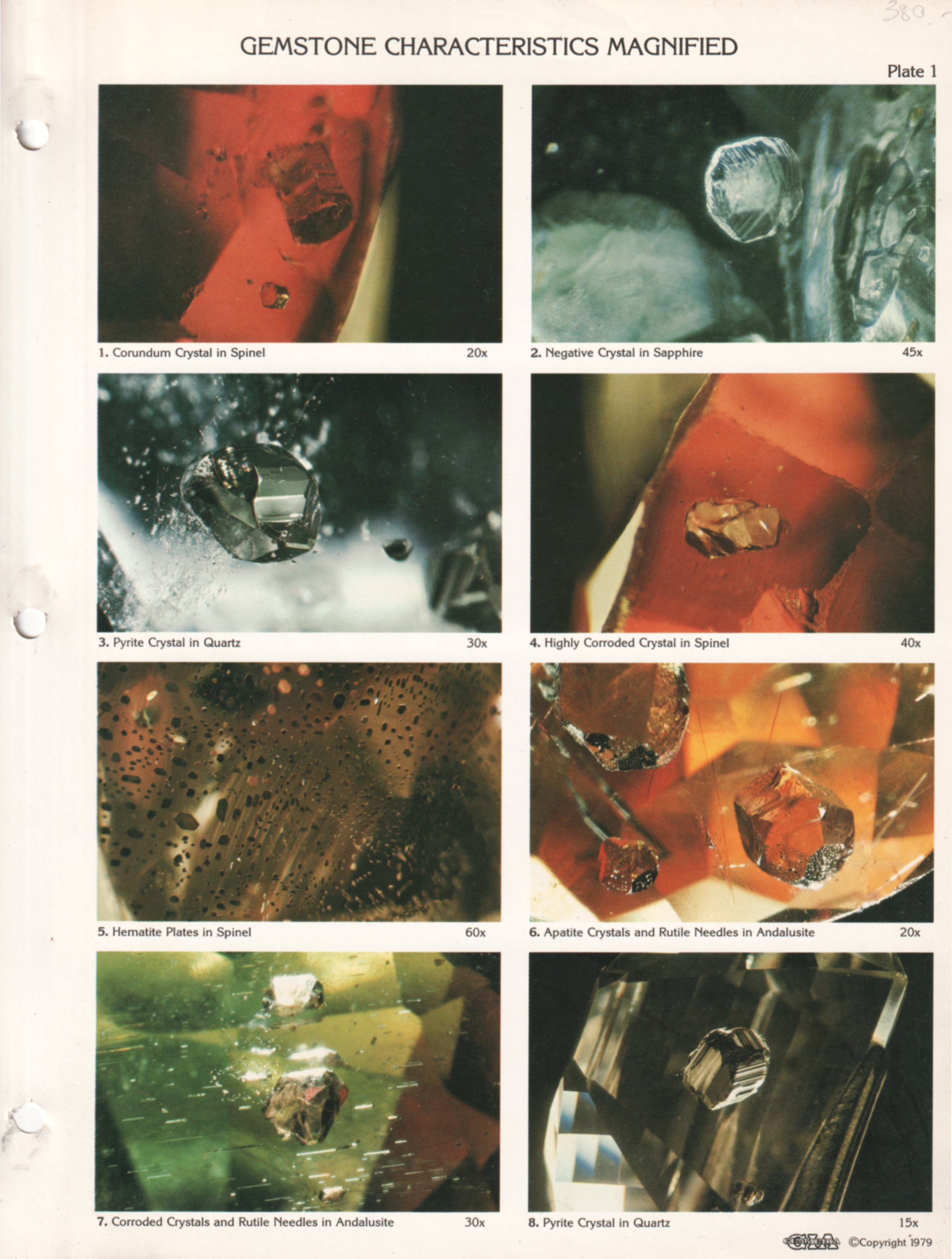
Gemstone Characteristics Magnified

Book
Gemological Institute of America (1979) Gemstone Characteristics Magnified. Los Angeles, CA. (U.S.A), Gemological Institute of America, 16 pp.
Record No. 817  |  Sinkankas/Born No.: NIS/NIB  |  RWHL*
Set of color plates in a folder by John Koivula displaying various inclusions in gemstones. Although his name is not on it, this is the first stand-alone publication of John Koivula’s photomicrographs on gems. Due to the manner in which it was bound, copies are extremely scarce today.

The geology, gemmology, mining methods and economic potential of the Pailin ruby and sapphire gem-field, Khmer Republic
Report
Berrangé, J.P. and Jobbins, E.A. (1976) The geology, gemmology, mining methods and economic potential of the Pailin ruby and sapphire gem-field, Khmer Republic. Institute of Geological Sciences, Overseas Division,
Record No. 4707  |  ISBN/ISSN: Report No. 35, 32 pp. + maps  |  RWHL*
The most detailed report ever prepared on the ruby and sapphire fields at Pailin, Cambodia.

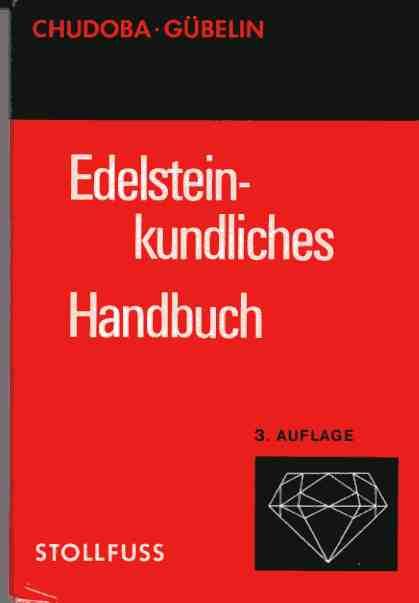
Edelsteinkundlisches Handbuch

Handbook of Gemology
Book
Chudoba, K. and Gübelin, E. (1974) Edelsteinkundlisches Handbuch. [Handbook of Gemology] Bonn, Germany, Wilhelm Stollfuss Verlag, 409 + 32 pp.
Record No. 6084  |  Sinkankas/Born No.: 1348; NIB  |  Language: in German  |  RWHL*
The new edition of this well-known text follows familiar lines. The first 160 pages are occupied by a glossary including cross-references to later sections of the book and details of synonyms, incorrect names and constants. Following this section is an account of the crystal systems and other physical and chemical data. The section on absorption spectra is expanded and improved in this edition with clear diagrams of spectra pertaining to the newer synthetics. As may be expected in a book by these authors, the chapters on inclusions are comprehensive. Although illustrations in the text would have been useful here (and generally throughout the work), there is a booklet of black-and-white photographs of inclusions in a pocket at the end of the book. A chapter on synthetics includes such unlikely candidates as BaF2 and MgF2, the first of which is slightly water-soluble; but there is no mention here or anywhere in the book of gadolinium gallium garnet, now on the market as a cut diamond simulant, nor of Gilson synthetic opal. This section is, however, very well written and comprehensive. A reading of Linde for Gilson on p. 340 is one of the rare misprints. For a book of this size and scope the coloured illustrations are not worthy and the world map of gemstone deposits is too crowded. A more serious criticism is the presence of material in the body of the book which appears neither in the glossary section nor in the short index. However, the usefulness of the work is considerable. Reviewed by Michael O’Donoghue

The Great Book of Jewels

Book
Heiniger, E.A. and Heiniger, J. (1974) The Great Book of Jewels. Lausanne, Edita Lausanne, 316 pp.
Record No. 5067  |  ISBN/ISSN: 821206273  |  Sinkankas/Born No.: 2847  |  RWHL*
Sinkankas: This physically large and elegantly designed book features handsome illustrations and reflects the considerable effort invested by the editors in locating notable gems and jewels—such as the Wittelsbach diamond—in order to produce new photographs. Many of the pieces included had never before been available for photography, and those previously published now appear in superior new images. The book originated from this remarkable photographic assemblage and was expanded with essays that align with its central theme. Of particular gemological interest is Eduard Gübelin’s opening essay, “The Origin of Gemstones” (pp. 15–32), which, though not focused on geological genesis, provides a general survey accompanied by photos of rough and cut gems. Billeter explores the timeless allure of gems in personal adornment, Gregorietti examines ancient precious ornaments, while Higgins and Tait of the British Museum trace the evolution of jewelry styles and forms. Other contributors include Ledit, who discusses sacred jewels as artistic objects; Lightbown, who covers regalia and ceremonial items; Neu, who addresses modern jewelry; and Switzer of the Smithsonian Institution, who describes some of the world’s most famous gems. The volume also includes a summary table detailing gemstone properties, sources, and historical periods of peak use. As expected from a high-quality “coffee-table” book, the illustrations are exceptional, though the generous type size and limited space for contributors mean the essays offer only cursory overviews of their respective subjects.

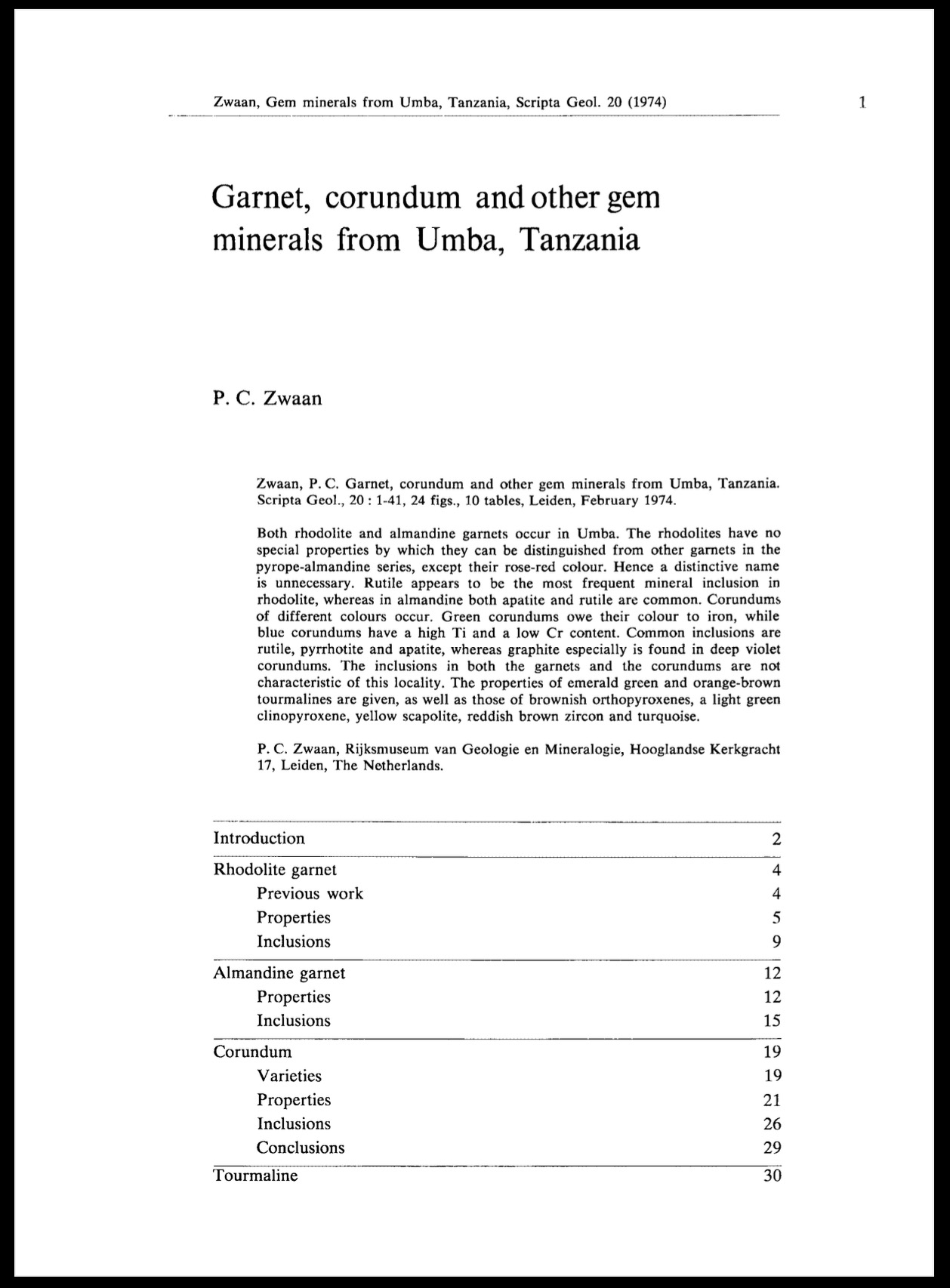
Garnet, corundum, and other gem minerals from Umba, Tanzania
Journal Article
Zwaan, P.C. (1974) Garnet, corundum, and other gem minerals from Umba, Tanzania. Scripta Geologica, Vol. 20, pp. 19–30.
Record No. 1925  |  RWHL*

Internal World of Gemstones

Book
Gübelin, E.J. (1973) Internal World of Gemstones. Zürich, ABC Verlag, 234 pp.
Record No. 894  |  Sinkankas/Born No.: 2582  |  RWHL*
Sinkankas: Lavishly produced and handsome, this work is a successor to the author’s previous book on inclusions (1953), but differs in several notable respects, mainly through its exclusive use of color photographs and through considerable elaboration of the text on the genesis of inclusions. The introduction by Wilhelm Friedrich Eppler provides a brief history of the investigation of inclusions in crystals and describes the ways by which they can be examined and identified, including the use of the electron microprobe. Gübelin explains genetic types of inclusions and the categories to which they are assigned, then passes to descriptions of inclusions typical of diamond, corundum, beryl, feldspar, garnet, peridot, quartz, spinel, topaz, tourmaline, and zircon, with the final section of text describing characteristic inclusions in a number of synthetic materials. The glossary defines technical terms and gives brief descriptions of inclusion species mentioned in the text. The bibliography, unfortunately without pagination, covers the important contributions to the study of inclusions and is not confined to gemstones but considers other minerals as well. The photographs, of superb color quality and sharpness of detail, are expected to provide ready visual reference as the student examines inclusions under the microscope. The lamentable use of cement-backed binding for so important a work is disastrous; leaves already spring loose from the first opening of the book. Regarding the problem of finding illustrations useful to a current project, Karl Zigerli indexed the work so that readers could quickly find crystals of the species and varieties, and the inclusions desired, among the many illustrations; this index appeared in Zeitschrift der Deutschen Gemmologischen Gesellschaft, 25(4), 1976, pp. 222–225. Review: Zeitschrift der Deutschen Gemmologischen Gesellschaft, 25, 1975, pp. 51–52.

[Gem Identification By The Inclusion]

Gem Identification By The Inclusion
Book
Chikayama, A. (1973) [Gem Identification By The Inclusion]. Tokyo, Japan, Gemmological Association of All Japan, 246 pp.
Record No. 506  |  Sinkankas/Born No.: NIS/NIB  |  Language: in Japanese  |  RWHL*
Chikayama presents a practical guide to gemstone identification through the microscopic examination of inclusions. The work illustrates and discusses internal features found in natural gemstones and shows how characteristic mineral inclusions, growth structures, fractures, cavities, zoning, and other internal features can aid identification and separation of gem materials. Particular emphasis is placed on the diagnostic value of inclusions in distinguishing natural stones from synthetic and imitation materials and in recognizing features characteristic of particular gem species. The volume serves as a reference for gemological microscopy and the systematic use of internal characteristics in gemstone identification.

Needles in corundum other than rutile
Journal Article
Eppler, W.F. (1972) Needles in corundum other than rutile. Journal of Gemmology, Vol. 13, No. 2, April, pp. 41–44.
Record No. 3758  |  ISBN/ISSN: 221252  |  RWHL*
Recently, a paper was published describing inclusions of corundum within corundum. The stones in question are light blue sapphires with a tinge of green, or alternatively brownish or purple-colored corundums. They are found in the Umba mine near the Umba River in northeastern Tanzania, close to Mount Kilimanjaro. The inclusions are elongated needles that, at first glance, resemble the well-known rutile needles often seen in corundum. Figure 1 illustrates that the needles follow three directions that appear to be at right angles to one another. Figure 2 reinforces this impression; however, in reality, the angles differ slightly but measurably from 90°. According to the cited publication, these needles run at right angles to the faces (42̅1), (22̅1), and (24̅1), which are steep hexagonal pyramid faces. X-ray analysis revealed that the needles are composed of corundum and occur in “twin positions” relative to the host crystal. Surprisingly, each of these needles is themselves twinned parallel to the prism faces of the surrounding corundum. Furthermore, the needles are of secondary origin, having formed after the host crystal. This, along with the fact that the inclusions induce considerable internal stress, suggests that the needles may have formed due to pressure. However, this theory has not yet been conclusively proven.

Composition of fluid inclusions

Journal Article
Roedder, E. (1972) Composition of fluid inclusions. US Geological Survey Professional Paper, No. 440JJ, 164 pp..
Record No. 1490  |  Sinkankas/Born No.: 5511  |  RWHL*
Fluid inclusions in minerals and rocks preserve for us tiny samples of the fluids that have been present during, and that have in part caused, a number of geological processes, including ore deposition. Although the original material trapped in them was generally a homogeneous fluid at the time of trapping, most inclusions have undergone changes on cooling to surface temperatures, resulting in the formation of new phases such as a gas bubble, immiscible liquids, or daughter minerals. This report is mainly a compilation of the world literature on the methods and results of study of their composition, but it also includes various unpublished data by the author. Sinkankas: Very important paper: “mainly a compilation of the world literature on fluid inclusions, methods and results of study of their composition.” A paper that should be at hand in any gemological laboratory; contains not only a vast fund of information on the nature and composition of inclusions but also illuminating discussions of the history of fluid inclusion research, the ways by which inclusions are trapped, and their subsequent appearances in the crystals, the methods used to examine their contents, etc. The exhaustive references mention studies from Robert Boyle to the present.

New analytical results of the inclusions in Siam rubies
Journal Article
Gübelin, E.J. (1971) New analytical results of the inclusions in Siam rubies. Journal of Gemmology, Vol. 12, No. 7, July, pp. 242–252.
Record No. 892  |  ISBN/ISSN: 221252  |  RWHL*

On the nature of mineral inclusions in gemstones
Journal Article
Gübelin, E.J. (1969) On the nature of mineral inclusions in gemstones. Journal of Gemmology, Vol. 11, No. 5, Jan., pp. 149–192.
Record No. 2097  |  ISBN/ISSN: 221252  |  Sinkankas/Born No.: NIS/NIB  |  RWHL*
Gübelin examines mineral inclusions in gemstones as evidence of the conditions and processes under which their host crystals formed. He discusses the nature, morphology, identification, and genetic significance of included minerals, showing how their crystal forms, orientations, associations, and relationships to other internal features can reveal aspects of a gemstone’s geological history. Numerous examples illustrate characteristic inclusions in important gem materials and demonstrate their usefulness in gem identification and, in favorable cases, determination of origin. Particular emphasis is placed on careful microscopic observation and interpretation of inclusion assemblages, not merely as a means of distinguishing natural stones, but as a method of reconstructing the environment of gemstone formation.

Edelsteine

Gemstones
Book
Gübelin, E.J. (1969) Edelsteine. [Gemstones] Zürich, Silva-Verlag, 144 pp.
Record No. 891  |  Sinkankas/Born No.: 2576; NIB  |  Language: in German  |  RWHL*
Sinkankas: In this pictorial popular work, the author provides a nontechnical description of the major gemstones in a language that stresses the beauty and fascination of gems and deliberately suppresses dry scientific data. Thus the book begins with several chapters extolling the wonders of gemstones, their colors and origins, the special beauty of gems that display color or reflective phenomena, inclusions in such gems as moss agates, and a little on the splendid crystals from which gems are cut and their sources in nature. Other chapters touch on the arts of the lapidary, the diamond, the corundum family, and many other gemstones, ending with a chapter on the Idar-Oberstein agate-cutting and carving industry, and closing with a very brief chapter on the true value of gemstones in their aesthetic appeal. The book includes a glossary in which technical terms are defined and the basic properties of gemstones mentioned elsewhere are summarized. There is no index nor bibliography. The most striking feature is the large number of superb color photographs, ranging from faceted gems, some obviously selected from the finest available for illustration, to cabochons, carvings, natural crystals, views of lapidary work in progress, scenes in famous gem-mining areas, jewelry, and objects of art made from stone. These are of particular value and reflect the author’s wide travels. Not seen. Reviews: Zeitschrift der Deutschen Gemmologischen Gesellschaft, 18(4), 1969, pp. 193–194; Der Aufschluss, 21(12), 1970, p. 384.

Jewelry Through the Ages

Book
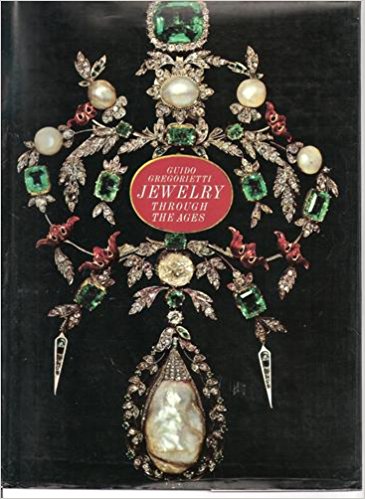
Gregorietti, G. (1969) Jewelry Through the Ages. New York, Crescent Books, 319 pp.
Record No. 845  |  Sinkankas/Born No.: 2518; NIB  |  RWHL*
Sinkankas: A large, lavishly illustrated book on jewelry of all ages but differing from most similar books by the inclusion of far more information on gold and gemstones instead of passing these over in incidental fashion as is too often the case. The gold is treated in the first chapter while colored gemstones are given all of the second chapter, [pp. 87–127], with appropriate illustrations. This chapter provides general remarks on gemstones and then describes those used in Indian, Asiatic, Egyptian, and other ornaments, with a section on pearl. The diamond receives special treatment in the Baroque Period, [pp. 219–221], with specific remarks on coral immediately following. Modern discoveries and uses of diamond are also discussed in a section on 19th-century jewelry, [pp. 269–281], which includes discoveries in South Africa, diamond in America, the trade, cutting, and descriptions of some famous diamonds, again with appropriate illustrations. Lastly, [pp. 308–312], is a table of gemstone properties with sources of rough, and periods in which the gemstones were used in jewelry. It is apparent that the author regards gemstones as of great importance as is evident from the many illustrations in which they are prominent. The bibliography is large but no paginations are supplied. Rev. G & G, 13, 4, 1969–70, 135–136.

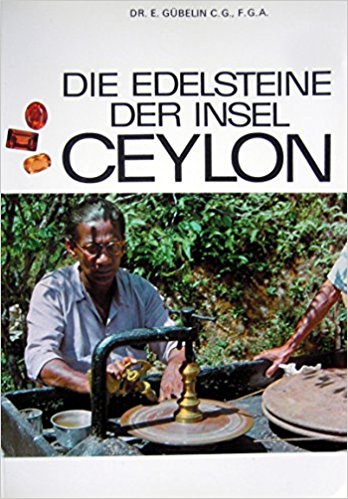
Die Edelsteine der Insel Ceylon

The gemstones of the island of Ceylon
Book
Gübelin, E.J. (1968) Die Edelsteine der Insel Ceylon. [The gemstones of the island of Ceylon] Lucerne, privately published, 152 pp.
Record No. 2094  |  Sinkankas/Born No.: 2575  |  Language: in German  |  RWHL*
Sinkankas: Aside from Iyer & Thiagarajan’s Indian Precious Stones (1961), which see, almost all information on the gemstones and gem industry of Ceylon had appeared in short articles scattered throughout a large variety of journals, both technical and nontechnical. Thus the present authoritative work clearly supersedes all previously published information and is based on the author’s numerous visits to the island. It is filled with splendid photographs, both scenic and pertaining to the industry. The text gives a sketch of the island’s geology as well as details of the alluvial deposits that furnish practically all of the gem material. Historical notes support the thesis that these gem deposits supplied gemstones to much of Asia, Egypt, and Europe from time immemorial. The section treating mining is exceptionally detailed and beautifully illustrated, discussing all the factors that must be taken into consideration before the commencement of mining operations and the traditional rules by which such activity is governed. Equally thorough are descriptions of the unique lapidary work and of the progress of the rough stone from mine to finished gem and ultimate sale. Descriptions of individual gemstones cover qualities, relative rarity, specific sources, properties, and diagnostic inclusions. Properties and absorption-spectra data are summarized in tabular form in the last part of the work. There is also a less detailed section on organic gem materials which furnishes an up-to-date account of the pearl fishery and contains remarks on coral and tortoiseshell. This work apparently was published at the author’s expense, although it is understood that copies were also made available through Rühle-Diebener Verlag, Stuttgart, at DM 38. Reviews: Der Aufschluss, 21(12), 1970, p. 384 (price given as DM 25.74); Journal of Gemmology, 11(6), 1969, p. 220 (price given as 70s); National Geographic, 64(1), 1969, pp. 74–75.

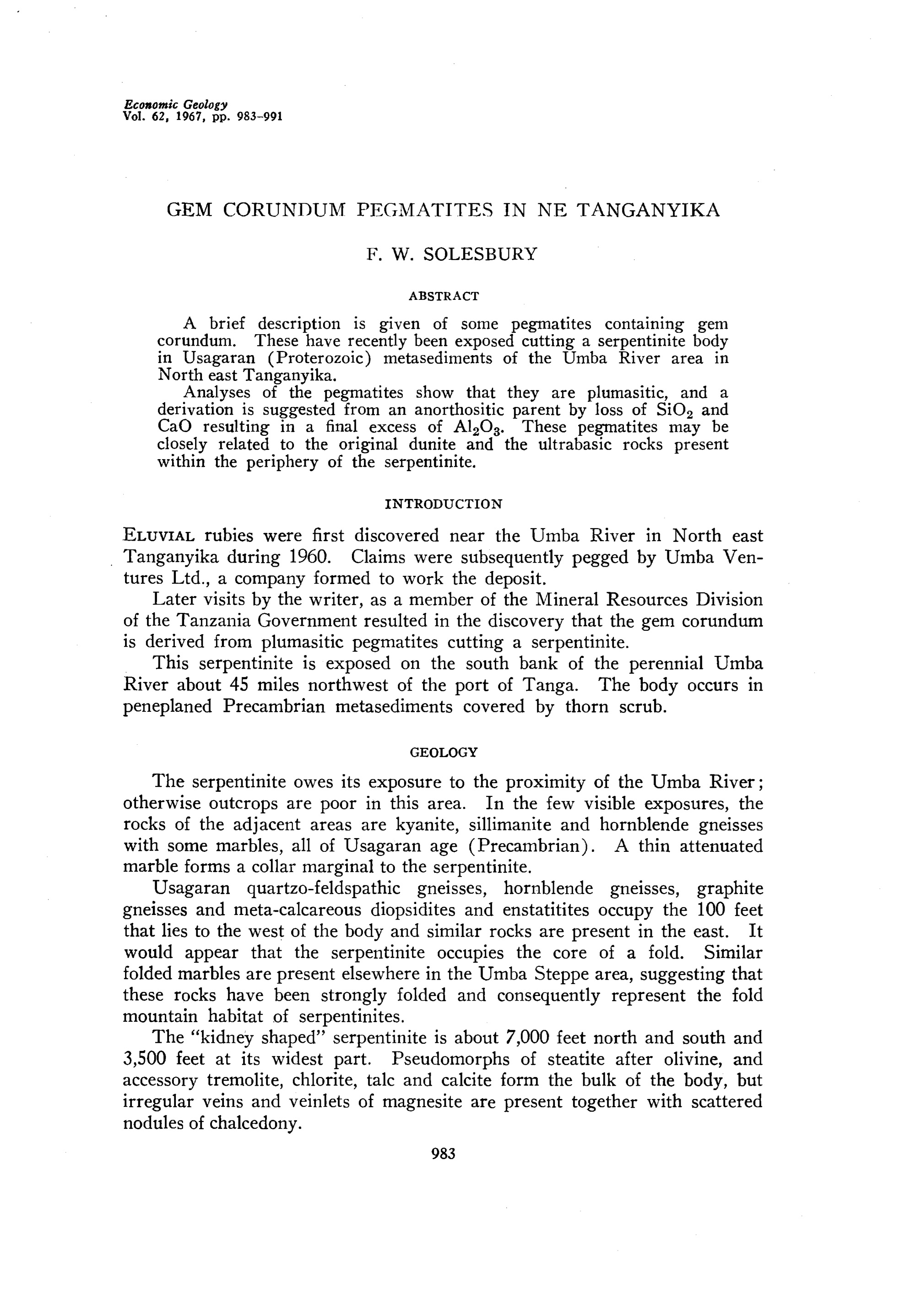
Gem corundum pegmatites in N.E. Tanganyika
Journal Article
Solesbury, F.W. (1967) Gem corundum pegmatites in N.E. Tanganyika. Economic Geology, Vol. 62, pp. 983–991.
Record No. 1623  |  RWHL*
New additional data on petrography and mineralogy of jadeite and associated rocks from the Polar Urals and Prebalkhash region are given. Some questions of the jadeite rock genesis in hyperbasites are also considered. In the Pay-Yer massif, Polar Urals, the jadeite rocks are associated with a gabbro–pyroxenite complex, garnet-bearing gabbro–amphibolite, metamorphic schists, and glaucophane rocks. Jadeitite and albitite form a chain of lens-shaped bodies in hyperbasites and represent metasomatic metagabbro rocks, altered under conditions of high pressure and high soda potential. Secondary processes of diaphthoresis are strongly revealed. In the Kantegir hyperbasite massif, northern Prebalkhash region, jadeitites form drop-like bodies together with numerous inclusions of unaltered granitoids and other metasomatic rocks. Jadeitite and hornblende are the earliest (high-temperature) metasomatic rocks. Chemical, optical, and X-ray data of jadeitite and accessory and other minerals of jadeite rocks are given. The authors conclude that jadeite rocks of the Polar Urals formed at a temperature close to 700 °C and at a general pressure not less than 14,000 bars; the Prebalkhash jadeite, at a temperature close to 600 °C and pressure not less than 12,000 bars. High pressure is caused by stress produced in deep fault zones. The Na₂O potential and partial pressure of H₂O are of great importance, a question discussed in the light of the most recent data. The prevailing type of formation process (mechanism) of jadeite rocks in hyperbasites is bimetasomatosis, which is not always accompanied by desilication. Composition and genesis of original rocks is not of decisive significance. Appropriate model and genetic features of the mentioned deposits are considered in this paper.

The origin of negative crystals in gemstones

Journal Article
Eppler, W.F. (1966) The origin of negative crystals in gemstones. Journal of Gemmology, Vol. 10, No. 2, April, pp. 49–56.
Record No. 3751  |  ISBN/ISSN: 221252  |  RWHL*

Exploring the Literature of Gemstone Inclusions

The literature of gemstone inclusions covers identification, origin determination, treatments, synthesis, mineral inclusions, fluid inclusions and other internal features of natural and synthetic gems.

For a curated selection of important sources, read Inclusions in Gemstones — Hyperion Literature Sources.

About Four Treasures

Four Treasures is Lotus Gemology's freely accessible gemological reference database. Use the full database to search by author, title or keyword and explore literature on gemology, mineralogy, jewelry and related fields. Where available, hyperlinks on titles may lead directly to the full publication.

Search the Complete Four Treasures Database