Gemstone Inclusions Bibliography

Gemstone Inclusions Bibliography

Explore books, articles and historical sources on inclusions in gemstones in Four Treasures, the Lotus Gemology reference database. This bibliography brings together matching records from the collection, with publication details, abstracts and cover images where available.

Gemstone Inclusion References

The list below matches the terms inclusion or inclusions in the database's searchable fields. Some references discuss inclusions as part of a broader subject.
361–380 of 1,121 matching references

Studies on inclusions in some Indian gemstones
Journal Article
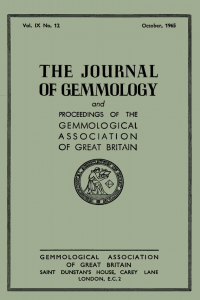
Phukan, S. (1966) Studies on inclusions in some Indian gemstones. Journal of Gemmology, Vol. 10, No. 1, January, pp. 1–7.
Record No. 1422  |  ISBN/ISSN: 221252  |  RWHL*

Apatite crystals in a Ceylon spinel

Journal Article
Zwaan, J.C. (1965) Apatite crystals in a Ceylon spinel. Journal of Gemmology, Vol. 9, No. 12, p. 434.
Record No. 4140  |  ISBN/ISSN: 221252  |  RWHL*

The ruby mines in Mogok in Burma

Journal Article
Gübelin, E.J. (1965) The ruby mines in Mogok in Burma. Journal of Gemmology, Vol. 9, No. 12, October, pp. 411–425.
Record No. 2086  |  ISBN/ISSN: 221252  |  Sinkankas/Born No.: 2573  |  RWHL*

Properties and growth of flux ruby

Journal Article
Linares, R.C. (1965) Properties and growth of flux ruby. Journal of the Physics and Chemistry of Solids, Vol. 26, No. 12, pp. 1817–1820.
Record No. 1191  |  RWHL*
The growth of ruby from molten fluxes has been studied with emphasis on the resulting spectral and optical properties. Growth was accomplished by the usual process of self nucleation as well as by deliberate seeding. The formation of a plate and rhombohedral form of ruby was studied and found to depend on local thermal conditions. The spectral properties of the grown rubies have been correlated with the incorporation of fluorine and noble metal ions into the ruby. Dislocation measurements show large dislocation free areas in slowly grown rubies. The types of inclusions have been studied and are found to be primarily flux and in special cases precipitated noble metal.

Ancient fluids in crystals

Journal Article
Roedder, E. (1962) Ancient fluids in crystals. Scientific American, Vol. 207, pp. 38–47.
Record No. 1489  |  Sinkankas/Born No.: 5510; NIB  |  RWHL*
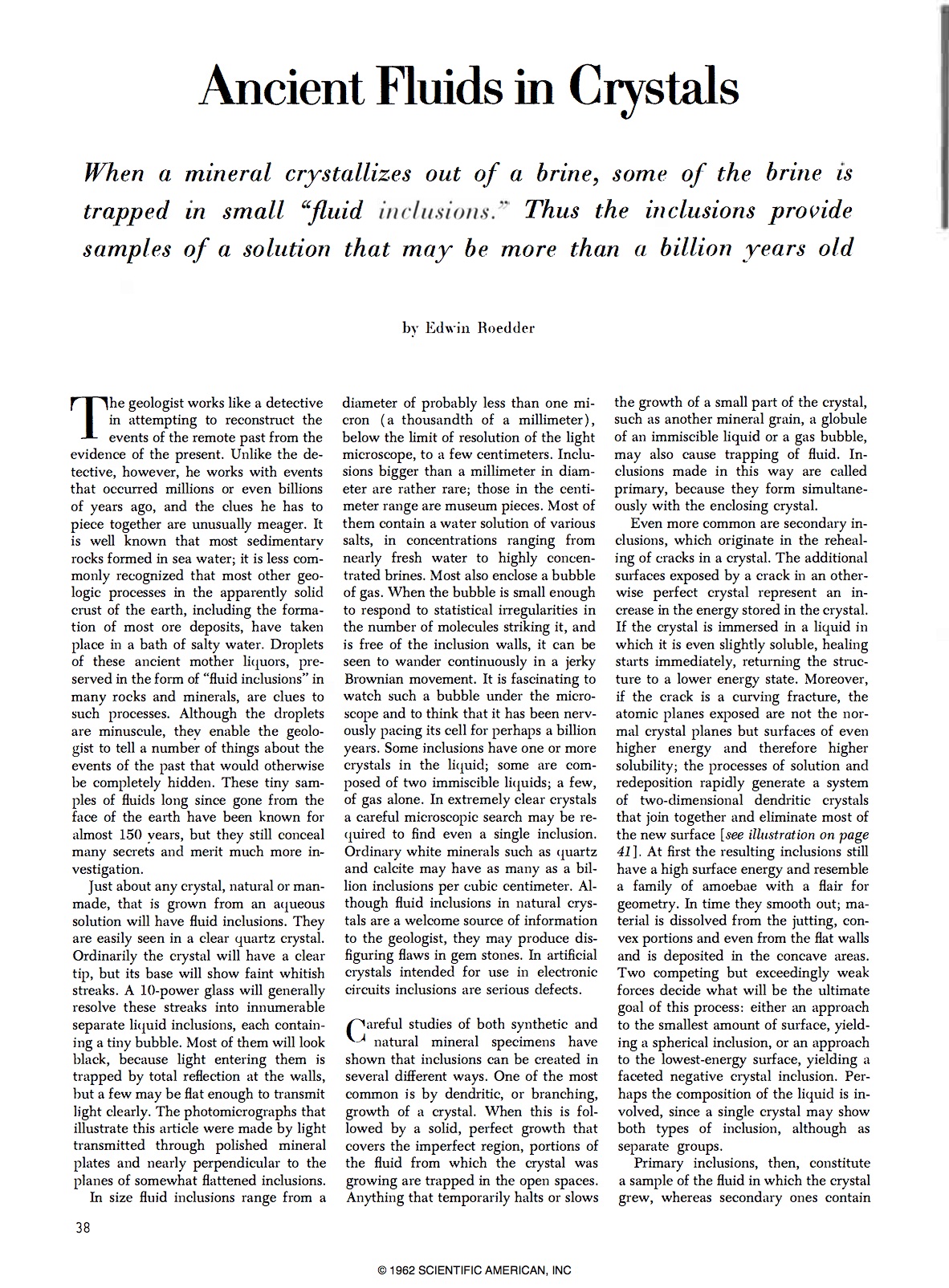
The geologist works like a detective in attempting to reconstruct the events of the remote past from the evidence of the present. Unlike the de­ tective, however, he works with events that occurred millions or even billions of years ago, and the clues he has to piece together are unusually meager. It is well known that most sedimentary rocks formed in sea water; it is less com­ monly recognized that most other geo­ logic processes in the apparently solid crust of the earth, including the forma­ tion of most ore deposits, have taken place in a bath of salty water. Droplets of these ancient mother liquors, pre­ served in the form of fluid inclusions" in many rocks and minerals, are clues to such processes. Although the droplets are minuscule, they enable the geolo­ gist to tell a number of things about the events of the past that would otherwise be completely hidden. These tiny sam­ ples of uids long since gone from the face of the earth have been known for almost 150 years, but they still conceal many secrets and merit much more in­ vestigation. Just about any crystal, natural or man­ made, that is grown from an aqueous solution will have uid inclusions. They are easily seen in a clear quartz crystal. Ordinarily the crystal will have a clear tip, but its base will show faint whitish streaks. A 10-power glass will generally resolve these streaks into innumerable separate liquid inclusions, each contain­ ing a tiny bubble. Most of them will look black, because light entering them is trapped by total re ection at the walls, hut a few may be at enough to transmit light clearly. The photomicrographs that illustrate this article were made by light transmitted through polished mineral plates and nearly perpendicular to the planes of somewhat attened inclusions. In size uid inclusions range from a diameter of probably less than one mi­ cron (a thousandth of a millimeter), below the limit of resolution of the light microscope, to a few centimeters. Inclu­ sions bigger than a millimeter in diam­ eter are rather rare; those in the centi­ meter range are museum pieces. Most of them contain a water solution of various salts, in concentrations ranging from nearly fresh water to highly concen­ h'ated brines. Most also enclose a bubble of gas. When the bubble is small enough to respond to statistical irregularities in the number of molecules striking it, and is free of the inclusion walls, it can be seen to wander continuously in a jerky Brownian movement. It is fascinating to watch such a bubble under the micro­ scope and to think that it has been nerv­ ously pacing its cell for perhaps a billion years. Some inclusions have one or more crystals in the liquid; some are com­ posed of two immiscible liquids; a few, of gas alone. In extremely clear crystals a careful microscopic search may be re­ quired to nd even a single inclusion. Ordinary white minerals such as quartz and calcite may have as many as a bil­ lion inclusions per cubic centimeter. Al­ though uid inclusions in natural crys­ tals are a welcome source of information to the geologist, they may produce dis­ guring aws in gem stones. In arti cial crystals intended for use in electronic circuits inclusions are serious defects."

Jadeite deposits of the Clear Creek Area, New Idria District, San Benito County, California
Journal Article
Coleman, R.G. (1961) Jadeite deposits of the Clear Creek Area, New Idria District, San Benito County, California. Journal of Petrology, Vol. 2, No. 2, pp. 209–247.
Record No. 4472  |  Sinkankas/Born No.: 1410  |  RWHL*
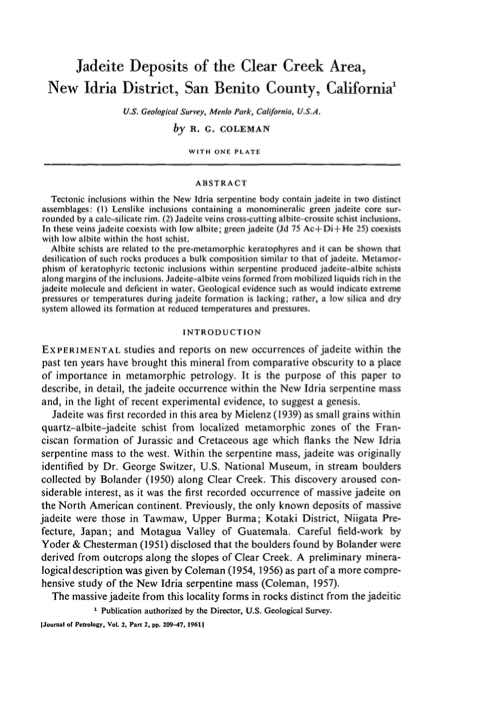
Tectonic inclusions within the New Idria serpentine body contain jadeite in two distinct assemblages: lenslike inclusions with a monomineralic green jadeite core encased by a calc-silicate rim, and jadeite veins cross-cutting albite-crossite schist inclusions. In these veins, jadeite coexists with low albite; green jadeite (Jd 75 Ac+Di+He 25) also coexists with low albite in the host schist. The albite schists are related to pre-metamorphic keratophyres, and desilication of such rocks results in a bulk composition similar to jadeite. Metamorphism of keratophyric tectonic inclusions within the serpentine produced jadeite-albite schists along the inclusion margins, while jadeite-albite veins formed from mobilized, jadeite-rich, water-deficient fluids. Geological indicators of extreme pressure or temperature during jadeite formation are absent, suggesting instead that its formation occurred under reduced temperature and pressure in a low-silica, dry system.

The origin of healing fissures in gemstones
Journal Article
Eppler, W.F. (1959) The origin of healing fissures in gemstones. Journal of Gemmology, Vol. 7, No. 2, April,
Record No. 3750  |  ISBN/ISSN: 221252  |  RWHL*
HEALING fissures as inclusions in gemstones are well known Hand have often been described. In spite of this, the question of their origin has not yet been answered. A most valuable hint can be found in papers published by American authors about liquid inclusions in some minerals of the pegmatite series. Here, the aim of numerous investigations was to find out whether or not the liquid inclusions could be used as a geologic thermometer." In this sense researches have been made to prove whether those particular inclusions could supply the desired information about the temperature at which the minerals of the pegmatites, and consequently the pegmatites of certain localities itself, have been formed."

Chinese Art

Book
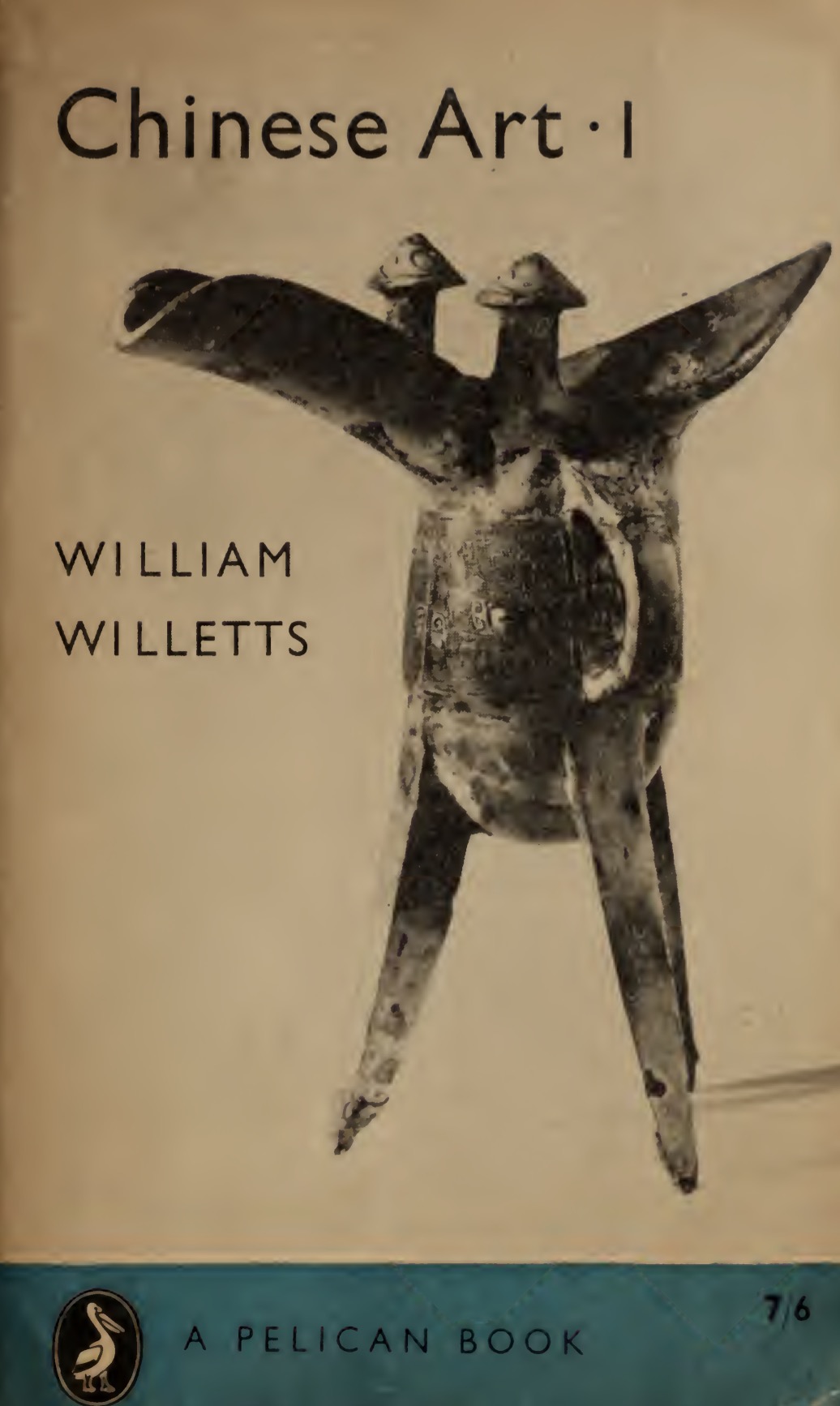
Willetts, W. (1958) Chinese Art. New York, Penguin, 2 Vols., 802 pp.
Record No. 28810  |  Sinkankas/Born No.: 7214  |  RWHL*
Sinkankas: An esteemed near-encyclopedic work covering all of Chinese art and much larger in content than its physical size suggests due to the use of small type. In addition to the usual discussions of history, stylistic features, artistic merits, cultural significances, etc., the work is remarkable for its inclusion of much technical information on all the arts, with discussions of the nature, provenance, and preparation of the materials employed in the manufacture of the various specimens. The first chapter is general and discusses the geography of China and early civilizations, followed by chapters on jades, and others on bronzes, lacquer and silks, sculpture, ceramics, painting and calligraphy, and architecture. The chapter on jade, p. 53–107, is excellent and frequently cited in later works on jade. The development of jade carving is traced from the Neolithic period into the present, and covers the nature and sources of jades, their lapidary treatment, employment of symbolism, special types of carvings and their meanings, ritual jades, and purely decorative pieces of carved jade.

Notes on asterism in spinel and chatoyancy in chrysoberyl, quartz, tourmaline, zircon and scapolite
Journal Article
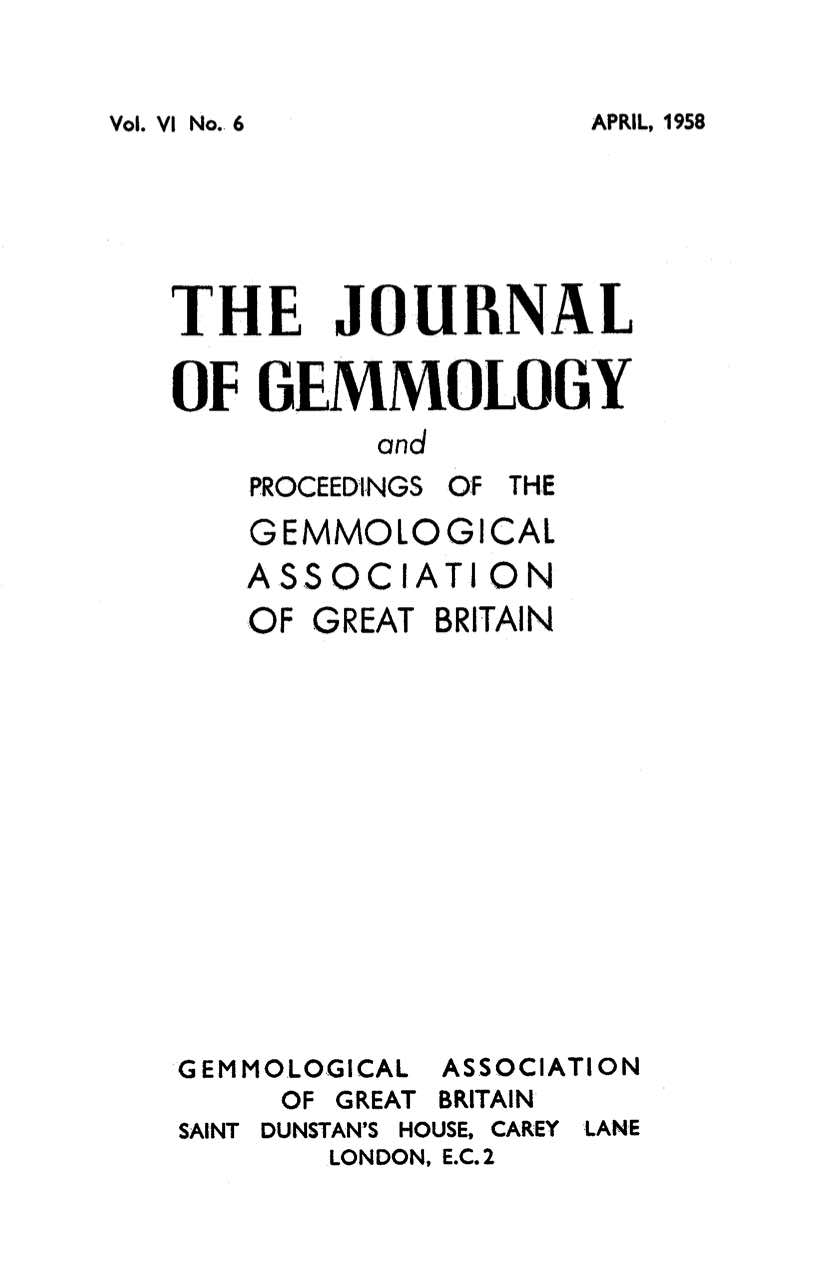
Eppler, W.F. (1958) Notes on asterism in spinel and chatoyancy in chrysoberyl, quartz, tourmaline, zircon and scapolite. Journal of Gemmology, Vol. 6, No. 6, April, pp. 251–263.
Record No. 4210  |  ISBN/ISSN: 221252  |  RWHL*

A contribution to the genealogy of inclusions
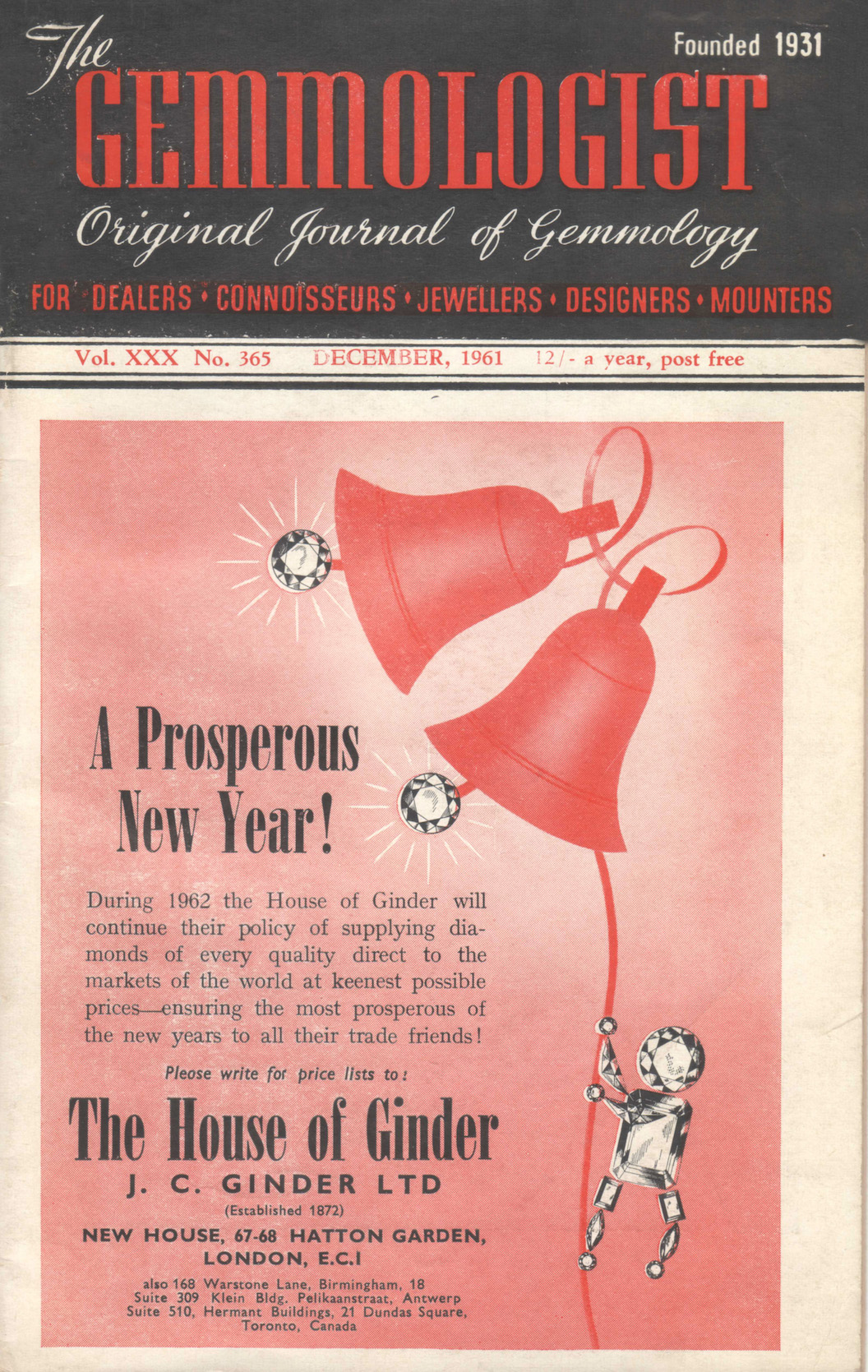
Journal Article
Gübelin, E.J. (1957) A contribution to the genealogy of inclusions. Journal of Gemmology, Vol. 6, No. 1, January, pp. 1–47.
Record No. 2049  |  ISBN/ISSN: 221252  |  Sinkankas/Born No.: 2565  |  RWHL*

Sapphires in India and Kashmir

Journal Article
Brown, J.C. (1956) Sapphires in India and Kashmir. The Gemmologist, Vol. 25, No. 298, pp. 78–80; No. 299, 97–100; No. 300, 129–132.
Record No. 524  |  RWHL*

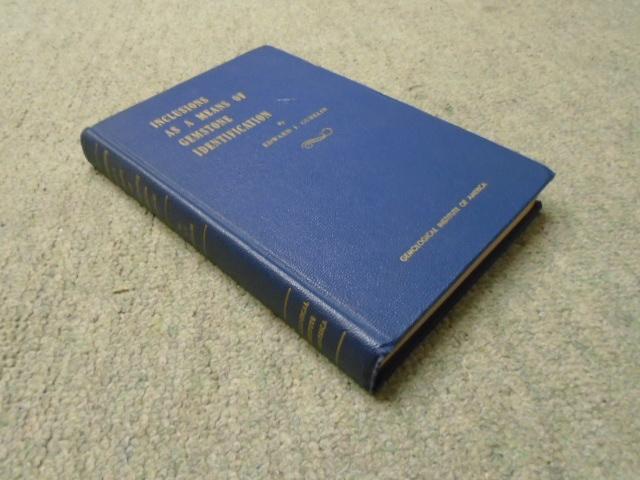
Inclusions as a Means of Gemstone Identification
Book
Gübelin, E.J. (1953) Inclusions as a Means of Gemstone Identification. Los Angeles, GIA, 220 pp.
Record No. 6416  |  Sinkankas/Born No.: 2562  |  RWHL*
Sinkankas: Unique among gemological monographs because of its very large number of inclusion photographs, taken by the author and clearly explained in the accompanying text. Preliminary chapters discuss inclusions in general, their types, formational causes, typical forms or accumulations, and inclusions in synthetic gem materials, glasses, and assembled stones. The work treats diamond, corundums, tourmalines, beryls, garnets, topaz, spinels, quartzes, peridot, moonstone, andalusite, kyanite, zircon, and fluorite. The color frontispiece shows inclusions in natural sapphire and ruby. A greatly enlarged color-plate version of this work, entitled Innenwelt der Edelsteine (1973), which see, provides essentially the same information, augmented with new material, but the present work continues in demand because it is more readily understood in some respects and more easily referred to. It is now rare. Review: Webster, The Gemmologist, 22, 1953, pp. 53–54, “cannot be overlooked … for the subject dealt with may be found in no other book studied in such great detail and from … a writer who has studied the subject so fully.” See also his comments in Journal of Gemmology, 4(2), 1953, pp. 78–80.

The diagnostic importance of inclusions in gemstones
Journal Article
Gübelin, E.J. (1950) The diagnostic importance of inclusions in gemstones. Journal of Gemmology, Vol. 2, No. 7, July, pp. 281–303.
Record No. 2037  |  ISBN/ISSN: 221252  |  RWHL*

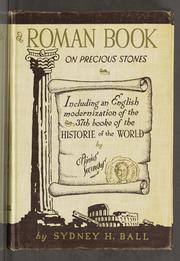
A Roman Book on Precious Stones

Book
Ball, S.H. (1950) A Roman Book on Precious Stones. Los Angeles, Gemological Institute of America, 338 pp.
Record No. 413  |  Sinkankas/Born No.: 333; NIB  |  RWHL*
Sinkankas: Adapted from the English translation of Philemon Holland, 1601. Published posthumously from materials assembled and edited by Kay Swindler of the Gemological Institute staff, but her services are not mentioned. Ball states (pref.): “Rightly or wrongly, I have for some years felt that the outstanding classical book on precious stones, the 37th book of Pliny’s Natural History, has never been edited by one well versed in the lore of precious stones.” With this goal in view, Ball provides an excellent study of Pliny’s book on gemstones, basing it on Philemon Holland’s London translation of 1601. D. E. Eichholz, in his translation of the same chapter (Loeb Classical Library, which see), comments that Ball’s work “contains a translation… with introductory chapters and a commentary, but the commentary is affected by the translation, which is merely a modernization of Philemon Holland’s version.” This statement may lend the impression that Ball’s book is trivial, and while there may be some merit in Eichholz’s remark, the fact remains that Ball’s translation and commentary, plus his introductory material, contain so much valuable information that one can look in vain elsewhere to find an equivalent fund of Plinian gemological knowledge. Furthermore, unlike Eichholz, Ball’s vast experience makes his comments and even his speculations perhaps more worthy of serious attention. The book is divided into three sections, with 15 chapters, the translation, and the commentary. In the introduction are treated such topics as Pliny himself, the authorities cited by him, his expertise in mineralogy and gemology, contemporary Roman jewelry, jewelers and lapidaries, sources of gemstones (with table), a historical summary of ancient commerce in gemstones, values and rankings of gemstones in Pliny’s day, gem mining, falsifications, and, importantly, attempts to correlate gemstones mentioned by Pliny with modern species and varieties (also with tables). The second part is the translation, specially decorated and printed upon tan paper. The third part, by far the most extensive, is the commentary and contains a wealth of ancillary information as well as discussions of etymological problems and obscure passages. While nearly all of the book is based on Pliny’s 37th book, Ball also adds Holland’s translation of the chapters of the 36th book wherein are treated gagates (jet) and obsidianus (obsidian). Rev. R. Webster, The Gemmologist, vol. 19, 1950, p. 211–12: “a volume built upon much painstaking research and the correlated information of years of work by one who understood gemstones;” also The Gemmologist, 2, 7, 1950, p. 317–19; P. Jordan Smith, Gems & Gemology, 6, 9, p. 323.

Gemstone inclusions

Journal Article
Gübelin, E.J. (1948) Gemstone inclusions. Journal of Gemmology, Vol. 1, No. 7, July, pp. 7–39.
Record No. 2032  |  ISBN/ISSN: 221252  |  RWHL*

Studies of precious stones in Siam

Journal Article
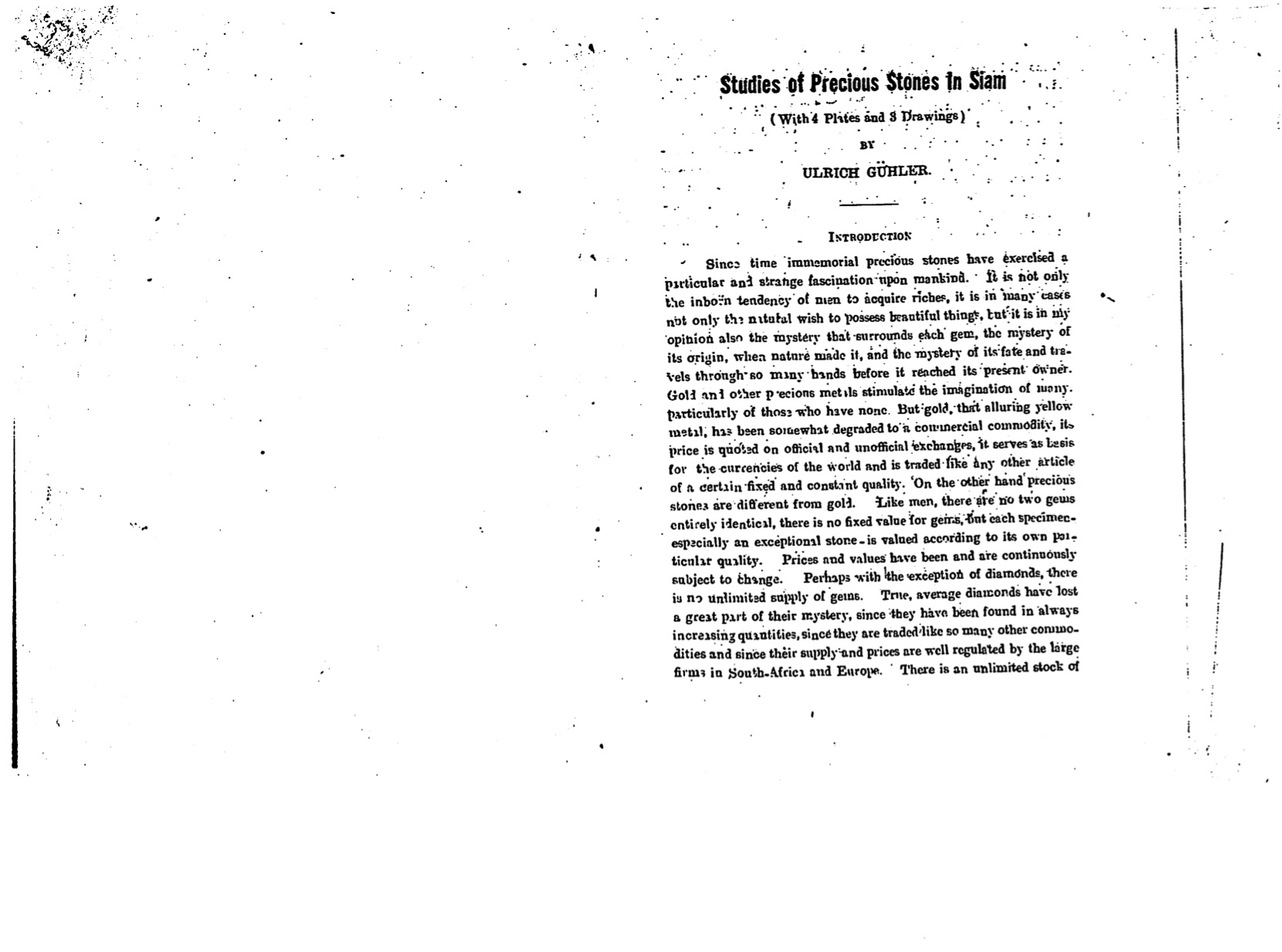
Gühler, U. (1947) Studies of precious stones in Siam. Siam Science Bulletin, Vol. 4, pp. 1–39.
Record No. 908  |  RWHL*

Differences between Burma and Siam rubies
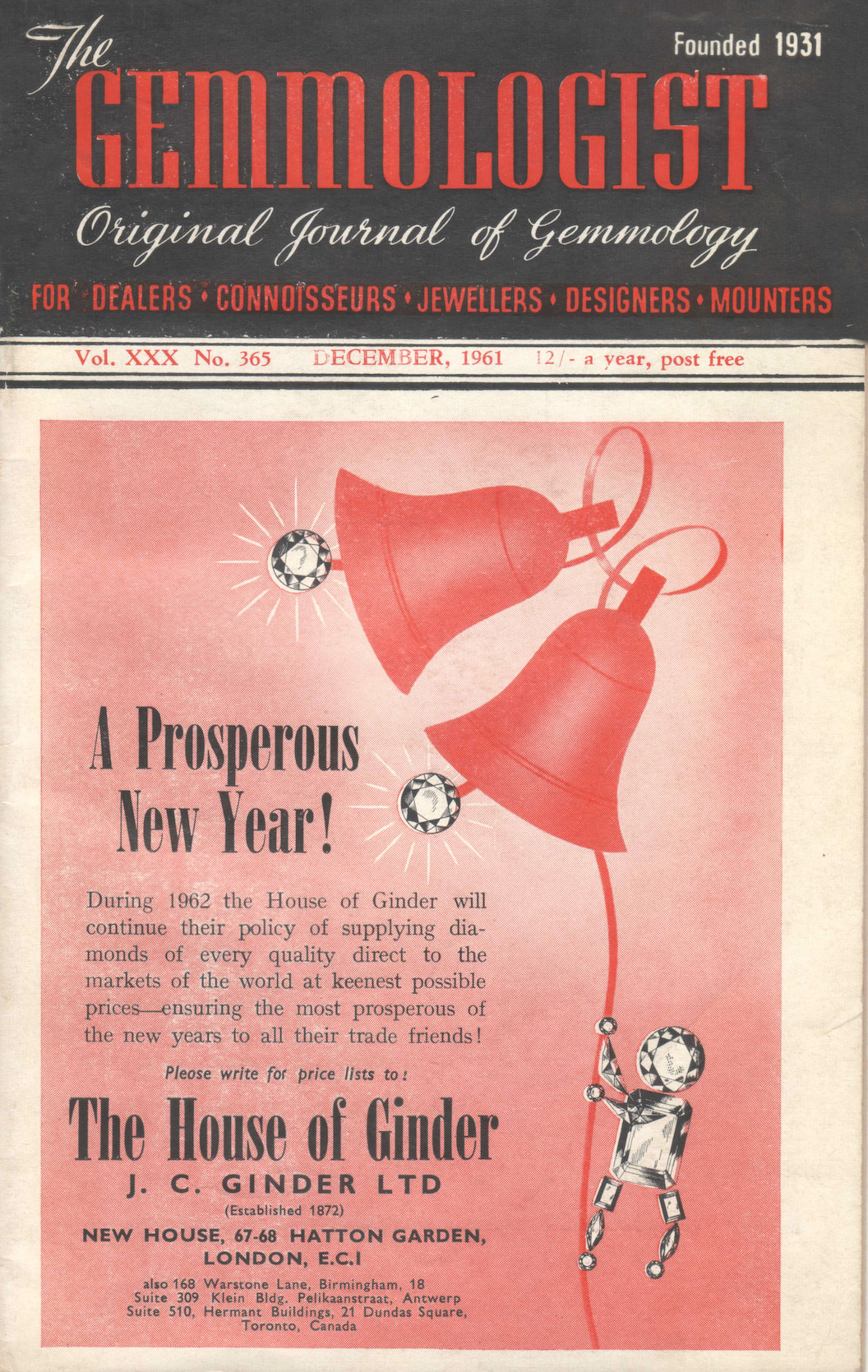
Journal Article
Gübelin, E.J. (1940) Differences between Burma and Siam rubies. Gems & Gemology, Vol. 3, No. 5, Spring, pp. 69–72.
Record No. 3182  |  ISBN/ISSN: 0016626X  |  RWHL*

Kashmir sapphires

Journal Article
Halford-Watkins, J.F. (1935) Kashmir sapphires. The Gemmologist, Vol. 4, No. 42, January, pp. 167–172.
Record No. 918  |  RWHL*

The Book of Amber

Book
Williamson, G.C. (1932) The Book of Amber. London, Ernest Benn Limited, 268 pp.
Record No. 4310  |  Sinkankas/Born No.: 7247  |  RWHL*
An exceptionally comprehensive and learned survey of all phases of the knowledge of amber as then known, and holding its place as the preeminent work on the subject in the English language until the recent appearance of P Rice's Amber: The Golden Gem of the Ages, 1980, which see. Rice's work contains much new information but does not entirely supersede Williamson's highly interesting monograph. The first chapters treat amber in general, discuss classical allusions, nomenclatural problems, the amber routes of antiquity, and the place of amber in anthropology and archeology. Amber is next considered as a substance with remarks on the geology of deposits, and the many inclusions of plant and animal life that have been found in it. Rather strangely, the flow of information on the natural history is here interrupted by a chapter on amber in art, after which the text returns to discussion of the famous amber deposits of the Baltic region, also those in England, and then again, rather jarringly, amber is discussed as a medicinal material and uses in amulets, or other lorical applications. However, from this point, the text treats amber in Sicily, Romania, and Burma, remarks on the similar-sounding ambergris, describes other fossil resins, the making of amber varnish, and amberoid or pressed amber. The bibliography is very extensive, possibly the largest to be assembled up to that time, but the entries lack paginations, and some lack the names of journals from which taken, and others are trivial. Rev K Andree, Bernstein-Forschungen, 3, 1933, 212. Copies are scarce and still much in demand. There is a reprint of same date in sepia-brown cloth, the gold spine Jett usually tarnished to copper.

Die künstlichen Edelsteine

The Artificial Gemstones
Book
Michel, H. (1926) Die künstlichen Edelsteine. [The Artificial Gemstones] Leipzig, Verlag von Wilhelm Diebener, 477 pp.
Record No. 1264  |  Sinkankas/Born No.: 4449; NIB  |  Language: in German  |  RWHL*
Sinkankas: Expanded, re-worked edition bearing little resemblance to its predecessor in respect to quantity of information and illustrations. New matter: formation of minerals in nature, more information on synthesis methods, new synthetic varieties, enlarged discussion of falsifications, imitations, and general problem of detection. In this connection, Ch. 3, on discrimination, now has become virtually a treatise on the principles and practice of gemological identification; it provides one of the earliest useful routines for the gemologist to follow, explaining the methods and their value, tests, gives examples of real identifications, a review of useful apparatus & accessories, and tables for identification purposes. The final chapter on pearls is much expanded also. Rev. W.F. Foshag, Amer. Min., 12, 6, 1927, 263.

Exploring the Literature of Gemstone Inclusions

The literature of gemstone inclusions covers identification, origin determination, treatments, synthesis, mineral inclusions, fluid inclusions and other internal features of natural and synthetic gems.

For a curated selection of important sources, read Inclusions in Gemstones — Hyperion Literature Sources.

About Four Treasures

Four Treasures is Lotus Gemology's freely accessible gemological reference database. Use the full database to search by author, title or keyword and explore literature on gemology, mineralogy, jewelry and related fields. Where available, hyperlinks on titles may lead directly to the full publication.

Search the Complete Four Treasures Database