Gemstone Inclusions Bibliography

Gemstone Inclusions Bibliography

Explore books, articles and historical sources on inclusions in gemstones in Four Treasures, the Lotus Gemology reference database. This bibliography brings together matching records from the collection, with publication details, abstracts and cover images where available.

Gemstone Inclusion References

The list below matches the terms inclusion or inclusions in the database's searchable fields. Some references discuss inclusions as part of a broader subject.
1,041–1,060 of 1,123 matching references

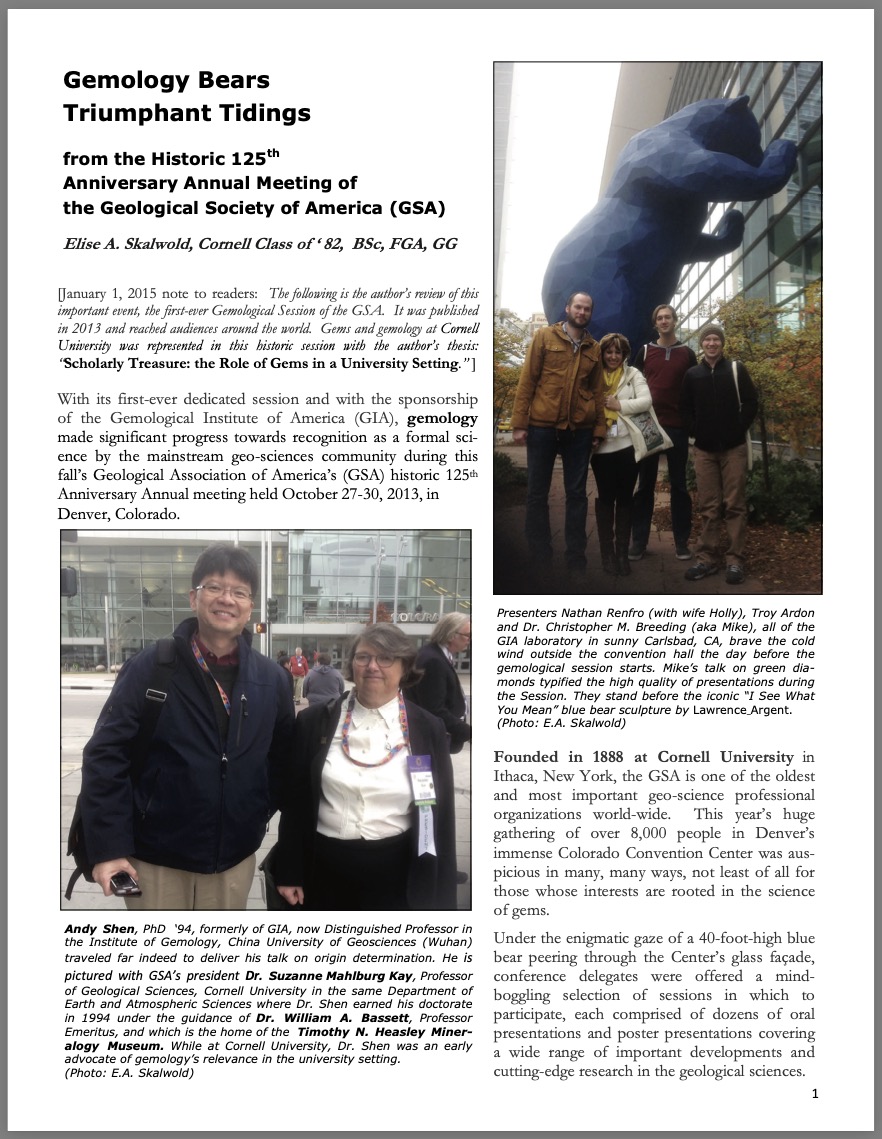
Gemology bears triumphant tidings. A review of the historic 125th Anniversary Annual Meeting of the Geological Society of America (GSA)
Conference Paper
Skalwold, E.A. (2013) Gemology bears triumphant tidings. A review of the historic 125th Anniversary Annual Meeting of the Geological Society of America (GSA). Denver, CO: Geological Society of America,
Record No. 4453
With its first-ever dedicated session and with the sponsorship of the Gemological Institute of America (GIA), gemology made significant progress towards recognition as a formal sci- ence by the mainstream geo-sciences community during this fall’s Geological Association of America’s (GSA) historic 125th Anniversary Annual meeting held October 27-30, 2013, in Denver, Colorado.

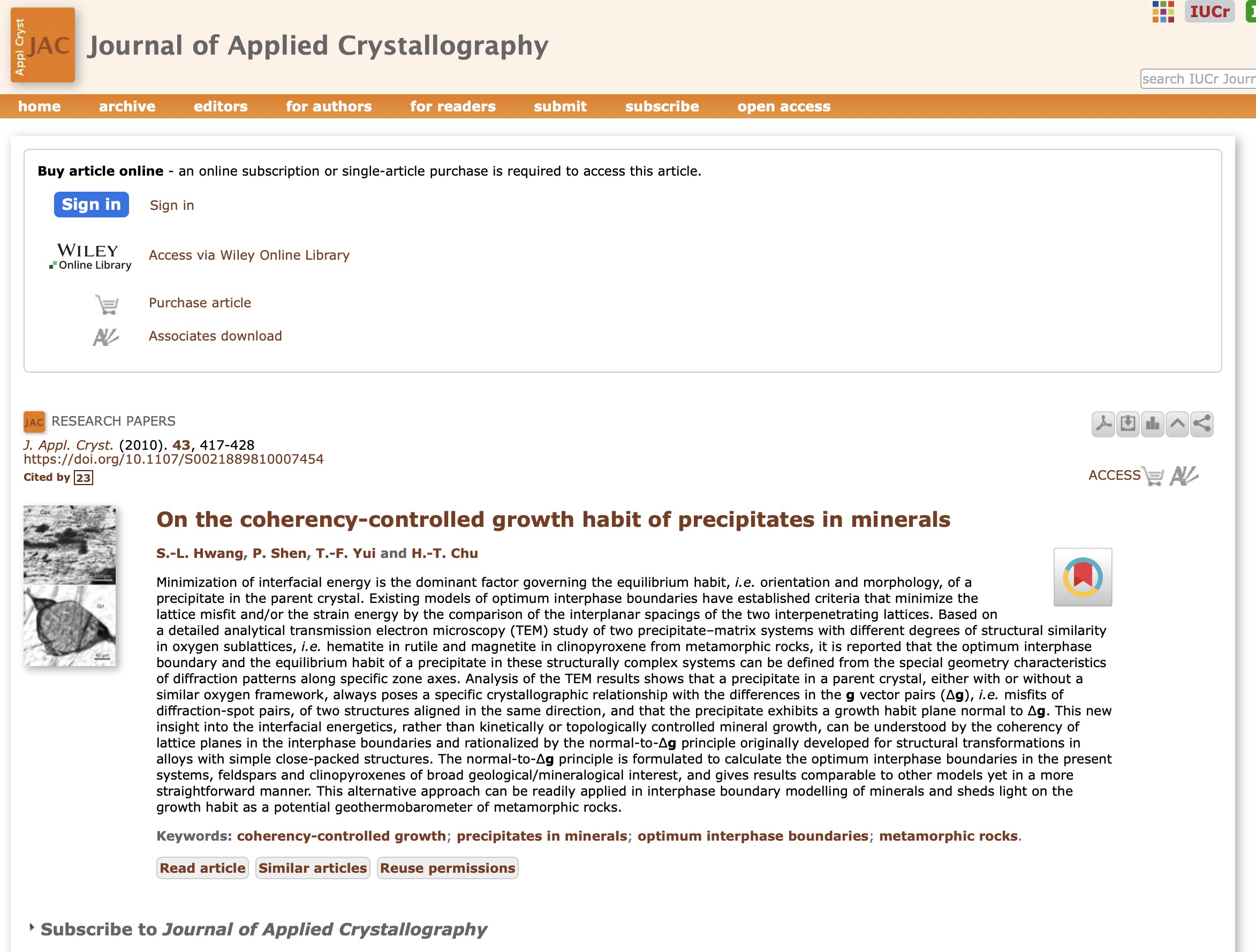
On the coherency-controlled growth habit of precipitates in minerals
Journal Article
Hwang, S.-L., Shen, P., Yui, T.-F. and Chu, H.-T. (2010) On the coherency-controlled growth habit of precipitates in minerals. Journal of Applied Crystallography, Vol. 43, No. 3, pp. 417–428.
Record No. 28241  |  ISBN/ISSN: 0021-8898  |  DOI: https://doi.org/10.1107/S0021889810007454  |  Sinkankas/Born No.: NIS/NIB  |  not seen
Minimization of interfacial energy is the dominant factor governing the equilibrium habit, i.e. orientation and morphology, of a precipitate in the parent crystal. Existing models of optimum interphase boundaries have established criteria that minimize the lattice misfit and/or the strain energy by the comparison of the interplanar spacings of the two interpenetrating lattices. Based on a detailed analytical transmission electron microscopy (TEM) study of two precipitate-matrix systems with different degrees of structural similarity in oxygen sublattices, i.e. hematite in rutile and magnetite in clinopyroxene from metamorphic rocks, it is reported that the optimum interphase boundary and the equilibrium habit of a precipitate in these structurally complex systems can be defined from the special geometry characteristics of diffraction patterns along specific zone axes. Analysis of the TEM results shows that a precipitate in a parent crystal, either with or without a similar oxygen framework, always poses a specific crystallographic relationship with the differences in the g vector pairs ([Delta]g), i.e. misfits of diffraction-spot pairs, of two structures aligned in the same direction, and that the precipitate exhibits a growth habit plane normal to [Delta]g. This new insight into the interfacial energetics, rather than kinetically or topologically controlled mineral growth, can be understood by the coherency of lattice planes in the interphase boundaries and rationalized by the normal-to-[Delta]g principle originally developed for structural transformations in alloys with simple close-packed structures. The normal-to-[Delta]g principle is formulated to calculate the optimum interphase boundaries in the present systems, feldspars and clinopyroxenes of broad geological/mineralogical interest, and gives results comparable to other models yet in a more straightforward manner. This alternative approach can be readily applied in interphase boundary modelling of minerals and sheds light on the growth habit as a potential geothermobarometer of metamorphic rocks.

Les gisements de saphirs et rubis associés aux basaltes alcalins de Madagascar: Caractéristiques géologiques et minéralogiques 1ère partie: caractéristiques géologiques des gisements

The sapphire and ruby deposits associated with alkaline basalts of Madagascar: Geological and mineralogical characteristics. Part 1: Geological characteristics of the deposits
Journal Article
Rakotosamizanany, S., Giuliani, G., Ohnenstetter, D., Rakotondrazafy, A.F.M. and Fallick, A.E. (2009) Les gisements de saphirs et rubis associés aux basaltes alcalins de Madagascar: Caractéristiques géologiques et minéralogiques 1ère partie: caractéristiques géologiques des gisements. [The sapphire and ruby deposits associated with alkaline basalts of Madagascar: Geological and mineralogical characteristics. Part 1: Geological characteristics of the deposits] Revue de Gemmologie A.F.G., No. 169, pp. 13–21.
Record No. 7748  |  Language: in French  |  not seen
Madagascar is one of the principal producers of gem corundums recovered from continental basaltic fields. The main deposits are the secondary deposits of Ambondromifehy from the Antsiranana Province in the northern part of the country (sapphire-bearing palaeoplacer and placer), Soamiakatra–Mandrosohasina from the Antananarivo Province in the central part (primary ruby deposit, and ruby and/or sapphire-bearing placer and palaeoplacer), and Vatomandry from the Toamasina Province in the eastern part of the island (ruby- and sapphire-bearing paleoplacer). Soamiakatra is the only known primary deposit where ruby is found in metagabbro and pyroxenite xenoliths, which were entrained and brought up to the upper crust by the Ankaratra volcanic event. Petrographic studies have demonstrated the existence of two different conditions of ruby formation at the boundary of the eclogite domain (HT ~1100 °C, HP ~20 kbar) and granulite facies (HT ~1100 °C, BP <15 kbar). In contrast, the sapphires originated from alkaline mafic magmatic chambers at the lower continental crust–mantle boundary. They occur within syenite and anorthoclasite xenoliths in the basalts or are associated with them. These alkali basalts transported corundum and their host rocks to the surface; they are linked with asthenosphere upwelling and thinning of the lithosphere underneath the Ankaratra Plateau during the Oligocene–Quaternary. The mineralogical study of ruby and sapphire permitted us to establish the relationships that exist between their chemical composition, their colour, and the nature of their solid inclusions. Iron is the main chromophore of sapphire, and the Fe²⁺/Fe³⁺ ratio in its structure, in addition to the quantity of titanium and chromium available in the fluid, determines the colour of the sapphire and the hue of the polychrome sapphires. Chromium is the second most important chromophore for pink, violet-blue, and some blue-green to light-blue sapphires. For ruby, chromium is the chromophore, but iron and vanadium interfere to produce red-brown to purplish-blue crystals. The deeply coloured, high-quality rubies are characterized by a Fe₂O₃/Cr₂O₃ ratio less than 1. The chemical diagrams used for the genetic classification of corundum indicate a metamorphic origin for all rubies from the central and eastern regions of Madagascar: rubies are hosted either by mafic and/or ultramafic rocks or by metasomatites formed by fluid–mafic rock alteration (“plumasite” or biotitite). Two processes have been identified to explain the origin of sapphires from the different regions: (i) a dominant magmatic process linked to syenites (anorthoclasite), and (ii) a metamorphic process (probably of skarn type). The oxygen isotopic compositions of the corundum corroborate these two origins. Solid inclusions such as pyrochlore, samarskite, uraninite, and anorthoclase in the sapphires confirm their syenitic origin. The presence of pentlandite, talc, sillimanite, titanite, and phlogopite in the rubies testifies to a metamorphic paragenesis.
New geological origin: Ruby from Mozambique
New geological origin: Ruby from Mozambique

Journal Article
Kawano, J., Kitawaki, H., Abduriyim, A. and Okano, M. (2009) New geological origin: Ruby from Mozambique. Gemmology, Vol. 40, No. 483, pp. 13–15.
Record No. 7739  |  Language: in Japanese with English translation  |  not seen
Rubies have recently been discovered in northern Mozambique, specifically in Niassa Province (M’sawize village, Lichinga district) and Cabo Delgado Province (Montepuez area). These rubies display internal features such as twin planes, fluid-film inclusions, negative crystals, and crystalline inclusions. Many of the crystalline inclusions are colorless to green amphibole (possibly pargasite), along with confirmed apatite and fine needles producing “silk.” Some fractures contain material resembling hematite. Infrared spectra of unheated Mozambique rubies show a broad absorption band at 3309 and 3081 cm⁻¹, which disappears after heating; weak bands at 2074 and 1980 cm⁻¹, likely from diaspore, may also be present. EDXRF analysis reveals Cr contents of 0.3–0.8 wt.% and Fe contents of 0.2–0.5 wt.%, higher than typical non-basalt-related rubies but lower than basaltic rubies. Most Mozambique rubies have been heat-treated, often leaving flux residues in fissures.

The structure and chemical composition of trapiche blue sapphire from southern Vietnam and Cambodia
Journal Article
Khotchanin, K., Thanasuthipitak, P. and Thanasuthipitak, T. (2009) The structure and chemical composition of trapiche blue sapphire from southern Vietnam and Cambodia. Journal of the Gemmological Association of Hong Kong, Vol. 30, pp. 25–35.
Record No. 5263  |  not seen
While trapiche emerald is well known, trapiche corundum (especially blue sapphire) is considerably rarer. The authors examined 33 blue sapphires from Vietnam and 27 from Cambodia. The majority showed trapiche structure, but non-trapiche specimens were included for comparison. The trapiche sapphires typically featured a brown core and brown to yellowish brown arms separating the sections of blue crystal; dotted and needle-like inclusions were also seen. Iron and titanium were both present in the samples, but the iron was concentrated in the trapiche core while the titanium was evenly distributed for the most part. The authors also compared the visual characteristics of trapiche rubies and sapphires, as well as trapiche vs. star phenomena. The trapiche structure could point to a multi-stage growth process that starts at the core, with the arms and blue crystal segments growing concurrently but at different rates.

The oxygen isotopic composition as an indicator of the genesis of “basaltic” corundum
Journal Article
Vysotsky, S., Yakovenko, V., Ignat'ev, A. and Karabtsov, A. (2009) The oxygen isotopic composition as an indicator of the genesis of “basaltic” corundum. Russian Journal of Pacific Geology, Vol. 3, No. 1, February, pp. 64–68.
Record No. 5190  |  DOI: http://dx.doi.org/10.1134/S1819714009010060  |  not seen
Abstract This paper reports an oxygen isotopic study of corundums and associated minerals from the Yogo lamprophyres (Montana, US), plagioclase-corundum inclusions in alkali basalt (Tunkin depression, Russia), and from modern alluvium of Podgelbanochnyi alkaline basaltic volcano (Primorye, Russia). It is shown that all sapphires genetically related to mafic magmatic rocks have a similar oxygen isotopic composition (the variations of δ18O are within 2.5‰) with most values plotting between +4.5 and +7.0‰ SMOW. The oxygen isotopic ratios in the associated minerals (olivines, pyroxenes, mica, and others) and host rocks are plotted in the same interval. This indicates that the sapphire crystallized during evolution of the parental mafic magma. However, there are xenogenic corundums, which were only transported by basaltic magma to the Earth’s surface. They have a sharply distinct oxygen isotopic composition, which suggests their disequilibrium with the host lavas, and, correspondingly, a different genetic nature.

Inside rubies

Journal Article
Smith, C.P., Beesley, C.R., Darenius, E.Q. and Mayerson, W.M. (2008) Inside rubies. Rapaport Diamond Report, Vol. 31, No. 47, December 5, pp. 140–149.
Record No. 5536  |  seen

Emeralds from the Panjshir Valley (Afghanistan)
Journal Article
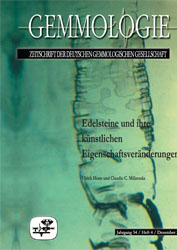
Fijal, J., Heflik, W., Natkaniec-Nowak, L. and Szczepaniak, A. (2004) Emeralds from the Panjshir Valley (Afghanistan). Gemmologie: Zeitschrift der Deutschen Gemmologischen Gesellschaft, Vol. 53, No. 4, pp. 127–142.
Record No. 6058  |  not seen

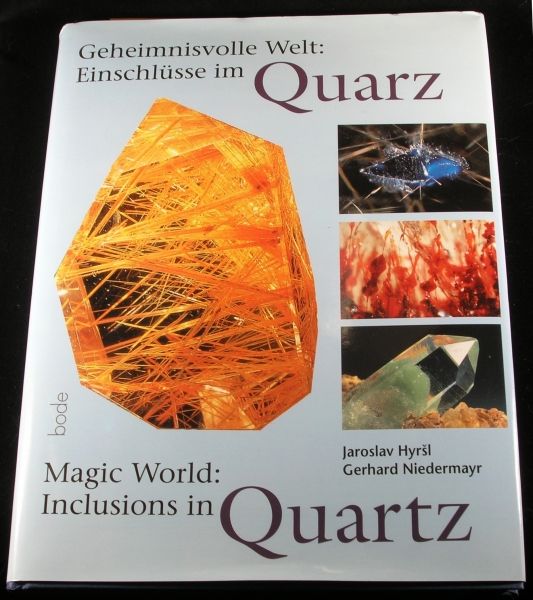
Magic World: Inclusions in Quartz

Book
Hyršl, J. and Niedermayr, G. (2003) Magic World: Inclusions in Quartz., Bode Verlag GmbH, 240 pp.
Record No. 17052  |  ISBN/ISSN: 3925094814  |  Sinkankas/Born No.: NIS/NIB  |  Language: in English and German  |  seen
Photomicrographs of inclusions in quartz. The every day mineral quartz can be found all over the world. It takes a long time to form. Over millions of years, a growing quartz crystal sometimes incorporates other minerals that develop simultaneously, thus forming so called inclusions. This book presents photos of fascinating inclusions in quartz, often beautiful like a dream. It wants to give you an idea of the fantastic inner life of quartz crystals and might also be an animation for your own engagement with this phenomenon. The every day mineral quartz so gets a whole new perspective.

Study on large-sized ruby grown by temperature gradient technique

Journal Article
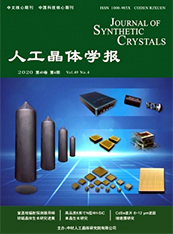
Song, C., Zhou, S., Si, J., Li, H., Zhou, G., Hang, Y. and Xu, J. (2003) Study on large-sized ruby grown by temperature gradient technique. Journal of Synthetic Crystals, Vol. 32, No. 5, pp. 423–426.
Record No. 7735  |  not seen
Large crystals of synthetic ruby (not of gem quality) were grown by the temperature gradient technique from seed plates using Al₂O₃ powders mixed with 0.5–3% Cr₂O₃. Crystallization started at 2,050 °C; cooling rates were 0.5–2.5 °C/hour. The largest crystal measured 75 mm in diameter, 45 mm long, and weighed 1,076 g. This crystal was dark red in the center and even darker red (almost black) at its edges and bottom. Wave-like growth bands were observed in the top portion, while clouds of minute inclusions were concentrated near the seed plate. The concentration of the inclusions decreased from edge to center and from bottom to top, resulting in a “trumpet”-shaped distribution along the growth direction similar to that found in synthetic Ti-doped sapphire crystals grown by the same technique. Electron-microprobe analysis showed that the inclusions were mainly uncrystallized Al₂O₃ powder. Gas bubbles or voids also were observed. Microprobe and spectroscopic (visible range) data showed that the Cr³⁺ concentration increased in two directions (i.e., from center to edge and from bottom to top), corresponding to the growth progression. The authors propose that the quality of synthetic ruby crystals produced by this method could be improved by optimizing the cooling rate, purifying the raw materials, and controlling the temperature during growth.
Les gisements de rubis associés aux marbres de l'Asie Centrale et du Sud-Est: genèse et caractérisation isotopique
Les gisements de rubis associés aux marbres de l'Asie Centrale et du Sud-Est: genèse et caractérisation isotopique

The ruby deposits associated with marbles from Central and Southeast Asia: genesis and isotopic characterization
Thesis
Garnier, V. (2003) Les gisements de rubis associés aux marbres de l'Asie Centrale et du Sud-Est: genèse et caractérisation isotopique. [The ruby deposits associated with marbles from Central and Southeast Asia: genesis and isotopic characterization]., Vandoeuvre-lès-Nancy: Institut National Polytechnique de Lorraine, 373 pp.
Record No. 7352  |  Language: in French  |  not seen

Geheimnisvolle Welt: Einschlüsse im Quarz—Magic World: Inclusions in Quartz
Book
Hyršl, J. and Niedermayr, G. (2003) Geheimnisvolle Welt: Einschlüsse im Quarz—Magic World: Inclusions in Quartz. Haltern, Bode, 240 pp.
Record No. 5938  |  ISBN/ISSN: 9783930000000  |  Sinkankas/Born No.: NIS/NIB  |  Language: In German and English  |  not seen

Rubis trapiches de Mong Hsu, Myanmar

Trapiche rubies from Mong Hsu, Myanmar
Journal Article
Garnier, V., Ohnenstetter, D., Giuliani, G. and Schwarz, D. (2002) Rubis trapiches de Mong Hsu, Myanmar. [Trapiche rubies from Mong Hsu, Myanmar] Revue de Gemmologie. A.F.G., No. 144, pp. 5–12.
Record No. 7763  |  Language: in French  |  not seen
After a comparison of the geologic occurrences of trapiche emerald and trapiche ruby, and a discussion of the various theories proposed for their formation, this article presents the results of an investigation of the chemical compositions, and the solid and fluid inclusions, of six trapiche rubies from Mong Hsu. The study used advanced analytical techniques such as energy- and wavelength-dispersive spectrometry and “cold” cathodoluminescence. The authors identify 12 minerals not previously reported as inclusions in trapiche rubies or as components of their skeletal “arms.” The rubies show a chemical zonation that can be linked to variations in the chemical composition of the growth fluid. The chromium content, in particular, appears to be related to variations in the circulation of metasomatic fluids rich in REE (rare-earth element) fluorides.
Nontraditional genetic classification of gem corundum deposits

Nontraditional genetic classification of gem corundum deposits

Journal Article
Melnikov, E.P., Vasiliev, A.V. and M.A., V. (2002) Nontraditional genetic classification of gem corundum deposits. Gemological Bulletin (Gemological Society of Russia), No. 5, pp. 7–18.
Record No. 7749  |  not seen
Based on mineralogic and geologic research on corundum occurrences in Russia, and published data on corundum localities occurring elsewhere, it is emphasized that regional metamorphism of different rock types (e.g., marble, gneiss) is the major factor controlling the formation of corundum deposits and determining the quality of the gems they contain. The chemical and physical properties of the metamorphic host rocks ultimately determine the characteristics of gem corundum. The sapphires from Kashmir and rubies from Myanmar, which formed in metamorphic environments, are cited as examples. The superb gems from these deposits had the appropriate chromophoric elements available during their formation, under the proper metamorphic conditions. Characteristic mineral inclusions are considered indicative of specific genetic types of corundum, and, for alluvial stones, the inclusions can be used to infer the origin of the gem corundum. Gem corundums originating from other geologic sources (e.g., igneous or metasomatic) are likely to be of lower quality than those of metamorphic origin.
Inclusões sólidas e fluidas da esmeralda de Campos Verdes, Estado de Goiás, Brasil Central: dados de microscopia eletrô- nica de varredura e de luz transmitida

Inclusões sólidas e fluidas da esmeralda de Campos Verdes, Estado de Goiás, Brasil Central: dados de microscopia eletrô- nica de varredura e de luz transmitida

Solid and fluid inclusions in emeralds from Campos Verdes, State of Goiás, Central Brazil: data from scanning electron microscopy and transmitted light.
Conference Paper
Duarte, L., Pulz, G.M., Acauan, R.B., Brum, T.M.M. and Juchem, P.L. (2001) Inclusões sólidas e fluidas da esmeralda de Campos Verdes, Estado de Goiás, Brasil Central: dados de microscopia eletrô- nica de varredura e de luz transmitida. [Solid and fluid inclusions in emeralds from Campos Verdes, State of Goiás, Central Brazil: data from scanning electron microscopy and transmitted light.] XI Congreso Latinoamericano de Geología, III Congreso Uruguayo de Geología, 12–16 November, Montevidéu: Sociedad Uruguaia de Gelogia, 1 CD–ROM.
Record No. 7800  |  Language: in Portuguese  |  not seen

LRM spectrum characteristic of filled glass in heat-treatment [sic] rubies
Journal Article
Xi, B., Xu, R., Gao, H. and Guan, X. (2001) LRM spectrum characteristic of filled glass in heat-treatment [sic] rubies. Journal of Gems & Gemmology, Vol. 3, No. 4, pp. 5–7.
Record No. 7752  |  not seen
Natural rubies are usually enhanced by heat treatment in a flux, and secondary glasses may be formed that then remain in the gems. These fluxes are commonly similar in appearance to glass inclusions found in flux-grown synthetic rubies. To differentiate between these two types of glasses, the chemical compositions and structural characteristics of both types were determined using electron microprobe and laser Raman microspectrometry (LRM) techniques.. Four types of glasses were found in the heat-treated natural rubies: sodic aluminosilicate glass, Na-P-Al glass, B-Na-Al glass, and aluminosilicate glass. Chemically, these glasses are significantly different from flux inclusions found in synthetic rubies. They differ not only in major elements, but also in trace elements. For example, Pb, W, Mo, and Bi present in synthetic rubies were not detectable in the glasses. The Raman spectra of the two materials also are distinct.TL

Zwölftstrahliger Sternsaphir aus Bang-kha-cha, Thailand
Twelve-rayed star sapphire from Bang-kha-cha, Thailand
Journal Article
Schmetzer, K. and Glas, M. (2001) Zwölftstrahliger Sternsaphir aus Bang-kha-cha, Thailand. [Twelve-rayed star sapphire from Bang-kha-cha, Thailand] Lapis, Vol. 26, No. 11, pp. 40–42, 54.
Record No. 5337  |  Language: in German  |  seen
After a brief overview of some basic facts concerning asterism, the characteristics of black star sapphires from Thailand are described. As in star corundums from other sources, these stars were found to be diffraction phenomena created by needles or lamellae of rutile or hematite-ilmenite. These inclusions can be oriented either parallel or perpendicular to the second-order prism faces.. Six-rayed star sapphires from Bang-kha-cha [also spelled Bang Kacha] show bluish white or, less commonly, “golden” yellow stars. The bluish white stars are caused by Ti-bearing hematite (as are similar black stars from Australia), whereas the nature of the mineral(s) forming the yellow stars is unknown. In the bluish white stars, the band of light (chatoyancy) can be oriented both parallel and perpendicular to the second-order prisms, but they are always parallel to these prisms in the yellow stars.. Rarely, both colors of stars are combined in the same specimen and form 12-rayed star sapphires. The authors studied nine such sapphires and found that the bluish white stars were always oriented perpendicular to the prism faces, whereas the yellow stars were parallel to these faces. The article is illustrated with four excellent photographs and two diagrams, which make the rather complicated phenomena easily understandable.

Comparison of inclusions in corundum from the new mines in Tanzania and on Madagascar
Conference Paper
Gübelin, E.J. (2001) Comparison of inclusions in corundum from the new mines in Tanzania and on Madagascar. XXVIII International Gemmological Conference, Madrid, Spain
Record No. 3107  |  not seen

Fluid inclusion characteristics of sapphires from Thailand

Journal Article
Srithai, B. and Rankin, A.H. (1999) Fluid inclusion characteristics of sapphires from Thailand. Mineral Deposits: Processes to Processing, Proceedings of the 5th Biennial SGA Meeting and the 10th Quadrennial IAGOD Symposium, London, pp. 107–111.
Record No. 5363  |  not seen
Three main types of fluid inclusions occur in Bo Ploi sapphires: (1) vapor-rich CO₂ with a density up to about 0.86 g/cm³; (2) multiphase inclusions containing several daughter minerals, hypersaline brine, and a CO₂-rich vapor phase; and (3) (silicate?)-melt inclusions with immobile vapor bubbles in an isotropic or weakly anisotropic phase of low relief, with bubbles becoming mobile when heated above 800 °C. These observations suggest a magmatic origin for the sapphires, although they did not crystallize as phenocrysts within the basalts that transported them to the surface.
Relationship and correlation between parent rocks, gemstones and mineral inclusions

Relationship and correlation between parent rocks, gemstones and mineral inclusions

Book Section
Gübelin, E.J. (1999) Relationship and correlation between parent rocks, gemstones and mineral inclusions. In: Gemmologists Handbook
Record No. 3108  |  Sinkankas/Born No.: NIS/NIB  |  not seen

Exploring the Literature of Gemstone Inclusions

The literature of gemstone inclusions covers identification, origin determination, treatments, synthesis, mineral inclusions, fluid inclusions and other internal features of natural and synthetic gems.

For a curated selection of important sources, read Inclusions in Gemstones — Hyperion Literature Sources.

About Four Treasures

Four Treasures is Lotus Gemology's freely accessible gemological reference database. Use the full database to search by author, title or keyword and explore literature on gemology, mineralogy, jewelry and related fields. Where available, hyperlinks on titles may lead directly to the full publication.

Search the Complete Four Treasures Database