Gemstone Inclusions Bibliography

Gemstone Inclusions Bibliography

Explore books, articles and historical sources on inclusions in gemstones in Four Treasures, the Lotus Gemology reference database. This bibliography brings together matching records from the collection, with publication details, abstracts and cover images where available.

Gemstone Inclusion References

The list below matches the terms inclusion or inclusions in the database's searchable fields. Some references discuss inclusions as part of a broader subject.
161–180 of 1,121 matching references

Blue sapphires from the Baw Mar mine in Mogok
Journal Article
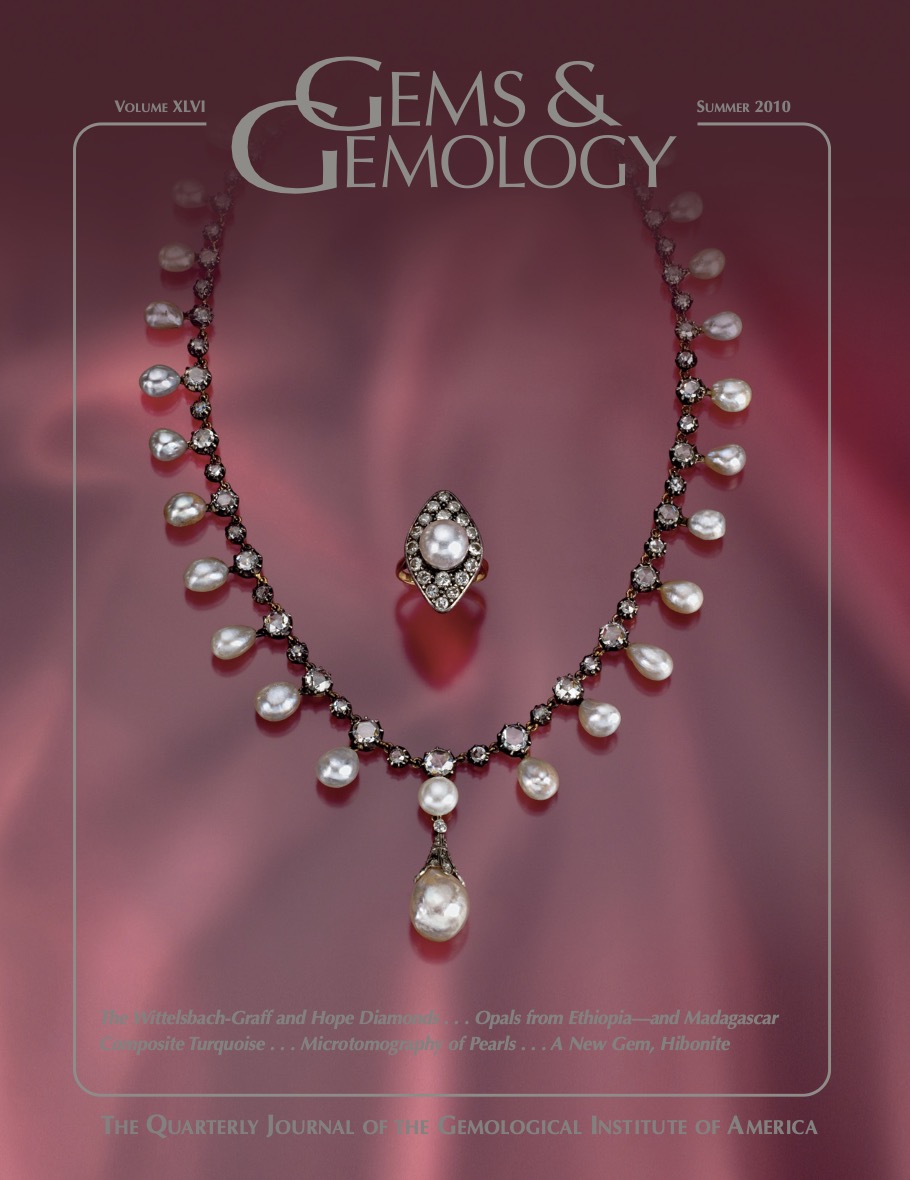
Kan-Nyunt, H.-P. (2013) Blue sapphires from the Baw Mar mine in Mogok. Gems & Gemology, Vol. 49, No. 4, Winter, pp. 223–232.
Record No. 5551  |  ISBN/ISSN: 0016626X  |  RWHL*
In the last five years, fine Burmese blue sapphires from the Baw Mar area of Mogok have reached the market. The faceted stones typically show a strong pleochroism from greenish to violetish blue when viewed perpendicular and parallel to the c-axis, respectively, with medium to strong saturation and medium to dark tone. Most of the samples were relatively clean under the microscope, showing multiple twinning with whitish needle-like inclusions (presumably boehmite) at the intersections. Often, these in-clusions were associated with stress tension fissures. Needles, most likely rutile, were found only occa-sionally, but small platelets and needle-like particles, probably ilmenite, appeared more frequently. Most of the stones contained surface-reaching open and healed fissures, but crystal inclusions of K-feldspar and mica (identified by Raman) were occasionally encountered. The sapphires also had a relatively high iron content, low gallium, and very low titanium. Their Ga/Mg ratio varied from 0.6 to 17. Their UV-Vis-NIR spectra displayed intense iron-related absorptions, and the FTIR absorption spectra presented mainly boehmite-and mica-related bands. Based on careful microscopic observations, combined with spectro-scopic and chemical analysis, the sapphire from Baw Mar can, in most cases, be distinguished from the blue sapphire of other localities.

Rubies from the Montepuez area (Mozambique)
Report
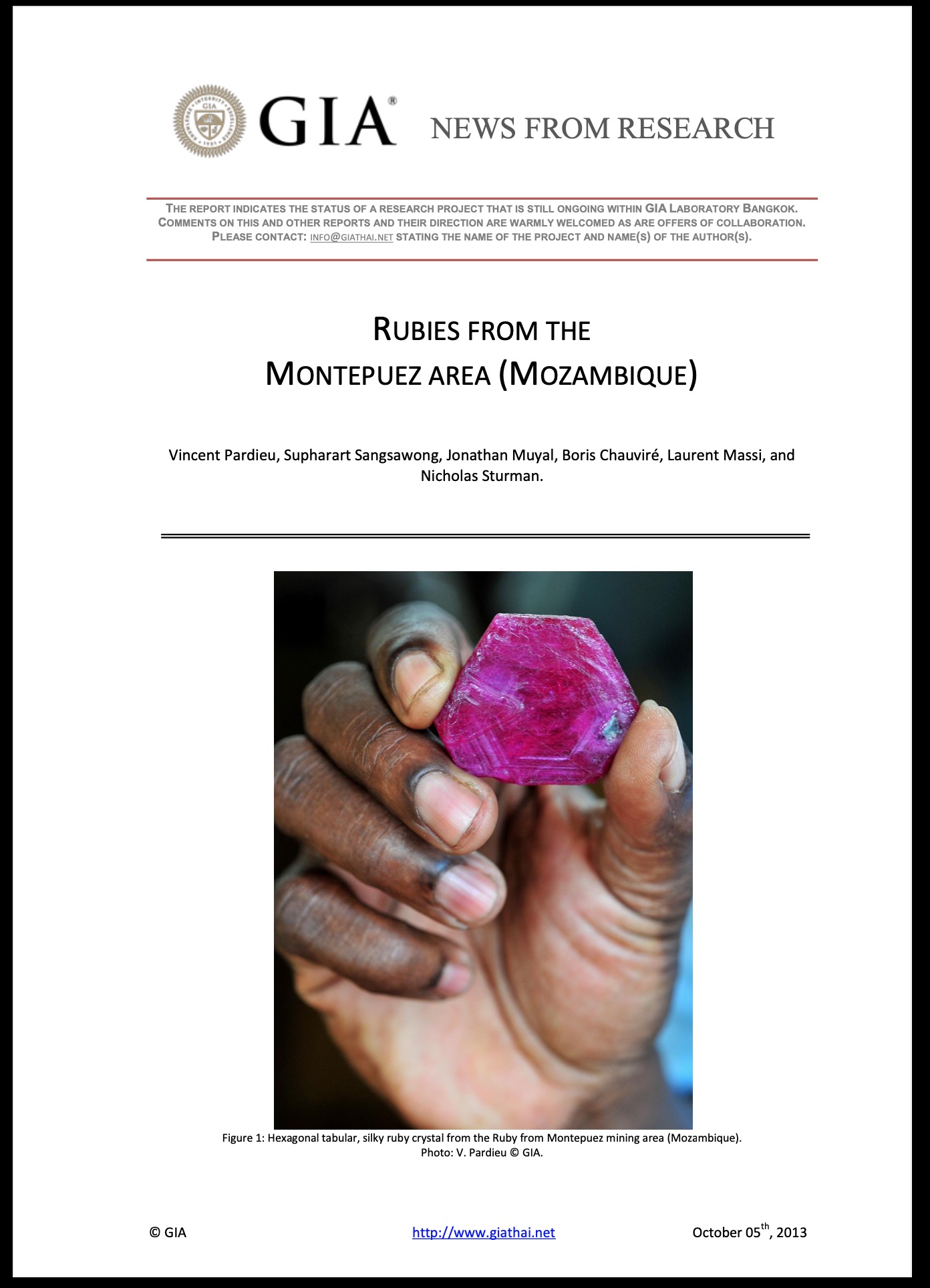
Pardieu, V., Sangsawong, S., Muyal, J., Chauviré, B., Massi, L. and Sturman, N. (2013) Rubies from the Montepuez area (Mozambique). GIA: News from Research, Bangkok: Gemological Institute of America, 5-Oct, 84 pp.
Record No. 5484  |  RWHL*
Rubies from Montepuez in northern Mozambique are particularly interesting as this new material rapidly dominated the ruby trade in Thailand, the world’s major ruby trading center, since the discovery of the deposit during the spring of 2009. This new material is quite different from rubies traditionally encountered in the market such as the marble type rubies, known for their strong fluorescent aspect related to their low iron content, like those from Mogok or Mong Hsu in Myanmar (Burma) or basalt related rubies, known for their low fluorescence due to higher iron content, from Thailand or Cambodia. Indeed the new deposit in Montepuez is not marble or basalt related but instead is an amphibole related deposit similar to the ruby deposits near Winza (Tanzania), M’Sawize (Mozambique) and probably the deposit near Didy (Madagascar), three other ruby deposits discovered fairly recently in Africa. Amphibole type rubies usually have higher iron content than those commonly found in marble related deposits but also usually exhibit lower iron content compared to those from basalt related deposits. It is interesting to note that these non-classic (i.e. amphibole type) metamorphic stones fill the gap, in relation to chemistry and appearance, between the highly fluorescent marble type rubies and the weakly fluorescent basalt related rubies familiar to the trade. For gemologists willing to find out where the gems they are studying come from, the fact that the rubies from Montepuez are coming from an amphibole related deposit is fascinating as the combination of the inclusion scene, the chemical fingerprint and the spectra associated with these stones will usually enable them to differentiate these gems quite easily from their cousins mined from marble or basalt related deposits. The data presented here, using GIA reference samples, should be very helpful in this regard.

A study of ruby (corundum) compositions from the Mogok Belt, Myanmar: Searching for chemical fingerprints
Journal Article
Harlow, G.E. and Bender, W. (2013) A study of ruby (corundum) compositions from the Mogok Belt, Myanmar: Searching for chemical fingerprints. American Mineralogist, Vol. 98, pp. 1120–1132.
Record No. 5480  |  RWHL*
For centuries the Mogok metamorphic belt of Myanmar (a.k.a. Burma) has been famous for producing classic, pigeons-blood ruby (corundum: Al2O3) specimens. The present model for the formation of rubies hosted in marble from the Himalayan arc is a closed-system metamorphism of former clays from evaporitic/organic-rich shale units in margin basins. Mogok has still not been fully included in this model. Involvement of igneous intrusions and the formation of skarn with the marble has been an outstanding topic. Twenty-three red corundum samples (nominally rubies) from eight sources in the Mogok belt marbles, including a skarn setting and local alluvial samples, have been analyzed using the electron microprobe and a laser ablation-inductively coupled plasma-mass spectrometer system to measure trace element compositions for evidence of different geological formational environments. Although inclusions, such as baddeleyite (ZrO2) and srilankite ([Ti,Zr]O2), as well as associated painite (CaZrAl9O15[BO3]), indicate skarn-related paragenesis of some samples, no signatures of B or Zr enrichment were found. Rather high levels of Si (300+ ppm) are found, possibly indicating nano-silicate inclusions when above 500 ppm. A distinct Fe enrichment, as in the case of metasomatic ruby, is observed. Sensitivity to the sub-ppm level may to be necessary to resolve, if even possible, whether there is a compositional signature from the skarn formation. Samples from individual sources in the belt show some distinct trace-element characteristics, in particular a discretely limited variation in V/Ti while the Cr content can vary considerably and independently. With the potential of V, Ti, and Cr being sourced from blackshale components in shelf carbonates that were transformed to marble, these Mogok belt rubies may record an informative intersection of organic chemistry, geochemistry, plate tectonics, metamorphism, and metasomatic processing.

Useful visual clue indicating corundum heat treatment
Journal Article
Koivula, J.I. (2013) Useful visual clue indicating corundum heat treatment. Gems & Gemology, Vol. 49, No. 3, Fall, pp. 160–161.
Record No. 3226  |  ISBN/ISSN: 0016626X  |  RWHL*

Blue sapphires and beryllium: 'An unfinished world quest'
Journal Article
Pardieu, V. (2013) Blue sapphires and beryllium: 'An unfinished world quest'. InColor, Summer 2013, pp. 36–43.
Record No. 3207  |  RWHL*
June 1, 2012: I was wearing a wet suit, standing in a stream in freezing temperatures surrounded by giant ferns in a remote wilderness area between Derby and Weldborough, in the north east of Tasmania (Figure 1). My local buddy, Chris Hood, a high-end jewelry shop owner in Hobart and a longtime friend (Figure 10), was doing his best to show me his expertise in gem fossicking. After spending 15 minutes in the cold water, thanks to our wet suits, we were getting surprisingly warm and comfortable. Suddenly we spotted in Chris’ sieve a small bright blue spot: Our very rst Tasmanian sapphire. I was delighted! At this point, you might wonder what a GIA field gemologist and an Aussie jeweler were doing with diving suits on, working a remote narrow stream in that Jurassic Park-like cold and wet forest. Well, that’s a very valid question and its answer is the subject of this article, which hopefully will interest you. In fact, I was trying to complete an unfinished research project that started in 2005 in Madagascar. This was an adventure that could be described as a perfect illustration of “Rule Number 3” in field gemology – “Expect the unexpected” (Pardieu 2012). It started as a gemological quest for samples and knowledge that would take me from the field to the lab, and places as diverse and remote as Ilakaka in southern Madagascar, the mountains of Northern Afghanistan and finally, the lush forests of Tasmania. It also launched the start of a successful and interesting collaboration with Ken Scarratt, the director of the GIA Laboratory in Bangkok. Three years after commencing our collaboration, Ken asked me to join him and become a full-time “field gemologist” for the GIA laboratory – a position that I have long dream of getting and one that I still very much enjoy these days. But let’s start from where the whole adventure started.

New occurrences of jadeitite, jadeite quartzite and jadeite-lawsonite quartzite in the Dominican Republic, Hispaniola: petrological and geochronological overview
Journal Article
Schertl, H.P., Maresch, W.V., Stanek, K.P., Hertwig, A., Krebs, M., Obaese, R. and Sergeev, S.S. (2012) New occurrences of jadeitite, jadeite quartzite and jadeite-lawsonite quartzite in the Dominican Republic, Hispaniola: petrological and geochronological overview. European Journal of Mineralogy, Vol. 24, pp. 199–216.
Record No. 28408  |  Sinkankas/Born No.: NIS/NIB  |  RWHL*
New occurrences of jadeitite and jadeite-rich rocks have been discovered in the Río San Juan Complex (RSJC) of the northern Dominican Republic within serpentinite mélanges associated with a former intra-oceanic subduction zone. Allochthonous blocks occurring in lag deposits developed upon mélange outcrops, as well as boulders within riverbeds, are common. A particularly unusual feature of the RSJC is the presence of concordant layers and discordant veins, ranging from centimetres to decimetres in thickness, within blocks of jadeite-lawsonite- or omphacite-garnet-bearing blueschist in the mélange. Two suites of jadeite-rich rocks may be distinguished. The first consists of quartz-free jadeitite sensu stricto (>90 vol.% jadeite), so far known only from blocks and boulders. The second suite comprises quartz-bearing jadeitite sensu stricto grading into jadeitite quartzite (JQ), jadeite-lawsonite quartzite (JLQ) and jadeite-free lawsonite quartzite (LQ). This second suite occurs not only as blocks and boulders but also as layers and veins within blueschist blocks. A single occurrence of a cross-cutting omphacitite vein within blueschist has likewise been documented. Additional minerals identified within both suites include omphacite, phengite, glaucophane, epidote, albite, calcite, titanite and zircon. Apatite and pumpellyite have thus far been observed only within the quartz-free jadeitite sensu stricto, whereas almandine-rich garnet has been found exclusively within JLQ. The jadeite-bearing rocks occur in various shades of green, range from fine- to coarse-grained and are generally equigranular. Mineral distribution is commonly homogeneous, although JLQ may display a patchy distribution that imparts a distinctly mottled appearance. Cathodoluminescence imaging reveals oscillatory zoning in jadeite, zircon, apatite and calcite, indicating crystallization from aqueous fluids under open-system conditions. Zircons separated from quartz-free jadeitite sensu stricto contain primary inclusions of high-pressure matrix minerals such as jadeite and omphacite, demonstrating coeval zircon growth. Zircon cores yield ages of 114.9 ± 2.9 Ma, indicating crystallization near the initiation of subduction within the Río San Juan Complex, at a time when relatively “warm” geothermal gradients of approximately 15°C/km prevailed. These ages contrast sharply with those of the blueschists hosting the younger quartz-bearing suite, which range from 80 to 62 Ma and correspond to the final stages of subduction-zone activity at around 55 Ma under cooler geothermal gradients of approximately 8–9°C/km. For the younger quartz-bearing suite, phengite compositions combined with available P–T–t paths for the host blueschists suggest crystallization temperatures of approximately 350–500°C at minimum pressures of 15–16 kbar. Conditions for the older quartz-free suite are more difficult to constrain, although phengite compositions together with the geothermal conditions prevailing in the early warm subduction zone imply minimum conditions of at least 500°C and 11 kbar. Temperatures and pressures as high as 600°C and 15 kbar, however, comparable to those documented for jadeitites of similar age exposed in eastern Cuba within the same subduction system, remain possible. The jadeitites and jadeite-rich rocks of the RSJC are therefore interpreted as having crystallized over a span of approximately 60 million years within a single thermally self-organizing and progressively cooling subduction zone, evolving from initial temperatures exceeding 500°C to later conditions near 350°C. The P–T conditions inferred for the younger quartz-bearing suite correspond closely with those of jadeitite formation south of the Motagua Fault Zone in Guatemala, the only other known locality worldwide where jadeitite containing both lawsonite and quartz appears to be common. Further evidence is nevertheless required to confirm whether the older quartz-free suite represents another example of the rare high-temperature jadeitite known from Cuba.

Synthetic alexandrite – Growth methods and their analytical fingerprints
Journal Article
Malsy, A.-K. and Armbruster, T. (2012) Synthetic alexandrite – Growth methods and their analytical fingerprints. European Journal of Mineralogy, Vol. 24, pp. 153–162.
Record No. 28099  |  DOI: https://doi.org/10.1127/0935-1221/2012/0024-2181  |  Sinkankas/Born No.: NIS/NIB  |  RWHL*
Synthetic alexandrite crystals grown by various methods (flux, Czochralski, zone melting) and originating from different manufacturers were investigated by standard gemmological testing and laser ablation inductively coupled plasma mass spectrometry (LA-ICP-MS). All samples investigated have (Cr³⁺ + V³⁺), or (Cr³⁺ + Fe³⁺), or Cr³⁺ only as colour dopant. The presence of trace contents of iridium platinum confirm Russian Czochralski and flux “Cr+Fe-type” samples to be synthesized from commonly used Ir crucibles. Other samples, i.e. Russian flux “Cr+V-type,” Kyocera Czochralski and Seiko zone-melting synthetics, have no Ir, but stand out by consistently present Mo contents. Thus, it can be assumed that Mo containers instead of Pt or Ir crucibles were used. Traces of molybdenum have also been observed in Russian flux “Cr+Fe-type” samples. However, the strongly variable contents of Mo, Bi, and W imply the use of a Bi₂O₃–MoO₃–WO₃ flux. These synthetic crystals further show additives such as B, Ga, Ge, and Sn in considerable concentrations. Other randomly encountered “impurities” are Sc, Mn, Co and Zr. Observed inclusion features are mostly in accordance with the respective synthesis method. Flux-grown crystals show inclusions of flux residues of varying texture whereas Czochralski crystals characteristically display curved growth structures. Crystals produced by zone melting (Seiko) typically have swirled or undulating growth structures. Samples received as Tairus zone-melting alexandrites do strongly differ from the Seiko products by their Mo content and different inclusions features. The manufacturing method of these samples is therefore doubted. A proper distinction of natural alexandrite from melt-grown synthetic alexandrite can be done on the basis of infrared features in the range from 2500 to 4000 cm⁻¹.

Gem News International: Emerald from Ethiopia
Journal Article
Cevallos, P., Simmons, W.B. and Falster, A.U. (2012) Gem News International: Emerald from Ethiopia. Gems & Gemology, Vol. 48, No. 3, Fall, pp. 219–220.
Record No. 26374  |  ISBN/ISSN: 0016626X  |  Sinkankas/Born No.: NIS/NIB  |  RWHL*
At the 2011 Tucson gem shows, gem dealer Farooq Hashmi (Intimate Gems, Glen Cove, New York) loaned the GIA a 1.36 ct emerald reportedly sourced from near Dubuluk, a town in southern Ethiopia approximately 80 km north of the Kenyan border. Hashmi noted that the area had been producing emeralds for a few years, and during a buying trip to Ethiopia in 2011, he observed several hundred grams of rough material, including some large crystals, though gem-quality portions were typically small. Examination of the trilliant-cut emerald revealed green color with weak pleochroism (yellowish green and bluish green), refractive indices of no = 1.585 and ne = 1.578, a birefringence of 0.007, specific gravity of 2.72, and weak red fluorescence under long-wave UV. Strong absorption lines near 700 nm were visible in a desk-model spectroscope, consistent with known emerald properties. Microscopic inspection showed roiled and jagged growth structures, blocky two-phase fluid inclusions, pale brown plates, short needles, and a pale brown elongated inclusion. Electron microprobe analysis conducted at the University of New Orleans indicated 0.05 wt.% Cr₂O₃ and 0.10 wt.% FeO, with vanadium below detection limits. Polarized UV-Vis-NIR spectroscopy revealed absorption features due to both Fe²⁺ and Cr³⁺, while the infrared spectrum showed bands at 2358 cm⁻¹ (linked to CO₂ in structural channels) and 2290 cm⁻¹ (of unknown origin). These findings suggest that Ethiopia may soon add emerald to its expanding portfolio of commercially significant gemstones.

Emeralds from the Fazenda Bonfim region, Rio Grande do Norte, Brazil

Journal Article
Zwaan, J.C., Jacob, D.E., Häger, T., Neto, M.T.O.C. and Kanis, J. (2012) Emeralds from the Fazenda Bonfim region, Rio Grande do Norte, Brazil. Gems & Gemology, Vol. 48, No. 1, Spring, pp. 2–17.
Record No. 6070  |  ISBN/ISSN: 0016626X  |  DOI: https://dx.doi.org/10.5741/GEMS.48.1.2  |  RWHL*
In 2006, emeralds were discovered in the Fazenda Bonfim region of northeastern Brazil. Emerald mineralization occurs in association with small recrystallized pegmatitic bodies hosted by metamorphosed ultramafic rocks within the Santa Mônica Shear Zone. Prospecting and exploration have been conducted in a few small pits and tunnels, yielding emerald crystals with transparent areas typically ranging between 2 and 5 mm. Polished samples usually display a saturated bluish green color with a medium-light to medium tone. The most common internal features are partially healed fissures with two-phase (liquid–gas) fluid inclusions and a variety of fine, parallel-oriented growth tubes. The emeralds contain moderate amounts of the chromophore elements Cr and Fe, along with traces of V; they also show relatively high K and low Li contents. FTIR spectroscopic features are consistent with alkali-bearing emeralds that contain significant CO₂ and a small amount of deuterated water. Emeralds from Fazenda Bonfim can be distinguished from those of other schist- and pegmatite-related commercial deposits.

Geographic Origin Determination of Colored Stones [in Chinese]
in Chinese
Book
Schwarz, D. (2012) Geographic Origin Determination of Colored Stones [in Chinese]., 330 pp.
Record No. 3248  |  ISBN/ISSN: 9787120000000  |  Sinkankas/Born No.: NIS/NIB  |  RWHL*

Lithois Indikois: Preliminary characterisation of some garnet seal stones from Central and South Asia
Book Section
Adams, N., Lüle, C., Passmore, E. and Sims-Williams, N. (2011) Lithois Indikois: Preliminary characterisation of some garnet seal stones from Central and South Asia. In: ‘Gems of Heaven’: Recent Research on Engraved Gemstones in Late Antiquity, c. AD 200–600, London: British Museum, Volume 177 of British Museum, Research publications , pp. 25–38.
Record No. 6402  |  ISBN/ISSN: 9780860000000  |  Sinkankas/Born No.: NIS/NIB  |  RWHL*
The GCEM project (Garnets: Classical, Eastern and Medieval): This paper presents the initial findings of the GCEM project,designed to create a scientific database of garnet intaglios held in different departments in the British Museum. Of all the ancient stones used as seal stones, garnets are perhaps the most promising in terms of yielding a broad reference database.Unlike diamond, the corundum series (ruby, sapphire) and spinels which were used relatively rarely in antiquity, substantial numbers of garnets were used steadily over many centuries. And, unlike the inclusions in the quartz group whose various members are ubiquitous throughout antiquity, the distinctive inclusions within garnets, when compositionally identified, may in some cases be used to match a particular gemstone to a host rock.

Structural evolution of TiO₂ precipitates in Ti-doped sapphire (α-Al₂O₃)
Journal Article
He, J., Lagerlöf, K.P.D. and Heuer, A.H. (2011) Structural evolution of TiO₂ precipitates in Ti-doped sapphire (α-Al₂O₃). Journal of the American Ceramic Society, Vol. 94, No. 4, pp. 1272–1280.
Record No. 5527  |  DOI: https://doi.org/10.1111/j.1551-2916.2010.04217.x  |  Sinkankas/Born No.: NIS/NIB  |  RWHL*
A time-dependent phase stability diagram has been developed describing the structural evolution of TiO₂ precipitates in Ti-doped sapphire (α-Al₂O₃). A high-pressure TiO₂ phase with the α-PbO₂ structure (α-TiO₂) forms as a coherent precipitate in Ti-doped sapphire annealed at 1200°–1300 °C; extended annealing times at these temperatures result in twinned particles, the twinning minimizing the precipitate–matrix misfit strain energy. Twinned α-TiO₂ eventually transforms to the rutile structure, coincident with the loss of coherency with the sapphire matrix. Rutile nucleates directly in sapphire annealed at temperatures at 1350 °C and above. Rutile is present mainly as semicoherent and twinned precipitates, the twinning occurring relatively early in the precipitation sequence. RWH: Great paper on the formation of rutile silk in corundum.

Mineralogical features and geological origin of the sapphires from the Mayo Kewol paleoplacer in Adamawa region (North-Cameroon)
Book Section
Boaka à Koul, M.L., Yongue-Fouateu, R. and Giuliani, G. (2011) Mineralogical features and geological origin of the sapphires from the Mayo Kewol paleoplacer in Adamawa region (North-Cameroon). In: Advances in Materials Science Research, Vol. 2, Chapter 7 , pp. 125–142.
Record No. 5514  |  Sinkankas/Born No.: NIS/NIB  |  RWHL*
The gem corundum deposits of detrital origin were studied along the Mayo Kewol in the Adamawa mining region (Cameroon). The region was affected by the Pan-African cycle producing abundant granitoid intrusions, metamorphism, and important tectonic movements that occurred due to two main structural features: the Central Cameroon Shear Zone and the Cameroon Volcanic Line. The gem sapphires found in the gravel layer are mostly blue and broken, but retain their typical primary habits. Zircon, ilmenorutile, and ilmenite are the solid inclusions observed within these gem corundum. Their oxygen isotopic signatures range from 4.7 to 5.4‰, with a mean δ¹⁸O of 5.0 ± 0.3‰ (n = 3). Geochemical signatures show significant values up to 5320 ppm FeO, 570 ppm Ga₂O₃, and 3270 ppm TiO₂. These results suggest that the sapphires mainly crystallized within the mantle in a magma of syenitic composition. They were incorporated as xenocrysts in basaltic magma during the ascent from the mantle to the surface. These phenomena are structurally linked to the Central Cameroon Shear Zone and the Cameroon Volcanic Line, reactivated within the rifting continental surroundings.

Different origins of Thai area sapphire and ruby, derived from mineral inclusions and co-existing minerals
Journal Article
Saminpanya, S. and Sutherland, F.L. (2011) Different origins of Thai area sapphire and ruby, derived from mineral inclusions and co-existing minerals. European Journal of Mineralogy, Vol. 23, No. 4, Aug.–Sept.,, 1-Aug-11 pp. 683–694.
Record No. 5405  |  DOI: https://dx.doi.org/10.1127/0935-1221/2011/0023-2123  |  RWHL*
Mineral inclusions and coexisting minerals of gem corundum from the Thailand area analysed by SEM-EDS in this study can be divided into sapphire and ruby suites. The sapphire suite includes alkali feldspar (sanidine), nepheline, zircon, hercynite-spinel series and magnetite-hercynite series. The ruby suite includes garnet (pyrope), high-Al diopside ( fassaite') and sapphirine. The mineral chemistry and other data suggest that Thai rubies could have crystallized in high-pressure metamorphic rock of ultramafic/mafic composition. In contrast, Thai area sapphires could have crystallized in high-grade metamorphic (gneissic) rock or from magmas of highly alkaline composition, located at shallower levels in the lithosphere than those hosting the Thai rubies.

The history of Pamir gems

ИСТОРИЯ ПАМИРСКИХ САМОЦВЕТОВ
Journal Article
Litvinenko, A.K. and Barnov, N. (2010) The history of Pamir gems. [ИСТОРИЯ ПАМИРСКИХ САМОЦВЕТОВ] ИЗВЕСТИЯ ВЫСШИХ УЧЕБНЫХ ЗАВЕДЕНИЙ, ГЕОЛОГИЯ И РАЗВЕДКА [Proceedings of Higher Educational Institutions. Geology and Exploration], No. 4,, 13-Feb pp. 70–74.
Record No. 29131  |  Sinkankas/Born No.: NIS/NIB  |  Language: in Russian with English absract  |  RWHL*
The authors present original data on discovering gem deposits in the Pamirs beginning in the 7th century. The Pamirs gems have a long history going back to the early Middle Ages, and the discoveries made during recent decades are evidence of great riches hidden deep within the Pamirs. The problems of discovering all the main deposits in the region are discussed. An exceptional paper.

Play-of-color opal from Wegel Tena, Wollo Province, Ethiopia
Journal Article
Rondeau, B., Fritsch, E., Gauthier, J.-P., Cenki-Tok, B., Bekele, E. and Gaillou, E. (2010) Play-of-color opal from Wegel Tena, Wollo Province, Ethiopia. Gems & Gemology, Vol. 46, No. 2, Summer, pp. 90–105.
Record No. 26699  |  RWHL*
A new opal deposit discovered in 2008 near the village of Wegel Tena in Ethiopia’s Wollo Province has yielded mostly white opal, along with some brown, fire, and colorless “crystal” opal, all hosted in volcanic rocks. While some specimens resemble sedimentary opals from Australia and Brazil due to their vivid play-of-color, their properties align with opal-CT and typical volcanic opals. Inclusions of pyrite, barium-manganese oxides, and native carbon are present, and some samples feature unusual “digit patterns,” where play-of-color and common opal interpenetrate like fingers. These opaque-to-translucent opals exhibit pronounced hydrophane behavior, becoming transparent when soaked in water. Notably, the white opals show elevated barium levels, previously unreported in opal-CT. Though the fire and crystal varieties are fragile, the white opals demonstrate exceptional durability. With an unusually high proportion of gem-quality material and over 1,500 kg already extracted using basic mining methods, this deposit—possibly extending several kilometers—has the potential to become a major source of fine opal.

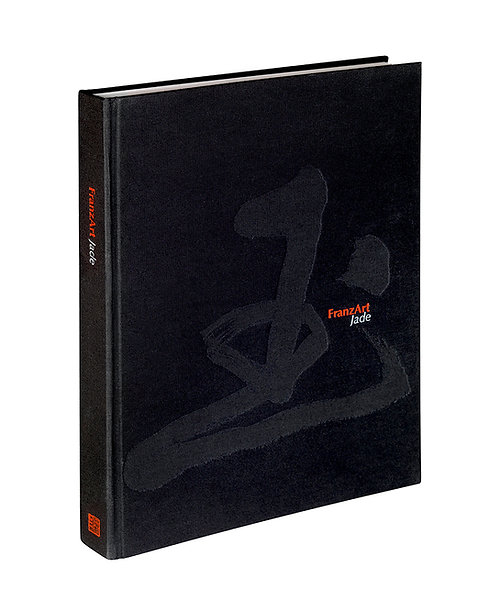
FranzArt Jade: Chinese Art from the Hedda and Lutz Franz Collection
Book
Franz, H. (2010–2018) FranzArt Jade: Chinese Art from the Hedda and Lutz Franz Collection. Hong Kong, privately published, 5 Vols. (jade, glass, stone, fire, lacquer), 317, 250, 246, 172, 299 pp.
Record No. 7387  |  ISBN/ISSN: 9789630000000  |  Sinkankas/Born No.: NIS/NIB  |  RWHL*
It's hard to believe that only 50 years ago few collectors were interested in Chinese snuff bottles. Chinese antiques dealers dumped them into baskets from which choice examples could be bought for just a few dollars. How far we have come from those days! Just last year an enameled glass bottle sold for an astonishing $3.3 million, and it's likely that record won't last for long. While the turning point was undoubtedly the publication of Lilla Perry's 1960 book Chinese Snuff Bottles: The Adventures & Studies of a Collector," the two-volume Franz set will show you what all the excitement is about. Chinese jade carvings are one of the most representative, and snuff bottles one of the most collectible, of the Chinese arts. Hedda and Lutz Franz of Hong Kong have spent a quarter century assembling a spectacular collection with remarkable connoisseurship and a bit of whimsy, too. Fortunately for us, not only have they chosen to share their collection, but they have done so in a beautiful, sumptuously produced set of books. More than 85% of the 335 items shown are snuff bottles – clearly the Franz's main love. A few other small carvings round out the first volume (Jade) and some non-snuff glass vessels the second volume (Glass). Among the jade bottles are an unusual number of fine and rare black (and contrasting black/white) nephrite examples, as well as others that take artistic advantage of the material's colored inclusions and underskin. This has to be one of the most impressive snuff bottle collections ever assembled."

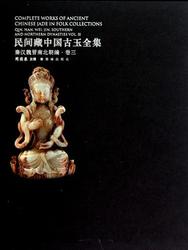
Complete Works of Ancient Chinese Yu in Folk Collections
民间藏中国古玉
Edited Book
Zhou, N., editor (2010) Complete Works of Ancient Chinese Yu in Folk Collections. [民间藏中国古玉]. Beijing, Forbidden City Press, Vol. 3: Qin, Han, Wei, Jin, Southern and Northern Dynasties [秦汉魏晋南北朝编(卷3)] , 347 pp..
Record No. 3853  |  ISBN/ISSN: 9787510000000  |  Sinkankas/Born No.: NIS/NIB  |  Language: in Chinese  |  RWHL*
The Collection of Collected Chinese Ancient Jade Works covers the history of the entire jade culture. The collections cover various periods such as the Neolithic Age, Xia and Shang dynasties, Western Zhou Dynasty, Spring and Autumn Period, the Warring States period, the Qin and Han and Wei and the Southern and Northern Dynasties, the Sui and Tang dynasties and the Five Dynasties, the Song and Liao Jinyuan, and the Ming and Qing dynasties. Based on the number of collections, the number of rolls will be determined in a specific period of time to form an open structure. Each volume will include about 300 jade collections. In addition to the name, size, and other factors, the important collections will be accompanied by expert comments. In addition, each volume has its own monograph, and it thoroughly analyzes the features of the times and the key points for identification. It aims to systematically and comprehensively reflect the folk collection of ancient jade in China, guide and improve the ancient jade collection market in China, enrich and promote the development of *** and promote the traditional culture of the Chinese nation. This book contains nearly 300 artifacts of different types during the period of Qin and Han Weijin Southern and Northern Dynasties. Like tools, weapons, rituals, accessories, burial jade, utility utensils, musical instruments, characters and animals. The times, devices, and ornamentation of the artifacts are arranged in order, which shows people more intuitively the development and changes of different types of artifacts at different times. The artifacts included in this book all passed through the expert team composed of Jade experts Zhou Nanquan, Sun Xuehai, Wang Zongguo, Lei Congyun, and Hua Yiwu. They are very authoritative. The book has a unique perspective and content, and the selected objects have high historical value, cultural value, artistic value and research value. 2. Jade.   Nine Thallium Complete Jade Nine Twelve A total of nine pieces, that is, a pair of jade eyes, a pair of jade nose plugs, a pair of jade ear plugs (also known as filling), a jade mouth, a jade plug, Jade feminine or male genitalia mask. When these artifacts are used, they are covered or stuffed in the dead nine to prevent the decay of the corpse. The ancient book Jade into the Nine Dragons to prevent immortality" refers to this device and its use. It is worth pointing out that the above-mentioned Nine Dragons were complete in the imperial tomb, but were often incomplete in some lower-level tombs. From the unearthed relics, there are many ears or stuffy noses, pimple inclusions, and less eye lids*. The appearance of such a situation seems to be related to the completeness or non-existence of different devices. The jade cymbals were popular in the Han and Wei Dynasties*. There were usually tombs in the nobility, one tomb, shaped like a cricket, but there were simplifications, many were not worn, and the size could just be used in the mouth of the deceased. In the Han Dynasty, Yuxi, also known as the tongue, or the rice cooker, meant that the deceased could be used to keep the deceased in the mouth. The deceased could always have food, and he hoped that the deceased would have a clear and graceful demeanor in the future. The newcomer changes and enters another better world of sublimation..   3. Jade Grips Pigs and.   jade pigs are usually held in the hands of the deceased when they are unearthed, commonly known as “grip-holding pigs”. The early shape is slightly abstract and deformed. Some people call it the jade tiger. Later, they were more realistic and realistic. When unearthed, there was a pair of tombs of the same size.. Its intention is presumably to show that wealth or the deceased had delicious food in the afterlife. Jade pigs are rare in the early and middle stages of the Western Han Dynasty, and some of them are used in the tombs of Liu Sheng of King Jing of Zhongshan. It was only in the middle and late period of the Han dynasty that it appeared in large numbers and continued into the Wei, Jin and Southern and Northern Dynasties. The above-mentioned various types of funeral jade, except for jade clothes and their matching jade pillows, were only available in the Han Dynasty. Others such as the jade garrison, the jade gripping pig and the jade crouching device were found in the Southern and Northern Dynasties from the Han to the Wei and Jin dynasties. Sooner or later, the form of the burial jade has changed, and the number of burial jades is different. Among them, the jade and jade wares are even rarer before and after this period."

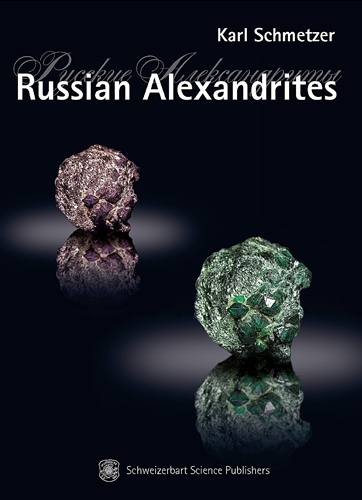
Russian Alexandrites

Book
Schmetzer, K. (2010) Russian Alexandrites. Stuttgart, Schweizerbart Science Publishers, 141 pp.
Record No. 3134  |  ISBN/ISSN: 9783510000000  |  Sinkankas/Born No.: NIS/NIB  |  RWHL*
Alexandrite, a variety of chrysoberyl, and one of the finest colour-change natural gemstones, may almost be called “the national gemstone of Russia”. This great prestige is based on two facts: its noble name in honour of the Tsarevich Alexander Nikolaevich (the future Tsar Alexander II) and its dazzling colours, green in daylight and red in incandescent light, the military colours of Imperial Russia. Although quantities of facetable quality alexandrite are considerably less than those of emerald, alexandrite is counted among and compared to the “big four” of the gem business: diamond – ruby – sapphire – emerald. In this book the authors present an historical overview of emerald mining in the Urals, the discovery of Russian alexandrites in the Uralian emerald mines, the naming and historical use of alexandrites and their appearance and display in mineralogical museums and the gem trade. Morphology and twinning of rough alexandrite is described for single crystals, single contact twins and cyclic twins (trillings). Mineralogical and gemmological properties are thoroughly explained and numerous photo-micrographs of inclusions and growth patterns in faceted samples are presented.

Inside emeralds

Journal Article
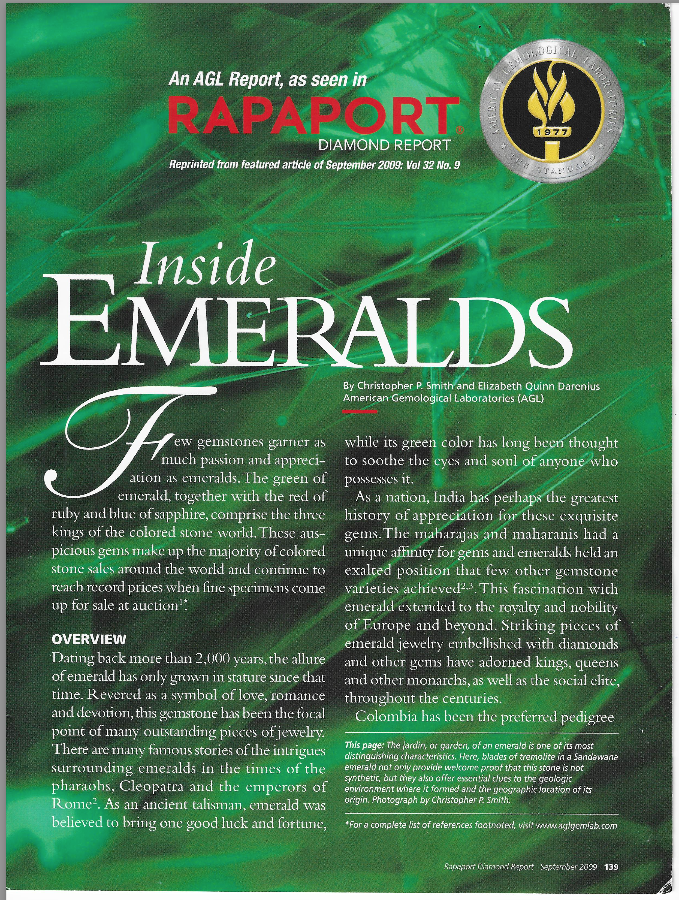
Smith, C.P. and Darenius, E.Q. (2009) Inside emeralds. Rapaport, Vol. 32, No. 9,, Sep-09 pp. 139–149.
Record No. 28125  |  Sinkankas/Born No.: NIS/NIB  |  RWHL*
Excellent summary of emerald inclusions and UV-Vis-NIR spectra from different origins and description of different emerald enhancements

Exploring the Literature of Gemstone Inclusions

The literature of gemstone inclusions covers identification, origin determination, treatments, synthesis, mineral inclusions, fluid inclusions and other internal features of natural and synthetic gems.

For a curated selection of important sources, read Inclusions in Gemstones — Hyperion Literature Sources.

About Four Treasures

Four Treasures is Lotus Gemology's freely accessible gemological reference database. Use the full database to search by author, title or keyword and explore literature on gemology, mineralogy, jewelry and related fields. Where available, hyperlinks on titles may lead directly to the full publication.

Search the Complete Four Treasures Database