
Four Treasures Reference Database
Record No. 1002
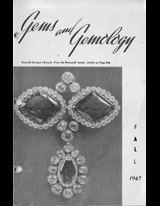
The new Linde stars
Journal Article
Holmes, R.J. (1947) The new Linde stars. Gems & Gemology, Vol. 5, No. 11, Fall, pp. 452–454, 478–479.
ISBN/ISSN: 0016626X | Sinkankas/Born No.: NIS/NIB | RWHL
corundum, synthetic corundum.7, Verneuil stars, Linde, gems
R.J. Holmes examines the newly marketed Linde synthetic star rubies and sapphires, describing their appearance, internal structure, and distinction from natural star corundum. Announced on September 23, the stones were offered as finished cabochons because the rough material was unavailable. Most commercial specimens weighed 4–15 carats and were graded chiefly by color, with the strength, perfection, and orientation of the star also considered. Holmes’s detailed tests centered on one red and one blue specimen, supplemented by examination of additional stones. The most conspicuous features are an unusually intense, sharply defined star with straight rays and a broad, pale belt crossing the cabochon between darker, more transparent ends. Microscopy reveals that the star-producing needles occupy a comparatively thin layer broadly following the upper curved surface. Their restricted distribution explains both the pale belt and the unequal extension of the rays: four continue toward the base, while the remaining pair terminate at the boundaries of the clearer end zones. Rotation against strong transmitted light therefore produces marked changes in transparency. Most specimens examined showed this belt, although two lacked conspicuous banding while retaining unequal transparency. Curved color bands, cloudy curved streaks, and numerous small spherical bubbles provide additional evidence of synthetic origin. Both red and blue stones exhibit dichroism, with the red material showing an unusually strong orange component. At approximately 50× magnification, the pale zone resolves into abundant short needles arranged in three intersecting sets at 60°. Their small size, close spacing, and great number account for the sharp, bright asterism. The stars are generally well centered, and interference figures support identification of the host as uniaxial negative corundum. Rough, curved bases prevented direct refractometer measurements, although immersion behavior was consistent with corundum. Specific gravities of 4.011 for the red specimen and 4.004 for the blue specimen likewise agreed with that identification, while hardness testing placed both between 8 and 9. Holmes distinguishes suggestive visual clues, such as strong color and perfect stars, from more decisive microscopic evidence, especially spherical bubbles, curved color bands, and the shallow concentration of needles. He concludes that the stones are corundum whose asterism arises from oriented inclusions, as in natural material, but emphasizes the different distribution of those inclusions. The manufacturing method remained undisclosed, and Holmes closes by questioning whether these structural differences affect their strict equivalence to natural star rubies and sapphires.