
Four Treasures Reference Database
Record No. 1192
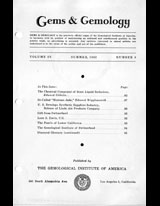
U.S. develops synthetic sapphire industry
Journal Article
Linde Air Products Co. (1943) U.S. develops synthetic sapphire industry. Gems & Gemology, Vol. 4, No. 6, Summer, pp. 88–91.
ISBN/ISSN: 0016626X | Sinkankas/Born No.: NIS/NIB | RWHL
corundum, synthetic corundum.7, Verneuil, Linde, gems
This company release describes the establishment of American synthetic sapphire production in response to wartime disruption of European supplies and increasing demand for jewel bearings in military and industrial instruments. Previously dependent on manufacturers in Switzerland, France, and Germany, the United States faced shortages despite stockpiling during 1939 and 1940. In autumn 1940, the government invited qualified domestic companies to develop production, and Linde Air Products Company undertook experimental work leading from a single laboratory furnace to commercial manufacture. The article reports that, eighteen months after beginning, Linde informed the War Production Board that it could supply colorless sapphire in any reasonable quantity. Production was then devoted entirely to essential industrial and military requirements. The manufacturing account outlines the Verneuil process, in which purified alumina powder passes through an oxygen–hydrogen flame and accumulates on a pedestal as a crystalline boule. Appropriate coloring agents produce ruby or colored sapphire, while controlled growth and slow cooling are necessary to obtain usable material. The company describes its progress through experimentation without European specialists available to supervise the work. An illustrated sequence contrasts a shattered, opaque 14-carat boule from December 1940 with the first clear 20-carat product, a representative commercial boule of approximately 200 carats, and an exceptional recent example weighing about 350 carats. Synthetic corundum’s principal advantages for bearings are presented as high hardness, uniformity, and resistance to wear, supporting prolonged accuracy in delicate mechanisms. Regular boule dimensions and relatively defect-free material permit standardized cutting, reduce waste, and offer economies compared with natural sapphire. A comparative table gives Mohs hardness and Knoop microhardness values for several materials, including natural and synthetic sapphire, and records differences according to crystal orientation. The discussion also notes that natural and synthetic corundum share the same basic chemical composition and that coloring agents have little effect on refractive index or specific gravity; small hardness differences require specialized equipment to measure. Although colorless sapphire dominated wartime production, ruby had also been manufactured, and fine colored material had been produced experimentally. Broader production of colored sapphire and synthetic spinel was anticipated after the war. Proposed peacetime applications extend beyond jewelry and bearings to electrical insulators, injector and burner nozzles, thread guides, and special abrasives, drawing on sapphire’s chemical resistance, thermal properties, and dielectric behavior. The release concludes with the expectation that expanded mechanization, domestic cutting, and a growing skilled workforce would establish a lasting American sapphire manufacturing industry.