
Four Treasures Reference Database
Record No. 122
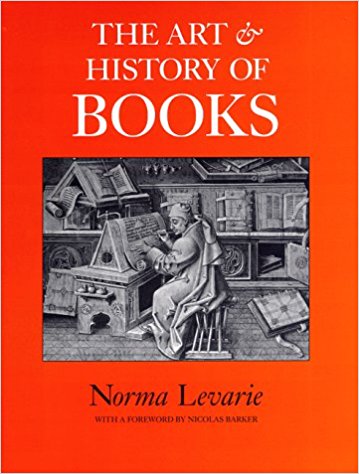
The Art & History of the Book
Book
Levarie, N. (1995) The Art & History of the Book. New Castle, DE, Oak Knoll Press, 315 pp.
ISBN/ISSN: 1884718027 | Sinkankas/Born No.: NIS/NIB | RWHL
gems, books on books, book collecting, gem books, bibliography
Norma Levarie’s The Art & History of Books, originally published in 1968 and reissued by Oak Knoll Press and the British Library in 1995 with a new foreword by Nicolas Barker, is an extensively illustrated survey of the development of the book as an artistic, intellectual, and material object. Rather than treating the history of printing solely as a sequence of technological innovations, Levarie examines the relationship between book design and the changing religious, political, economic, and cultural circumstances of the societies that produced books. The study ranges from the earliest surviving examples of written and illustrated books to twentieth-century publishing, considering the evolution of manuscript production, typography, illustration, page composition, and the aesthetic principles governing the relationship between text and image. Particular attention is given to the transformation from manuscript to printed book and the ways in which printers, artists, publishers, and patrons adapted established artistic conventions to new methods of reproduction. The introduction of movable-type printing in fifteenth-century Europe is considered within the broader history of bookmaking, emphasizing both its revolutionary consequences and its continuity with earlier manuscript traditions. Levarie examines the influence of Renaissance humanism, religious reform, expanding literacy, and changing patterns of patronage upon the appearance and production of books. The study follows the development of European printing through successive centuries, addressing the interaction between typography, illustration, decorative ornament, and the increasingly specialized professions associated with book production. Illustrated books receive particular emphasis, including the artistic possibilities offered by different reproductive techniques and the contributions of artists and designers to the visual character of printed works. The changing relationship between publisher, printer, illustrator, and reader is examined alongside improvements in printing technology and the emergence of new markets for books. The discussion extends beyond European printing to consider bookmaking traditions in other parts of the world, placing Western developments within a broader cultural and artistic context. One of the publication’s principal strengths is its extensive visual documentation, comprising 176 facsimile pages reproduced from books selected for their unusual beauty, historical significance, or distinctive design. Many examples were photographed specifically for the original publication, allowing readers to examine the arrangement of type, illustrations, margins, ornament, and other elements of page design. These reproductions are integral to the author’s argument that the history of the book cannot be understood independently of the physical and visual qualities of surviving examples. The volume itself demonstrates the principles under discussion through its carefully considered typography, page layout, and relationship between illustrations and explanatory text. The 1995 edition preserves the original study while adding Barker’s introductory perspective and an updated bibliography. Although the work is not specifically concerned with gemology, it provides valuable historical context for the study of early mineralogical, scientific, and gemological publications, particularly their typography, engraved illustrations, printing methods, and changing standards of book design. For bibliographers and collectors of historical gemological literature, the volume offers a useful framework for understanding the artistic and technological circumstances in which illustrated books were produced, as well as the importance of their physical characteristics in bibliographic description and historical interpretation.