
Four Treasures Reference Database
Record No. 140
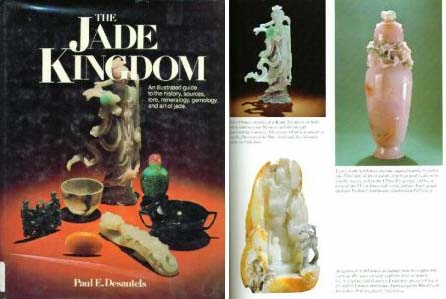
The Jade Kingdom
Book
Desautels, P.E. (1986) The Jade Kingdom. New York, Van Nostrand Reinhold, 118 pp.
Sinkankas/Born No.: 1667; NIB | RWHL
jade, jadeite, fei cui, nephrite, Burma, China, gems
Jade towers above all other hardstone carving materials—rose quartz, aventurine, agate, rock crystal, bloodstone, lapis lazuli, turquoise, and the rest—in both long-term popularity and sustained value, yet despite its intensive exploitation by widely diverse cultures, little authoritative work exists in the English language. When books on jade do appear, they are usually no more than cursory surveys of some of the more exotic carvings that have flowed, generation after generation, from the lapidary shops of China. But jade’s history, lore, mineralogy, gemology, and art cannot be confined to the ideas of “green” and “China”: the material has been known for thousands of years, is widely distributed across the Earth’s surface, and has been extensively used by several ancient and modern civilizations. Nonetheless, the Chinese have had the most enduring and sophisticated association with jade, especially the green varieties, which have consistently been the most highly prized. Over time, Chinese jade carving developed into a highly refined art form, incorporating a vast repertoire of designs and symbols, many of whose meanings are either lost to history or distorted through transmission. Given this richness and complexity—ancient and modern, primitive and sophisticated, sacred and secular, symbolic and utilitarian—it is no surprise that the study of jade has largely been undertaken by artists, art historians, anthropologists, and archaeologists. The systematic study of jade is still relatively recent, and its development has been hindered by various obstacles. Art historians and archaeologists have struggled to identify and date jade objects that were removed from their original contexts by unscientific collecting methods; when written records exist, they are often vague or inaccurate. It is remarkable that researchers have managed to sketch out a tentative chronology of styles and periods spanning thousands of years, despite the uncertainties surrounding many questions—such as when diamond-cutting tools were introduced into China or where the high-quality jade used in ancient Mesoamerica was originally mined. Nonetheless, efforts to synthesize evidence from different scientific fields are beginning to bear fruit. Misguided theories, like ancient commerce between China and the Americas or the Asiatic origins of European jade, have now been discredited with the discovery of jade deposits in Europe itself. Slowly but steadily, records of jade use across various civilizations are being clarified as raw data yield to sustained scientific scrutiny. One central challenge has always been defining what jade actually is. “Jade” is a gemological rather than a mineralogical term, and for much of history, it was identified on the basis of qualities such as toughness, workability, edge-holding ability, and beauty—rather than chemical composition. Only in the 1860s did Alexis Damour succeed in distinguishing the two principal varieties, nephrite and jadeite, through chemical analysis. Since then, accumulated analytical results, new deposit discoveries, and artifact sampling have refined but also complicated these definitions. New findings, such as the chromium-bearing jadeite known as ureyite, and the growing understanding of jade as a heterogeneous rock rather than a pure mineral, have further muddied the waters. As a result, public confusion remains high, and authoritative facts are difficult to find, scattered as they are across obscure and highly technical sources. This book attempts to remedy that fragmentation by compiling a coherent body of information on the nature of jade, its geological distribution, its historical use by major cultures, the ways in which those cultures worked and valued it, and the technologies they developed to master it.