
Four Treasures Reference Database
Record No. 151
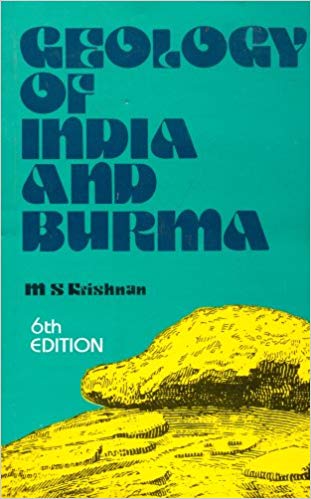
Geology of India and Burma
Book
Krishnan, M.S. (1949) Geology of India and Burma. Madras, Madras Law Journal Press, 544 pp.
Sinkankas/Born No.: NIS/NIB | RWHL
India.12, Burma.12, corundum, jade, jadeite, fei cui, gems
M.S. Krishnan’s Geology of India and Burma is a comprehensive survey of the geological structure, stratigraphy, tectonics, and mineral resources of the Indian subcontinent and Burma (Myanmar), incorporating the findings of the Geological Survey of India and other geological investigations. The work begins with an examination of the physical geography and structural features of the region, including the Himalayas, the ancient crystalline rocks of Peninsular India, the Indo-Gangetic plains, and the complex mountain belts of Burma. It then presents a systematic account of geological formations from the Archaean through the Pleistocene, discussing their distribution, lithology, fossil contents, structural relationships, and economic significance. Particular attention is devoted to the ancient metamorphic and igneous rocks of southern India, Rajasthan, and the Eastern Ghats, together with the geological formations of the Himalayan and Burmese mountain belts. Of special gemological interest are the sections dealing with corundum, beryl, garnet, tourmaline, spinel, zircon, and other gem minerals. Krishnan describes corundum occurrences associated with highly metamorphosed aluminous rocks and ultrabasic intrusions in southern India, including the Salem district of Tamil Nadu and parts of Andhra Pradesh, Karnataka, and Odisha. The discussion of Burma’s Mogok Stone Tract is particularly important. Krishnan identifies the crystalline complex of the Mogok region as consisting principally of gneisses and schists, including calc-silicate rocks and crystalline limestones, together with granitic and other igneous intrusions. He describes the metamorphic mineral assemblages associated with ruby and sapphire occurrences, including calcite, diopside, scapolite, forsterite, spinel, garnet, and other minerals. Ruby is associated particularly with crystalline limestone and calc-silicate rocks, while sapphire, spinel, tourmaline, zircon, and other gemstones are recorded from the region. Krishnan notes the long history of ruby mining in the Mogok district and the continued importance of its gemstone production. The broader survey of mineral resources includes references to precious and semiprecious stones such as moonstone, peridot, aquamarine, amethyst, topaz, cat’s-eye, and garnet, as well as the diamond deposits of India. The diamond-bearing formations of the Vindhyan System receive particular attention, including the historic workings around Panna in Madhya Pradesh and the occurrence of diamonds in conglomerates and associated geological formations. Krishnan also discusses the geological conditions of the diamond-bearing districts of southern India and their relationship to ancient sedimentary deposits and volcanic rocks. Throughout the work, mineral occurrences are considered within their geological and structural settings rather than simply as isolated localities. Numerous geological maps, stratigraphic tables, diagrams, and bibliographies accompany the regional descriptions. The book provides a valuable historical synthesis of geological knowledge in India and Burma during the first half of the twentieth century, particularly for understanding the geological environments of important ruby, sapphire, diamond, and other gemstone deposits before the development of modern plate-tectonic interpretations.