
Four Treasures Reference Database
Record No. 1539
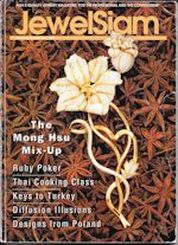
Lab Report: Kashan synthetic rubies; synthetic ruby from Russia; hydrothermal synthetic ruby—infrared spectrum
Journal Article
Scarratt, K. (1994) Lab Report: Kashan synthetic rubies; synthetic ruby from Russia; hydrothermal synthetic ruby—infrared spectrum. JewelSiam, Vol. 5, No. 1, February/March, pp. 62–69.
ISBN/ISSN: 8581843 | Sinkankas/Born No.: NIS / NIB | RWHL
corundum, synthetic corundum.7, gems
Three laboratory notes describe the production history, internal characteristics, and infrared examination of synthetic rubies encountered by the Asian Institute of Gemological Sciences. The Kashan note records Steve Ruyle’s acquisition of the remaining production assets associated with the synthetic ruby originally manufactured by F. Truehart Brown from the mid-1960s. Ruyle reported acquiring several furnaces, one of which was producing small quantities of Kashan-type material by what he described as a combination of flux and hydrothermal techniques. The stones actually examined were reportedly more than ten years old, so their characteristics document earlier material rather than establish the properties of the new production. Their colours ranged from pink through orangy red to deep purple-red. Microscopy revealed characteristic flux-filled feathers resembling twisted veils and isolated flux-filled cavities with forms previously likened to moccasin footprints, dog bones, or paint splashes. A second note examines two Russian synthetic ruby products attributed to different growth processes. The first was described as horizontally grown by a method combining aspects of pulling and floating-zone techniques, using a seed, a boat-shaped container of powdered constituents, and a moving tungsten heat source. Several heating passes reportedly produced a large crystal over approximately two weeks. The specimen examined weighed 2,817 carats despite being broken at one end, measured approximately 11 × 9 × 2 cm, and contained numerous gas bubbles together with dendritic crystal formations concentrated in its pointed end. The second product was reportedly made by combining Verneuil flame fusion and pulling techniques. Its 286.44-carat crystal, approximately 7 × 2 cm, had a roughly hexagonal seed-end outline and a rippled, silky exterior. Unlike typical Verneuil material, it appeared free of the usual bubbles; the only observed growth structures were fine diagonal lines. The final note reports Fourier-transform infrared examination of a previously described Russian hydrothermal synthetic ruby using a Nicolet Magna 550 spectrometer. Comparison with a natural ruby from Myanmar revealed distinct spectral differences across approximately 3800–2800 cm⁻¹, illustrated by pronounced absorption features in the synthetic specimen.