
Four Treasures Reference Database
Record No. 1558
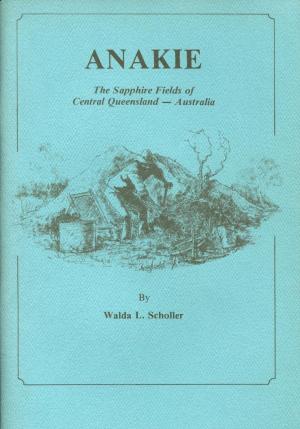
Anakie: The Sapphire Fields of Central Queensland—Australia
Book
Scholler, W.L. (1985) Anakie: The Sapphire Fields of Central Queensland—Australia. Anakie, E & W Scholler, 112 pp.
Sinkankas/Born No.: NIS/NIB | RWHL
corundum, Australia.12, quality.10, gems
Walda L. Scholler’s Anakie: The Sapphire Fields of Central Queensland—Australia, first published in 1985 and subsequently revised in 1986 and 1990, is an illustrated regional history of the sapphire-mining districts surrounding Anakie, Rubyvale, and Sapphire in central Queensland. Written and published locally, the book documents the development of one of Australia’s most important gemstone-producing regions, combining the history of sapphire discoveries and mining settlements with accounts of the people and commercial interests associated with the fields. The region’s recorded sapphire history began in 1873, when surveyor Archibald John Richardson discovered sapphire near Retreat Creek, west of Emerald. Subsequent discoveries and mining activity established a district internationally known for its corundum deposits, particularly blue, yellow, green, and parti-colored sapphires. The sapphire fields attracted prospectors, small-scale miners, merchants, cutters, and collectors, whose activities connected relatively isolated Queensland settlements with international gemstone markets. The book is especially interesting for its treatment of exceptional gemstones recovered from the fields. A description of the third edition identifies several notable stones, including the Golden Willow, Stonebridge’s Green, the Centenary Gem, and the celebrated Black Star of Queensland. The latter, a remarkably large star sapphire, became internationally famous through its acquisition by the Kazanjian brothers, Los Angeles jewelers and gemstone dealers. The same description indicates that the book discusses the brothers’ purchasing activities and their acquisition of other important Anakie gemstones, illustrating the influence of international buyers upon the marketing of Australian sapphire. This aspect of the local industry is particularly relevant to gemological trade history, since Australian rough sapphire became an important component of the material exported to Thailand for cutting, treatment, and international distribution. Contemporary gemological reporting confirms that, by the 1980s, Thai buyers were purchasing substantial quantities of sapphire directly from Australian mining operations, with heat treatment frequently employed to improve appearance. Although these broader trade practices provide context for Scholler’s subject, their treatment in the book has not been independently verified. The publication is of particular bibliographic and historical interest because it records a regional gemstone industry through the perspective of a local author, preserving information concerning mining settlements, notable discoveries, and personalities that might otherwise be dispersed among local records and oral traditions. The 1990 third edition comprises 112 pages and includes illustrations. A separate, later publication by Scholler, Images of the Anakie Sapphire Fields, Queensland (1993), was praised in a contemporary Journal of Gemmology review for its detailed historical research, particularly its extensive use of local newspaper accounts and documentation of miners and mining personalities. That review concerns the later book and cannot establish the precise contents of the 1985–1990 editions. Nevertheless, the documented subject matter of Anakie makes it a useful reference for the history of Australian sapphire mining, notable corundum discoveries, and the development of commercial connections between Queensland’s gemfields and the international gemstone trade.