
Four Treasures Reference Database
Record No. 16372
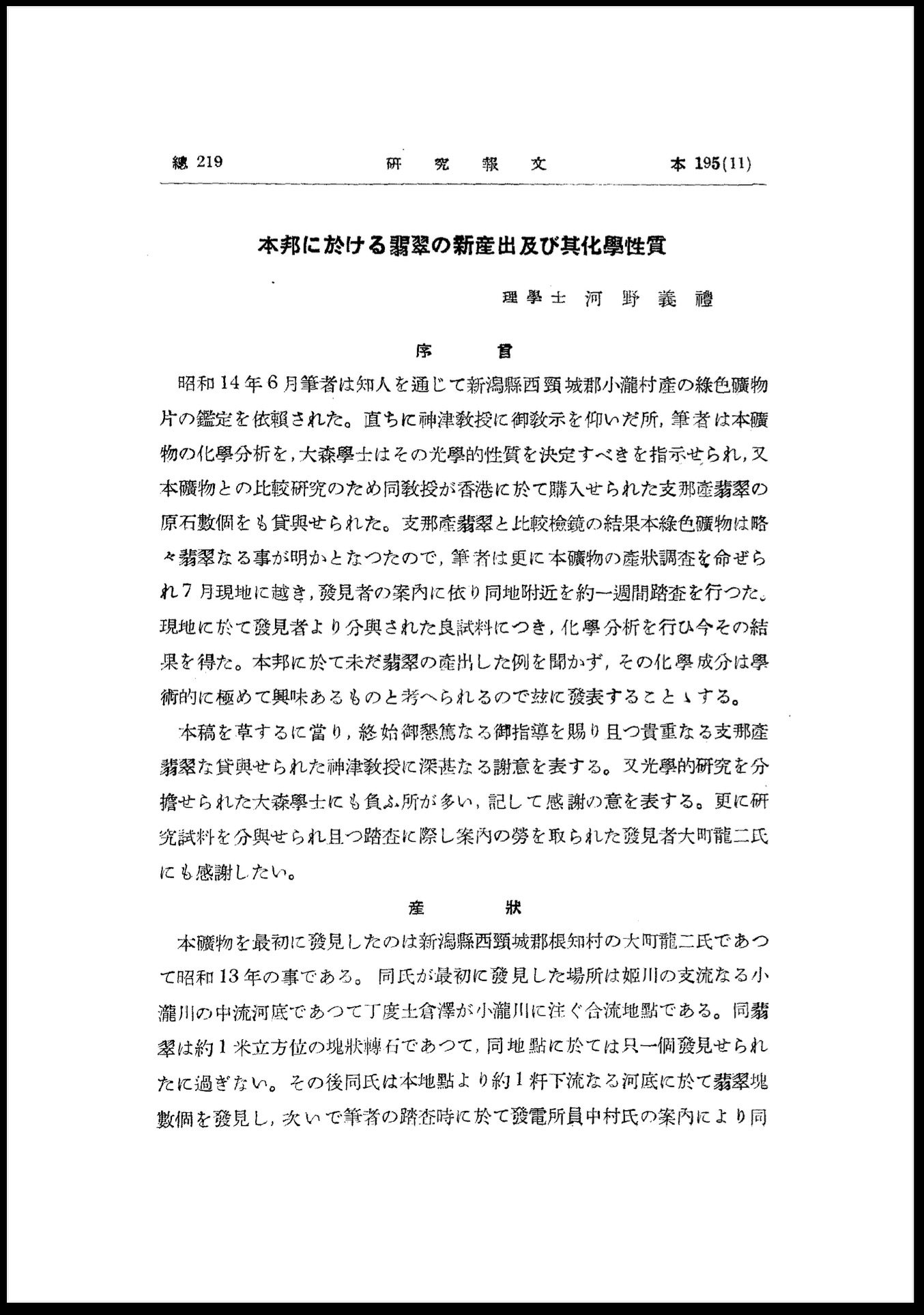
A new occurrence of jade (jadeite) in Japan and its chemical properties
本邦に於ける翡翠の新産出及び其化學性質
Journal Article
Kawano, Y. (1939) A new occurrence of jade (jadeite) in Japan and its chemical properties. [本邦に於ける翡翠の新産出及び其化學性質] Journal of the Japanese Association of Mineralogists, Petrologists and Economic Geologists, Vol. 22, No. 5, pp. 219–225.
Sinkankas/Born No.: NIS/NIB | Language: in Japanese | RWHL
gems, jade, jadeite, fei cui, Japan
Kawano reports the first recognized occurrence of jadeite in Japan, discovered as large boulders in the Kotaki River near Kotaki, Niigata Prefecture. Field investigation located more than ten jadeite blocks within a restricted area of about 150 m, suggesting a nearby bedrock source associated with the contact zone between limestone, sandstone-shale, and small serpentinite bodies. The jadeite is principally white, with locally attractive green portions commonly developed adjacent to veins of actinolite/tremolite; associated minerals led Kawano to tentatively suggest formation by contact metamorphism, although he emphasized that the origin required further study. Chemical analyses of both green and white material showed compositions close to jadeite, with the green portion containing slightly more MgO and CaO because of included amphibole. Kawano interpreted K, Ca, Mg, and Fe²⁺ as substituting principally for Na rather than representing a diopside component in solid solution, rejecting Winchell’s interpretation. The analyses are compared with jadeites from Burma, China, Switzerland, and other localities.