
Four Treasures Reference Database
Record No. 16450
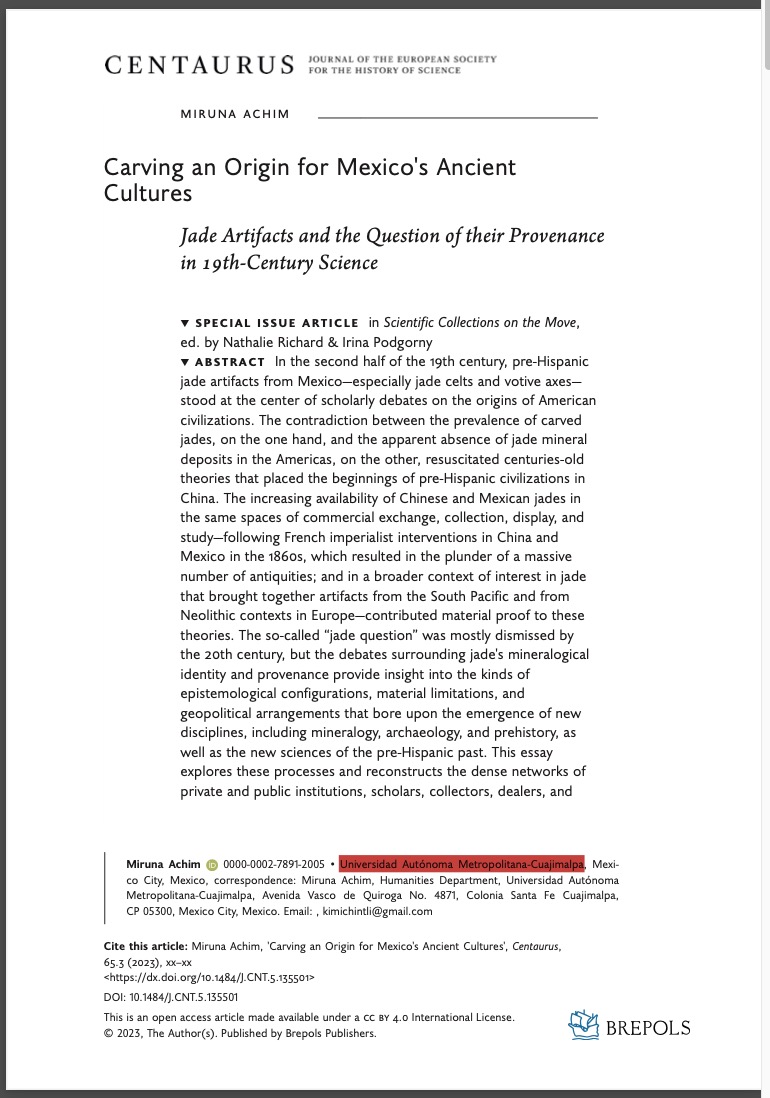
Carving an origin for Mexico's ancient cultures. Jade artefacts and the question of their provenance in the 19th century
Journal Article
Achim, M. (2023) Carving an origin for Mexico's ancient cultures. Jade artefacts and the question of their provenance in the 19th century. Centaurus, Vol. 65, No. 3, 21 pp..
gems, jade, pyroxene jade, fei cui, Chinese history, 1766 BC-220 AD, Chinese history, Mesoamerica, Guatemala, Mexico, nephrite, South Pacific, Europe, Mayan, Olmec, Fischer-Other
In the second half of the nineteenth century, prehispanic jade artifacts from Mexico– especially jade celts and votive axes – stood at the center of scholarly debates on the origins of American civilizations. The contradiction between the prevalence of carved jades, on the one hand, and the apparent absence of jade mineral deposits in the Americas, on the other, resuscitated centuries-old theories that placed the beginnings of prehispanic civilizations in China. The increasing availability of Chinese and Mexican jades in the same spaces of commercial exchange, collection, display, and study – following French imperialist interventions in China and Mexico in the 1860s, which resulted in the plunder of a massive number of antiquities—, in a broader context of interest in jade that brought together artifacts from the South Pacific and from Neolithic contexts in Europe, contributed material proof to these theories. The so-called “jade question” was mostly dismissed by the twentieth century, but the debates surrounding jade’s mineralogical identity and provenance provide insight into the kinds of epistemological configurations, material limitations, and geopolitical arrangements that bore upon the emergence of new disciplines, including mineralogy, archaeology, and prehistory, as well as the new sciences of the prehispanic past. This essay explores these processes and reconstructs the dense networks of private and public institutions, scholars, collectors, dealers, and connoisseurs, that made jade artifacts from Mexico – and Central America — into a scientific, aesthetic, and commercial category.