
Four Treasures Reference Database
Record No. 16454
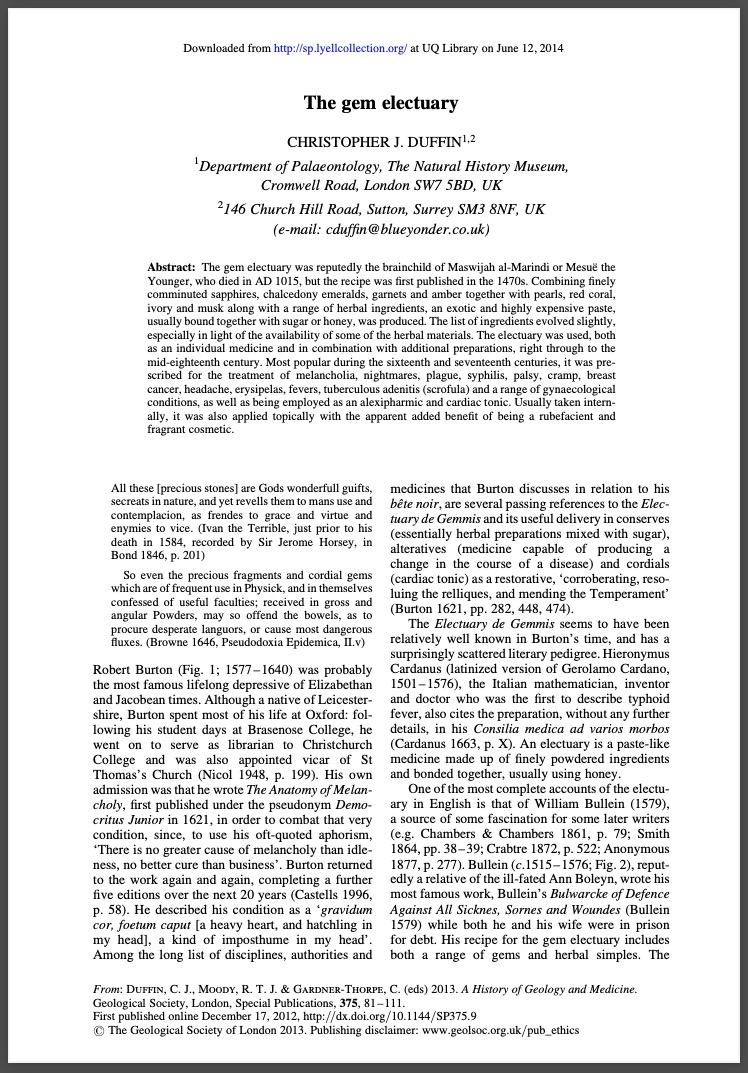
The gem electuary
Book Section
Duffin, C.J. (2013) The gem electuary. In: A History of Geology and Medicine, London: Geological Society, London, Special Publications, Vol. 375 , pp. 81–111.
Sinkankas/Born No.: NIS/NIB | RWHL*
Close Abstract
Hide Keywords
Copy Reference
gems, jade, medicine, history of medicine
The gem electuary was reputedly the brainchild of Maswijah al-Marindi or Mesuë the Younger, who died in AD 1015, but the recipe was first published in the 1470s. Combining finely comminuted sapphires, chalcedony emeralds, garnets and amber together with pearls, red coral, ivory and musk along with a range of herbal ingredients, an exotic and highly expensive paste, usually bound together with sugar or honey, was produced. The list of ingredients evolved slightly, especially in light of the availability of some of the herbal materials. The electuary was used, both as an individual medicine and in combination with additional preparations, right through to the mid-eighteenth century. Most popular during the sixteenth and seventeenth centuries, it was prescribed for the treatment of melancholia, nightmares, plague, syphilis, palsy, cramp, breast cancer, headache, erysipelas, fevers, tuberculous adenitis (scrofula) and a range of gynaecological conditions, as well as being employed as an alexipharmic and cardiac tonic. Usually taken internally, it was also applied topically with the apparent added benefit of being a rubefacient and fragrant cosmetic.