
Four Treasures Reference Database
Record No. 16456
‘Not used to be worn as a Jewel’: The wearing of precious stones in early modern England – ornaments or medicine?
Book Section
Blaen, T. (2016) ‘Not used to be worn as a Jewel’: The wearing of precious stones in early modern England – ornaments or medicine? In: Geology and Medicine: Historical Connections, London: Geological Society, London, Special Publications, Vol. 452, Issue 1
Sinkankas/Born No.: NIS/NIB | RWHL*
gems, medicinal uses of gems, lore, history of gems
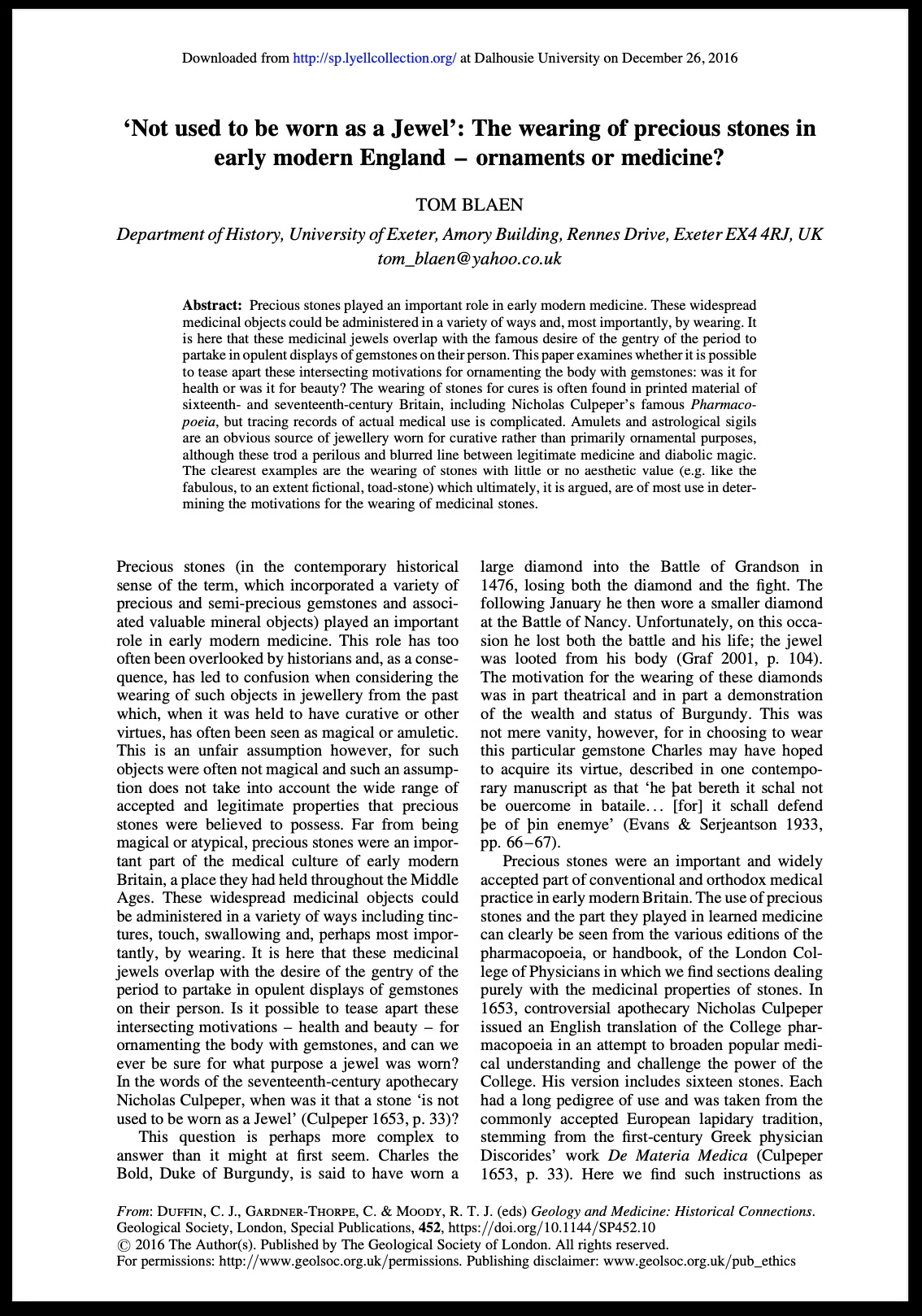
Precious stones played an important role in early modern medicine. These widespread medicinal objects could be administered in a variety of ways and, most importantly, by wearing. It is here that these medicinal jewels overlap with the famous desire of the gentry of the period to partake in opulent displays of gemstones on their person. This paper examines whether it is possible to tease apart these intersecting motivations for ornamenting the body with gemstones: was it for health or was it for beauty? The wearing of stones for cures is often found in printed material of sixteenth- and seventeenth-century Britain, including Nicholas Culpeper's famous Pharmacopoeia, but tracing records of actual medical use is complicated. Amulets and astrological sigils are an obvious source of jewellery worn for curative rather than primarily ornamental purposes, although these trod a perilous and blurred line between legitimate medicine and diabolic magic. The clearest examples are the wearing of stones with little or no aesthetic value (e.g. like the fabulous, to an extent fictional, toad-stone) which ultimately, it is argued, are of most use in determining the motivations for the wearing of medicinal stones.