
Four Treasures Reference Database
Record No. 16499
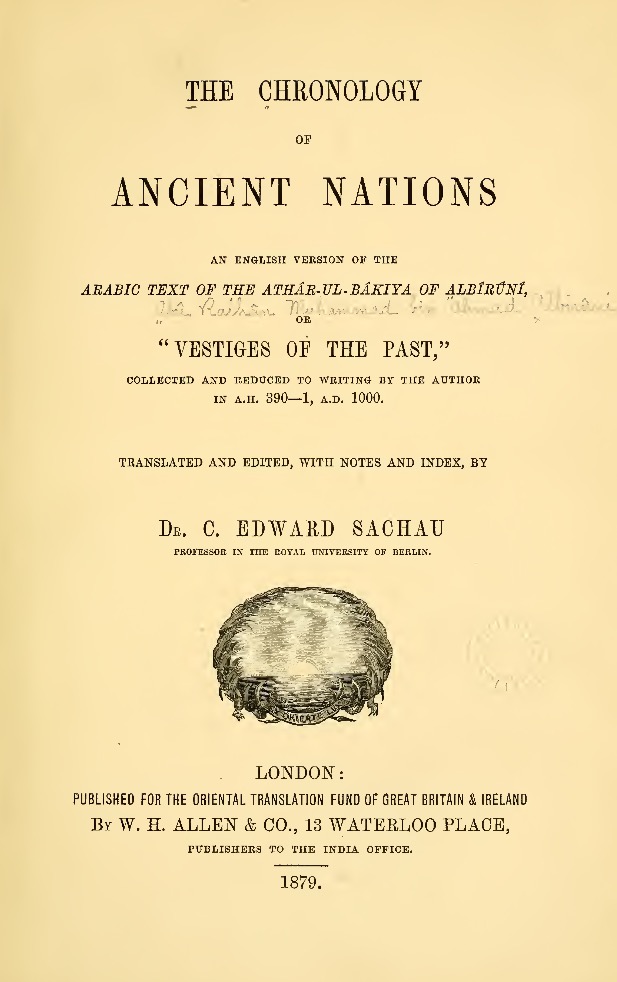
The chronology of ancient nations; an english version of the Arabic text of the Athâr-ul-Bâkiya of Albîrûnî, or Vestiges of the past""
Book
Biruni, M.i.A., al- and Sachau, E.C. (1879) The chronology of ancient nations; an english version of the Arabic text of the Athâr-ul-Bâkiya of Albîrûnî, or Vestiges of the past"". London, Oriental Translation Fund of Great Britain & Ireland, 464 pp.
Sinkankas/Born No.: NIS/NIB | RWHL
gems, Arabic mineralogy, al-Biruni
The book known in English as ‘The Chronology of the Ancient Nations’ was written in Arabic by the famous astronomer and polymath Abu Rayhan al-Biruni (or al-Bayruni) in the year 1000. It is a monumental compendium of the calendars and chronological systems of a very wide range of societies and cultures from the late antique Hellenistic world and the ancient and medieval Near East and Central Asia, including pagans, Christians, Muslims, Jews, and Zoroastrians, as well as other religious and ethnic groups. It describes not only the technical, astronomical aspects of their time reckoning methods, but also their varied festivals and liturgical practices. This remarkable product of early Islamic scholarship sheds light on cultural and religious diversity in the early Islamic world. In the context of this project, it constitutes an important milestone in the standardization of time-reckoning in the medieval world. The ‘Chronology’ was first published, and then translated into English, by Eduard Sachau in 1878 and 1879. Sachau’s edition is based on three late manuscripts, all of which are in fact copied from a common archetype, which was not accessible to Sachau, but has since been acquired by the Edinburgh University Library; it was copied in 1307. In this manuscript, due to the physical loss of a large number of pages, substantial portions of the text are missing, e.g. in chapters 6, 7, 8, 9, 16, 20. Chapter 16, in particular, is mostly missing in Sachau’s edition: it concerns the Christian Computus, i.e. the calculation of the date of Easter. These and other deficiencies can now be corrected with the help of superior copies, in particular, a complete manuscript in Istanbul from the 12th century and several other old manuscripts. Moreover, research in the course of the last hundred years has shed considerable light on obscure or misunderstood passages in al-Biruni’s book.