
Four Treasures Reference Database
Record No. 16526
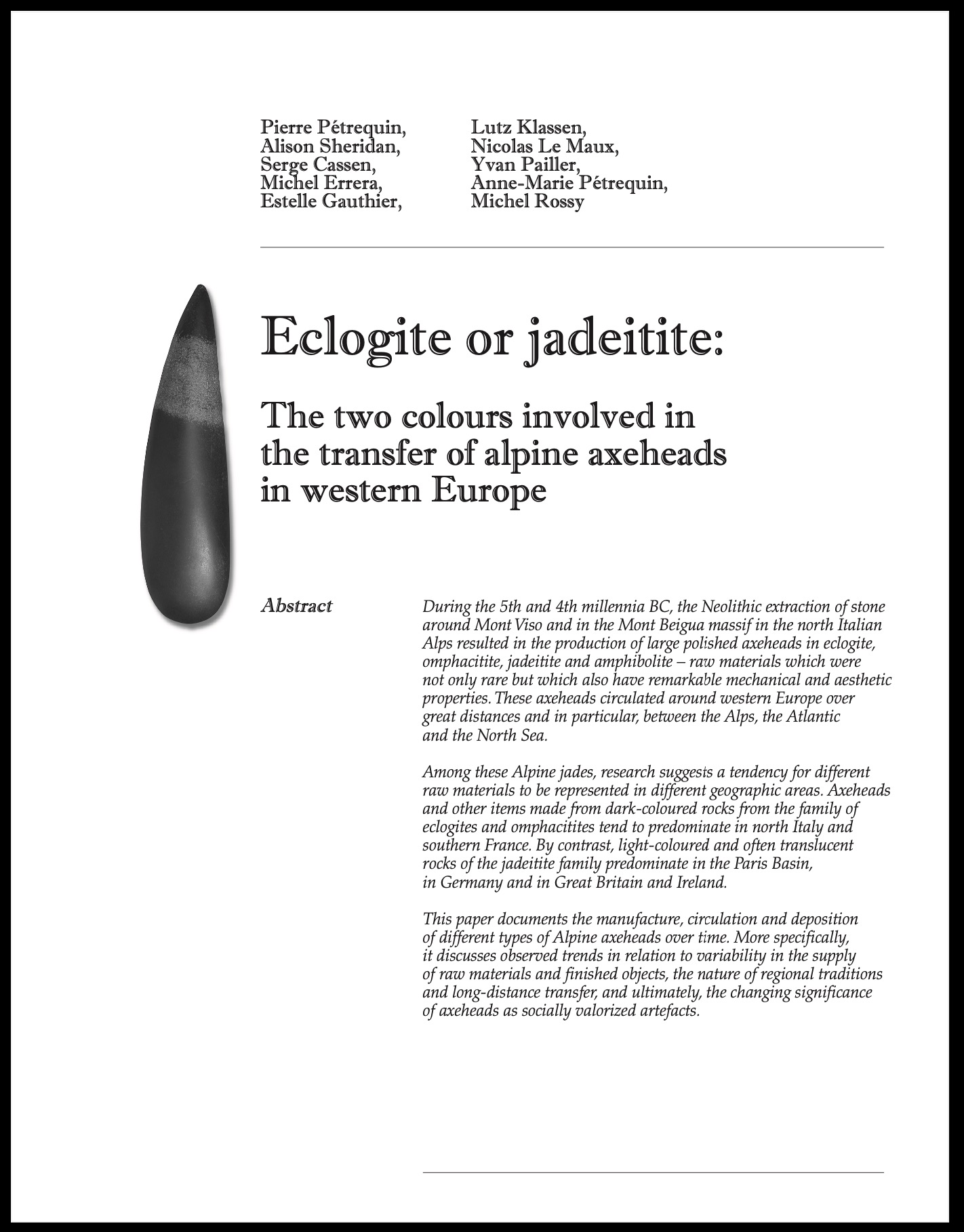
Eclogite or jadeitite: The two colours involved in the tranfer of alpine axeheads in western Europe
Book Section
Pétrequin, P., Sheridan, A., Cassen, S., Errera, M., Gauthier, E., Klassen, L., Maux, N., Le, Pailler, Y. and Pétrequin, A.-M. (2022) Eclogite or jadeitite: The two colours involved in the tranfer of alpine axeheads in western Europe. In: Stone Axe Studies III, Barnsley, UK: Oxbow Books, pp. 55–82.
ISBN/ISSN: 9781790000000 | Sinkankas/Born No.: NIS/NIB | RWHL
gems, jade, Europe, Switzerland, Italy, jade axes, nephrite, pyroxene jade, jadeite, fei cui, omphacite, kosmochlor, fei cui, Neolithic Archaeology, Stone axes (Archaeology),
During the 5th and 4th millennia BC, the Neolithic extraction of stone around Mont Viso and in the Mont Beigua massif in the north Italian Alps resulted in the production of large polished axeheads in eclogite, omphacitite, jadeitite and amphibolite – raw materials which were not only rare but which also have remarkable mechanical and aesthetic properties. These axeheads circulated around western Europe over great distances and in particular, between the Alps, the Atlantic and the North Sea. Among these Alpine jades, research suggests a tendency for different raw materials to be represented in different geographic areas. Axeheads and other items made from dark-coloured rocks from the family of eclogites and omphacitites tend to predominate in north Italy and southern France. By contrast, light-coloured and often translucent rocks of the jadeitite family predominate in the Paris Basin, in Germany and in Great Britain and Ireland. This paper documents the manufacture, circulation and deposition of different types of Alpine axeheads over time. More specifically, it discusses observed trends in relation to variability in the supply of raw materials and finished objects, the nature of regional traditions and long-distance transfer, and ultimately, the changing significance of axeheads as socially valorized artefacts.