
Four Treasures Reference Database
Record No. 16582
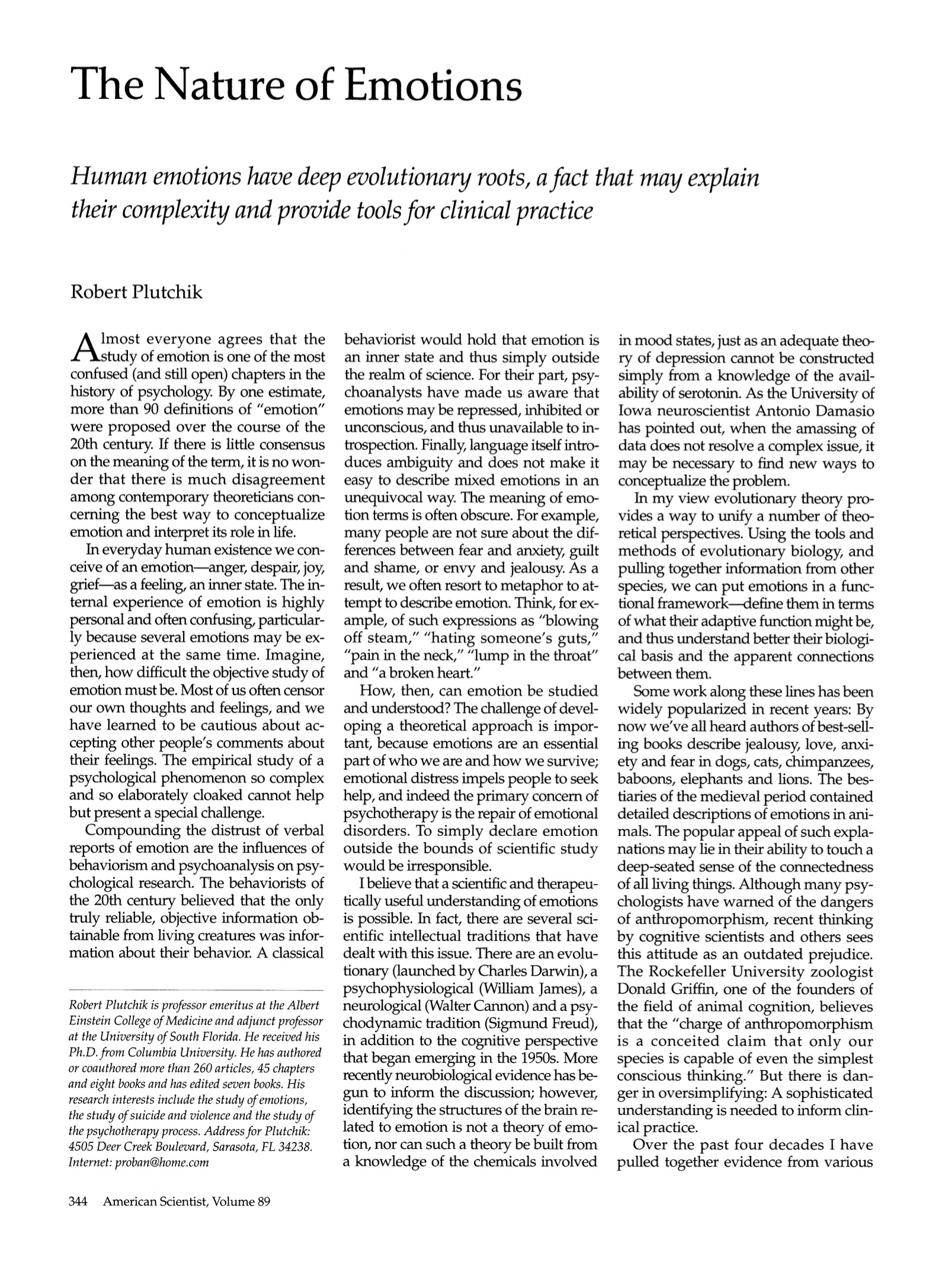
The Nature of Emotions: Human emotions have deep evolutionary roots, a fact that may explain their complexity and provide tools for clinical practice
Journal Article
Plutchik, R. (2001) The Nature of Emotions: Human emotions have deep evolutionary roots, a fact that may explain their complexity and provide tools for clinical practice. American Scientist, Vol. 89, No. 4, July–August, pp. 344–350.
ISBN/ISSN: 30996 | Sinkankas/Born No.: NIS/NIB | RWHL
gems, color science, color theory, psychology
An examination of the evolutionary origins, functions, and organization of human emotions, presenting a theoretical framework in which emotions are understood as adaptive responses developed through natural selection. The author identifies eight primary emotions—joy, trust, fear, surprise, sadness, disgust, anger, and anticipation—arranged in opposing pairs and represented in his well-known three-dimensional “wheel of emotions.” Each primary emotion can vary in intensity, while combinations of emotions produce more complex emotional states, analogous to the mixing of primary colors. Plutchik argues that emotions serve important biological functions, including protection, reproduction, social bonding, exploration, and responses to environmental challenges. The article explains how emotional experiences, behavioral expressions, and physiological responses are interconnected, and how apparently different emotions can share underlying adaptive mechanisms. Particular attention is given to the application of this evolutionary model in understanding personality, psychological disorders, and psychotherapy. The work provides an influential conceptual framework for classifying and interpreting human emotions and illustrates the usefulness of multidimensional models for organizing complex subjective experiences.