
Four Treasures Reference Database
Record No. 16583
Cultural, gender, and individual differences in perceptual and semantic structures of basic colors in Chinese and English
Journal Article
Moore, C., Romney, K. and Hsia, T.-L. (2002) Cultural, gender, and individual differences in perceptual and semantic structures of basic colors in Chinese and English. Journal of Cognition and Culture, Vol. 2,, 1-Mar pp. 1–28.
DOI: https://dx.doi.org/10.1163/156853702753693280 | RWHL
gems, color science, color theory, linguistics
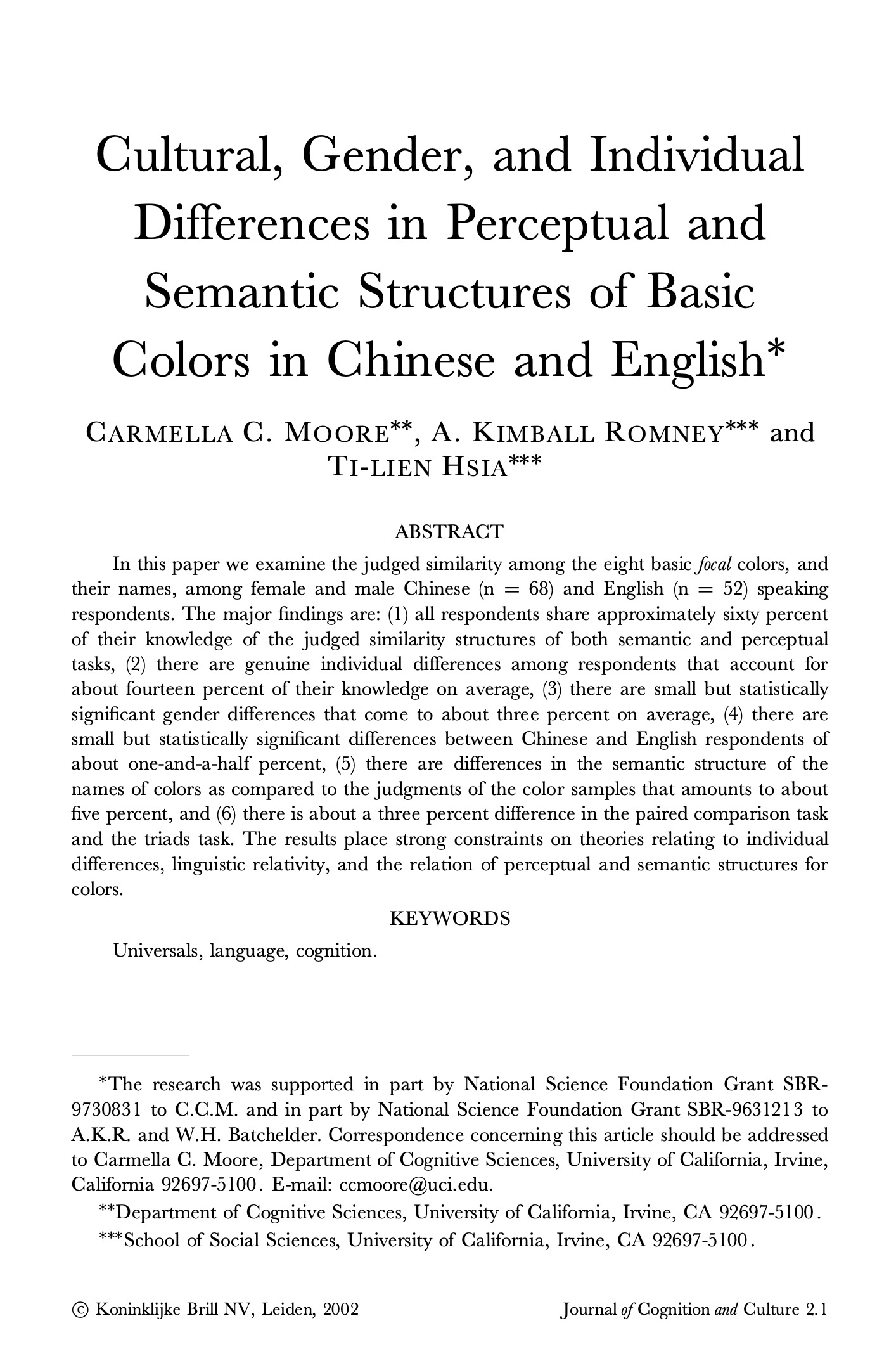
In this paper we examine the judged similarity among the eight basic focal colors, and their names, among female and male Chinese (n = 68) and English (n = 52) speaking respondents. The major findings are: (1) all respondents share approximately sixty percent of their knowledge of the judged similarity structures of both semantic and perceptual tasks, (2) there are genuine individual differences among respondents that account for about fourteen percent of their knowledge on average, (3) there are small but statistically significant gender differences that come to about three percent on average, (4) there are small but statistically significant differences between Chinese and English respondents of about one-and-a-half percent, (5) there are differences in the semantic structure of the names of colors as compared to the judgments of the color samples that amounts to about five percent, and (6) there is about a three percent difference in the paired comparison task and the triads task. The results place strong constraints on theories relating to individual differences, linguistic relativity, and the relation of perceptual and semantic structures for colors.