
Four Treasures Reference Database
Record No. 16591
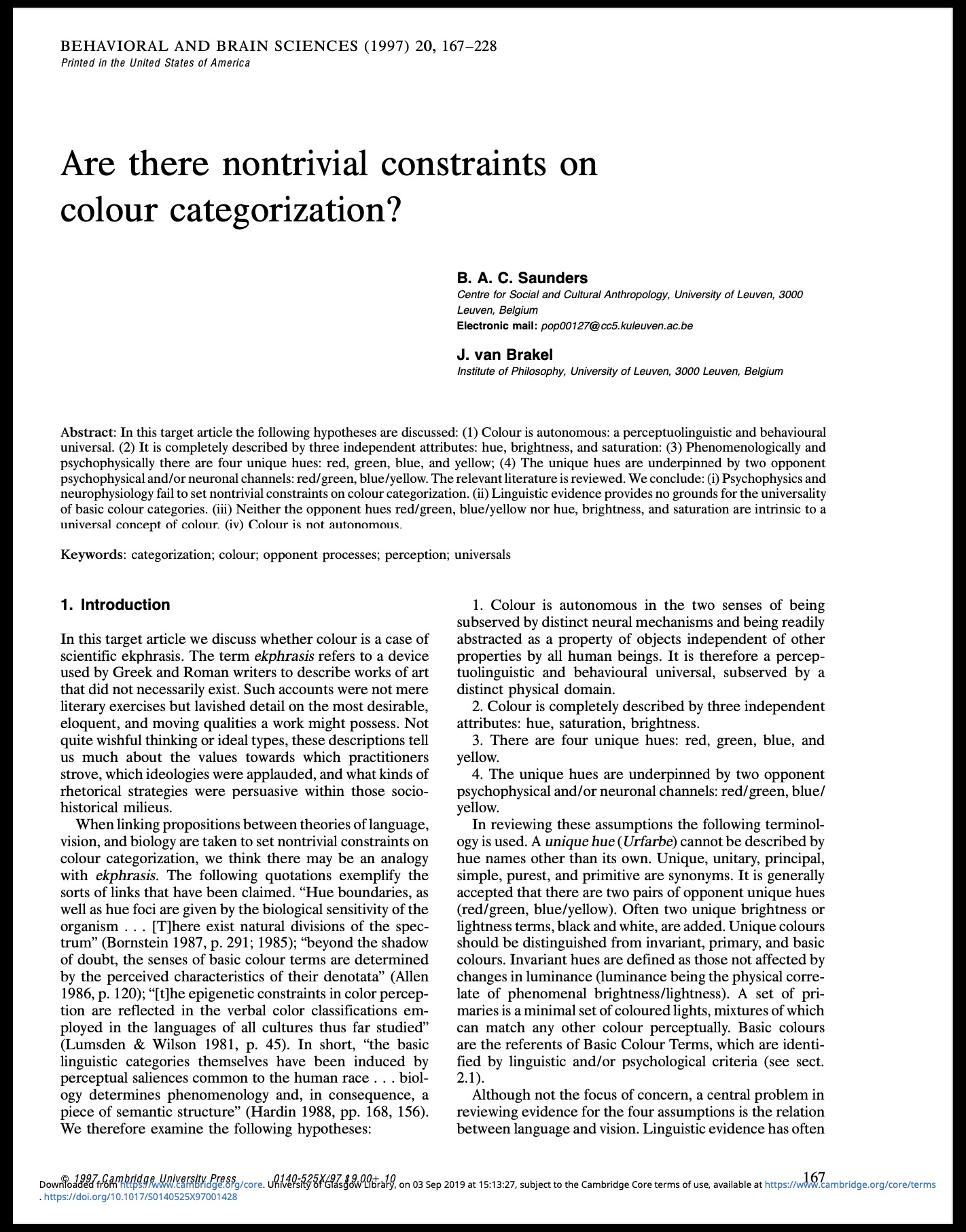
Are there nontrivial constraints on colour categorization?
Journal Article
Saunders, B.A.C. and Brakel, J., van (1997) Are there nontrivial constraints on colour categorization? Behavioral and Brain Sciences, Vol. 20, pp. 167–228.
Sinkankas/Born No.: NIS/NIB | RWHL*
gems, color science, color theory
This article explores several hypotheses: that color is autonomous, serving as a perceptuolinguistic and behavioral universal; that it is fully described by three independent attributes—hue, brightness, and saturation; that there are four unique hues (red, green, blue, and yellow) identifiable both phenomenologically and psychophysically; and that these unique hues are supported by two opponent psychophysical and/or neuronal channels (red/green and blue/yellow). After reviewing the relevant literature, we conclude that psychophysics and neurophysiology fail to impose significant constraints on color categorization, linguistic evidence does not support the universality of basic color categories, neither the opponent hues nor the attributes of hue, brightness, and saturation are intrinsic to a universal concept of color, and color is not autonomous.