
Four Treasures Reference Database
Record No. 16708
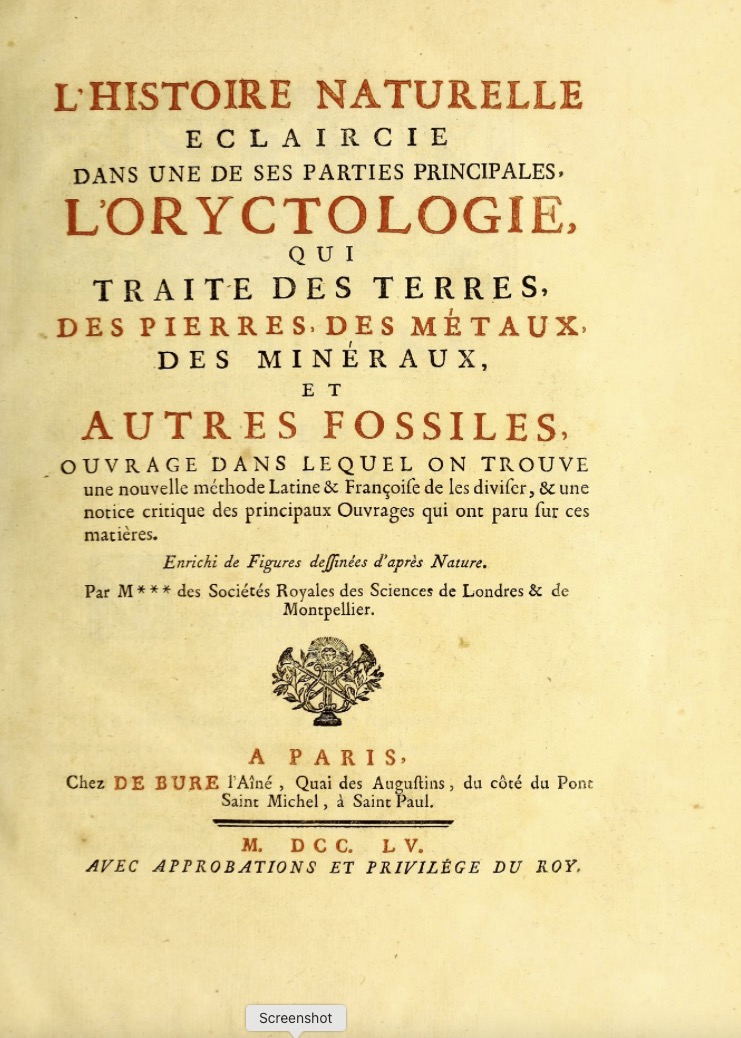
L’histoire naturelle éclaircie dans une de ses parties principales, l’oryctologie : qui traite des terres, des pierres, des métaux, des minéraux, et autres fossiles : ouvrage dans lequel on trouve un nouvelle méthode latine & françoise de les diviser, & une notice critique des principaux ouvrages qui ont paru sur ces matières
The Natural History Elucidated in One of Its Principal Parts, Oryctology: Which Deals with Earths, Stones, Metals, Minerals, and Other Fossils: A Work in Which a New Latin and French Method of Classifying Them Is Presented, Along with a Critical Review of the Principal Works Published on These Subjects
Book
Dezallier d’Argenville, A.J., Chedel, P.Q. and Collin de Vermont, H. (1755) L’histoire naturelle éclaircie dans une de ses parties principales, l’oryctologie : qui traite des terres, des pierres, des métaux, des minéraux, et autres fossiles : ouvrage dans lequel on trouve un nouvelle méthode latine & françoise de les diviser, & une notice critique des principaux ouvrages qui ont paru sur ces matières. [The Natural History Elucidated in One of Its Principal Parts, Oryctology: Which Deals with Earths, Stones, Metals, Minerals, and Other Fossils: A Work in Which a New Latin and French Method of Classifying Them Is Presented, Along with a Critical Review of the Principal Works Published on These Subjects] Paris, Chez De Bure l’aîné (560 pp.).
Sinkankas/Born No.: NIS/NIB | Language: in French | RWHL
gems, jade, Fischer-Book
Dezallier d’Argenville’s L’histoire naturelle éclaircie… l’oryctologie (1755) is an important mid-eighteenth-century treatise on what would later develop into mineralogy and geology. The work systematically describes and classifies earths, stones, metals, minerals, and other substances then grouped under the broad category of “fossils,” presenting parallel Latin and French terminology and discussing the principal earlier literature on the subject. Of particular gemological interest are its descriptions and classification of precious and ornamental stones, including diamonds, rubies, sapphires, emeralds, topazes, garnets, opals, agates, jaspers, rock crystal, and other lapidary materials, with attention to their physical appearance, varieties, localities, and contemporary nomenclature. The volume is also notable for its engraved plates, drawn by Hyacinthe Collin de Vermont and engraved by Pierre Quentin Chedel, illustrating minerals, crystals, fossils, and related natural-history specimens. It provides a valuable picture of European mineralogical and gemological knowledge immediately before the major advances in chemical mineralogy and crystallography of the later eighteenth century.