
Four Treasures Reference Database
Record No. 16752
The Central Position of the Shan/Tai as ‘Knowledge Brokers’ in the Inter-ethnic Network of the China-Burma (Myanmar) Borderlands
Conference Paper
Hlaing, C. (2007) The Central Position of the Shan/Tai as ‘Knowledge Brokers’ in the Inter-ethnic Network of the China-Burma (Myanmar) Borderlands. Shan Religion and Culture Conference, 8–10 December, London: School of Oriental and African Studies, London University, 15 pp..
Sinkankas/Born No.: NIS/NIB | RWHL
gems, jade, fei cui, pyroxene jade, history of fei cui, jade trade in Burma
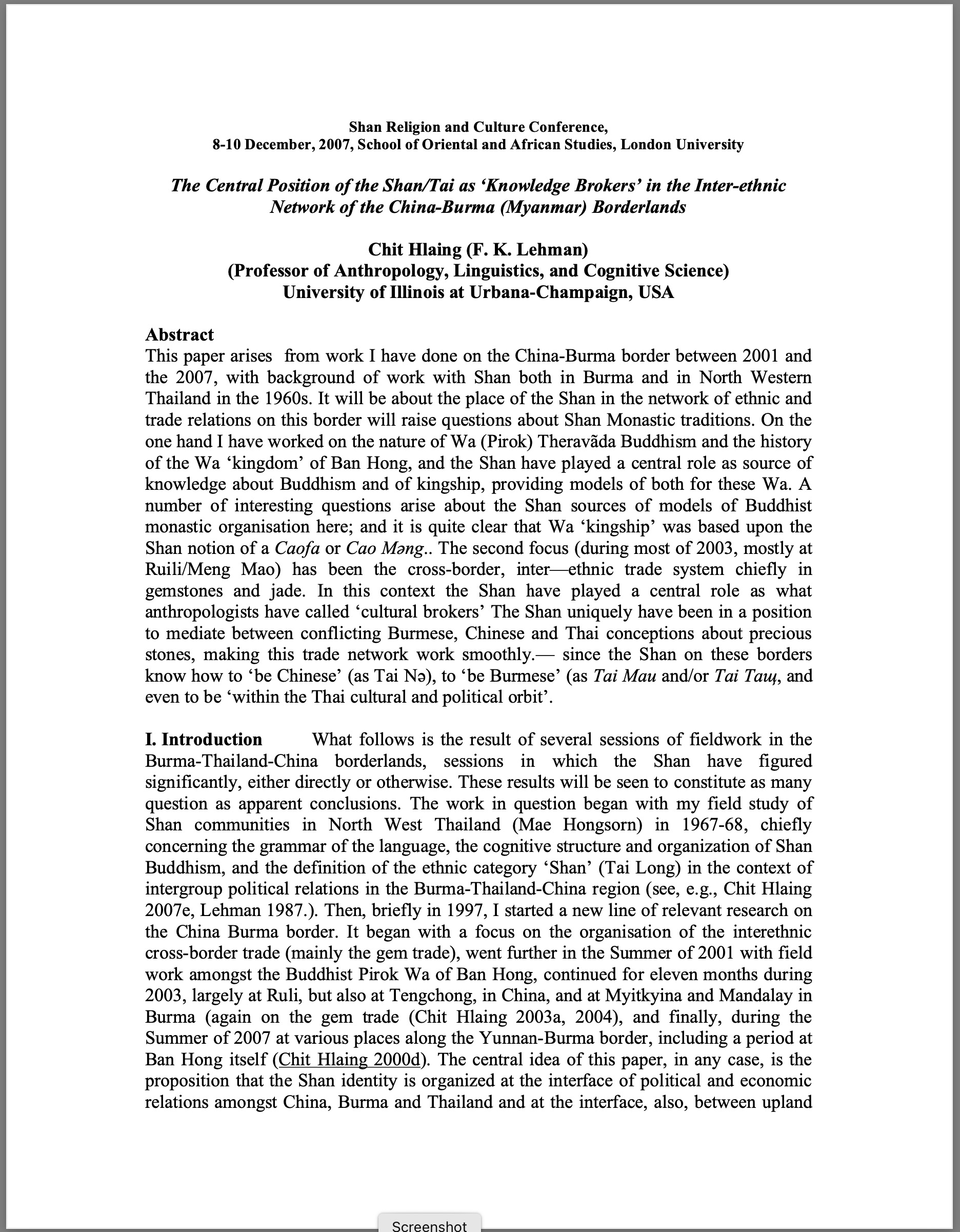
This paper arises from work I have done on the China-Burma border between 2001 and the 2007, with background of work with Shan both in Burma and in North Western Thailand in the 1960s. It will be about the place of the Shan in the network of ethnic and trade relations on this border will raise questions about Shan Monastic traditions. On the one hand I have worked on the nature of Wa (Pirok) Theravãda Buddhism and the history of the Wa ‘kingdom’ of Ban Hong, and the Shan have played a central role as source of knowledge about Buddhism and of kingship, providing models of both for these Wa. A number of interesting questions arise about the Shan sources of models of Buddhist monastic organisation here; and it is quite clear that Wa ‘kingship’ was based upon the Shan notion of a Caofa or Cao Mәng.. The second focus (during most of 2003, mostly at Ruili/Meng Mao) has been the cross-border, inter—ethnic trade system chiefly in gemstones and jade. In this context the Shan have played a central role as what anthropologists have called ‘cultural brokers’ The Shan uniquely have been in a position to mediate between conflicting Burmese, Chinese and Thai conceptions about precious stones, making this trade network work smoothly.— since the Shan on these borders know how to ‘be Chinese’ (as Tai Nә), to ‘be Burmese’ (as Tai Mau and/or Tai Taщ, and even to be ‘within the Thai cultural and political orbit’.