
Four Treasures Reference Database
Record No. 16811
Opal, a beautiful gem between myth and reality
Journal Article
Caucia, F., Ghisoli, C., Marinoni, L. and Bordoni, V. (2012) Opal, a beautiful gem between myth and reality. Neues Jahrbuch für Mineralogie - Abhandlungen, Vol. 190, No. 1, pp. 1–9.
gems, opal, ancient text
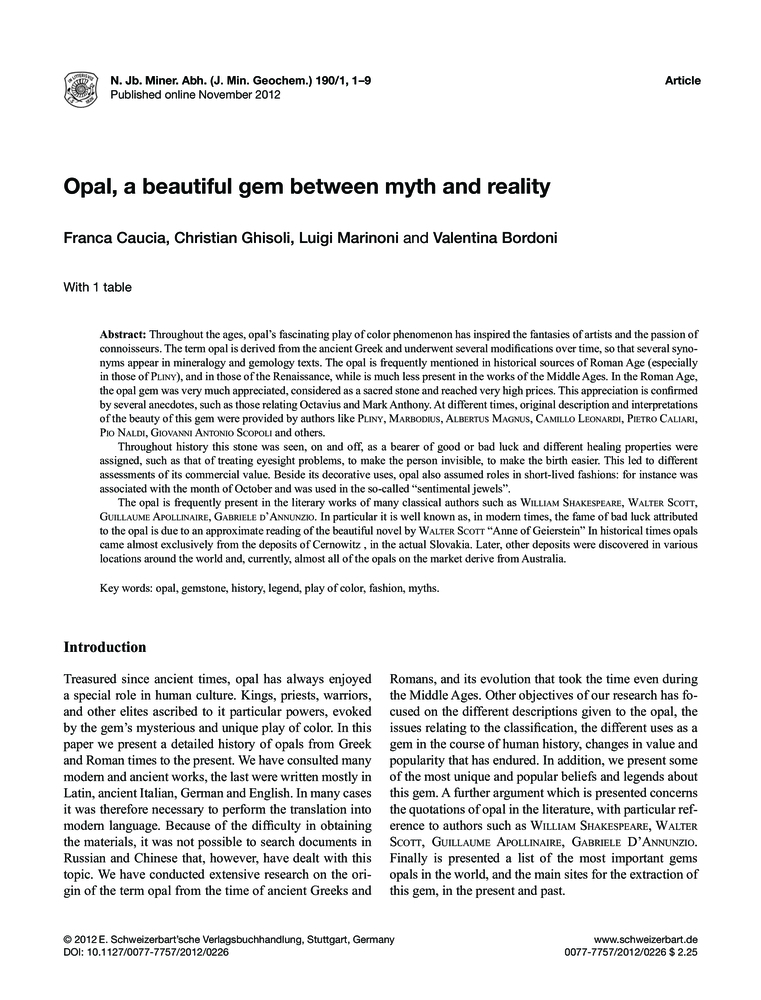
Throughout the ages, opal’s fascinating play-of-color phenomenon has inspired the fantasies of artists and the passion of connoisseurs. The term opal is derived from ancient Greek and underwent several modifications over time, resulting in various synonyms appearing in mineralogical and gemological texts. Opal is frequently mentioned in historical sources from the Roman era—especially those of Pliny—and again during the Renaissance, while it is much less referenced in medieval works. In Roman times, opal was highly valued, considered a sacred stone, and fetched very high prices, a status confirmed by anecdotes involving figures like Octavius and Mark Antony. Over time, original descriptions and interpretations of its beauty were offered by authors such as Pliny, Marbodius, Albertus Magnus, Camillo Leonardi, Pietro Caliari, Pio Naldi, Giovanni Antonio Scopoli, and others. Throughout history, the opal has alternately been regarded as a stone of good or bad luck, and it was believed to possess various healing properties, such as aiding eyesight, granting invisibility, or easing childbirth. These shifting beliefs affected its commercial value. Beyond its decorative uses, opal also played roles in transient fashions—for example, it was associated with the month of October and used in so-called “sentimental jewels.” Opal appears in the literary works of many classical and modern authors, including William Shakespeare, Walter Scott, Guillaume Apollinaire, and Gabriele d’Annunzio. Notably, the modern association of opal with bad luck stems from a misinterpretation of Walter Scott’s novel Anne of Geierstein. Historically, opals came almost exclusively from the Cernowitz deposits in what is now Slovakia; later, other deposits were discovered worldwide, and today nearly all commercially available opals originate from Australia.