
Four Treasures Reference Database
Record No. 16892
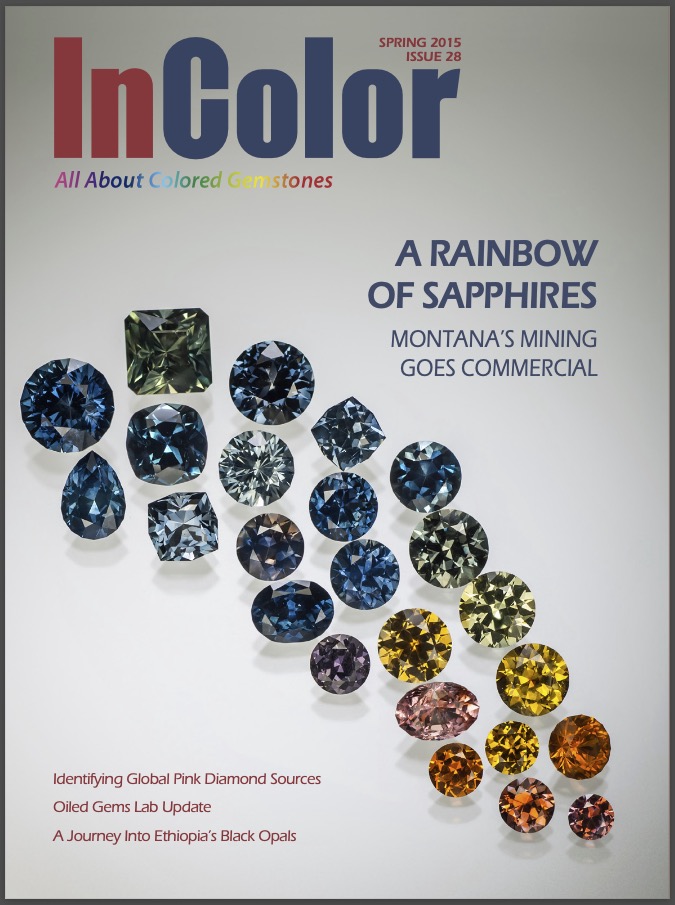
Reviewing the GemmoRaman-532
Journal Article
Hughes, E.B. (2015) Reviewing the GemmoRaman-532. InColor, Spring, pp. 28–31.
Sinkankas/Born No.: NIS / NIB | RWHL*
gems, gem testing, gemology, instruments, spectrophotometers, Raman
Hughes evaluates the GemmoRaman-532 Raman and photoluminescence spectrometer through its practical use at Lotus Gemology, emphasizing its suitability for rapid, nondestructive identification of gem materials. Designed by M&A Gemological Instruments specifically for gemmologists, the compact instrument employs a 532 nm green laser and accommodates rough and cut specimens without special preparation. The review outlines the Raman effect and explains how characteristic spectral patterns permit mineral identification, while photoluminescence can provide additional information even when fluorescence obscures the Raman signal. Operation involves calibration with a colourless diamond, positioning the specimen over the sample-stage aperture and selecting automatic or manual acquisition. A supplied neutral-density filter reduces excessive signal intensity when saturation occurs. Hughes praises the straightforward software, step-by-step prompts, customizable display and gem-specific data fields, as well as regularly updated software and reference libraries. Database searching ranks spectral matches by percentage and allows comparison with alternative references. Peak positions are emphasized as more important than relative intensities when assessing matches. However, an accurate mineral identification does not necessarily establish the correct gem variety: emerald may match aquamarine because both are beryl, and differently coloured spinels may produce closely matching spectra. A heated spinel initially classified as unheated illustrates the consequences of a mislabelled reference spectrum; the manufacturer promptly corrected the database after being notified. An informal test involving a couple of dozen rare specimens demonstrated successful identification of materials including taaffeite, painite, scapolite, poudretteite, fibrolite and kornerupine. The review nevertheless stresses that the instrument generally cannot distinguish natural, synthetic and treated counterparts, although exceptions include some spinel applications. Very dark or black materials, strongly fluorescent stones such as ruby, composites and artificial glasses can be problematic, while metals cannot be identified. Optional diamond-screening and liquid-nitrogen accessories are described but were not personally tested. Criticisms and suggested improvements concern shipping protection, native Mac software, an internally switchable neutral-density filter, alternative lid sizes and direct export of publication-quality spectral images. Hughes concludes that intuitive design, portability and responsive technical support make the instrument a valuable aid to gem testing, while careful microscopy, conventional tests and experienced interpretation remain essential.