
Four Treasures Reference Database
Record No. 16910
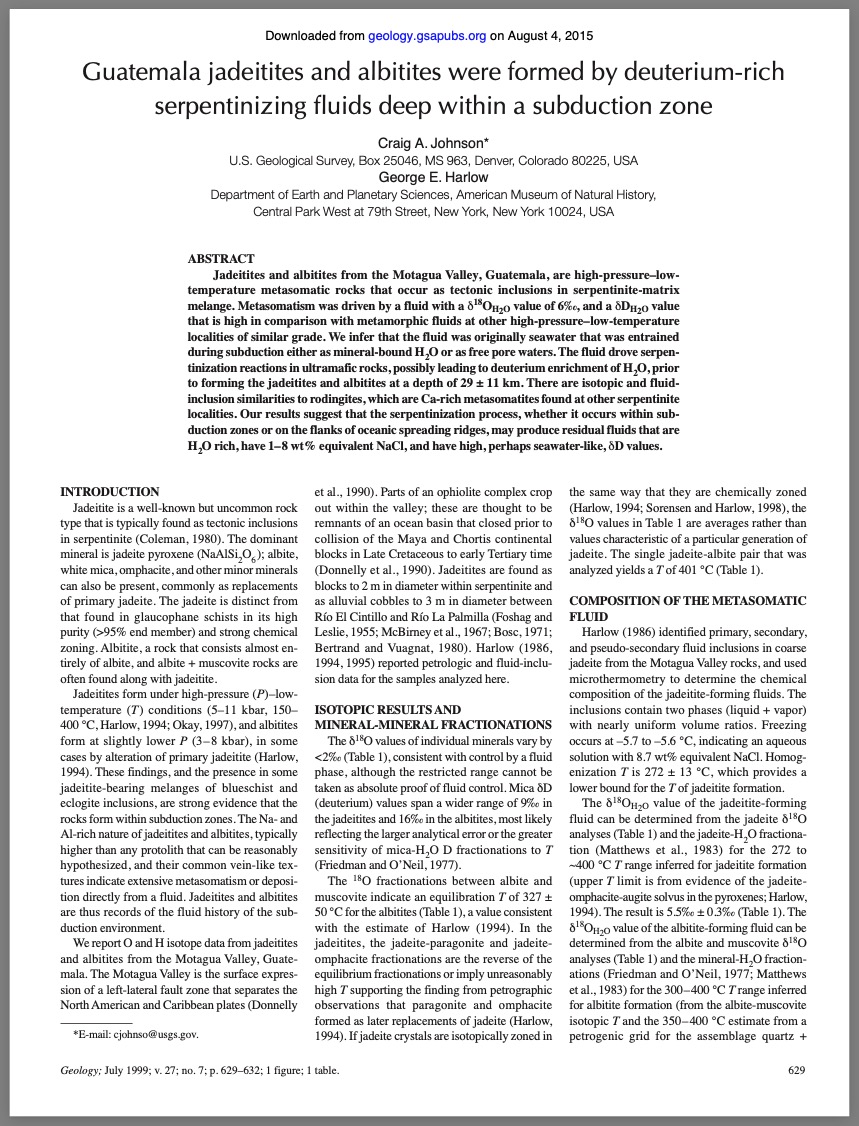
Guatemala jadeitites and albitites were formed by deuterium-rich serpentinizing fluids deep within a subduction-channel
Journal Article
Johnson, C.A. and Harlow, G.E. (1999) Guatemala jadeitites and albitites were formed by deuterium-rich serpentinizing fluids deep within a subduction-channel. Geology, Vol. 27, pp. 629–632.
Close Abstract
Hide Keywords
Copy Reference
gems, jade, fei cui, pyroxene jade, geology, Guatemala, Montagua valley, jade formation
Jadeitites and albitites from the Motagua Valley, Guatemala, are high-pressure–low-temperature metasomatic rocks that occur as tectonic inclusions in a serpentinite-matrix mélange. Metasomatism was driven by a fluid with a δ¹⁸Oₕ₂ₒ value of 6‰ and a δDₕ₂ₒ value that is high compared to metamorphic fluids from other high-pressure–low-temperature settings of similar metamorphic grade. It is inferred that the fluid was originally seawater, entrained during subduction either as mineral-bound H₂O or as free pore water. This fluid facilitated serpentinization reactions in ultramafic rocks, potentially leading to deuterium enrichment of the H₂O, before forming the jadeitites and albitites at an estimated depth of 29 ± 11 km. The isotopic signatures and fluid-inclusion data show similarities to rodingites, Ca-rich metasomatic rocks commonly found in serpentinite-bearing environments. These findings suggest that serpentinization, whether in subduction zones or at oceanic spreading ridges, may yield residual fluids that are rich in H₂O, contain 1–8 wt% equivalent NaCl, and display elevated δD values—potentially seawater-like in character.