
Four Treasures Reference Database
Record No. 16913
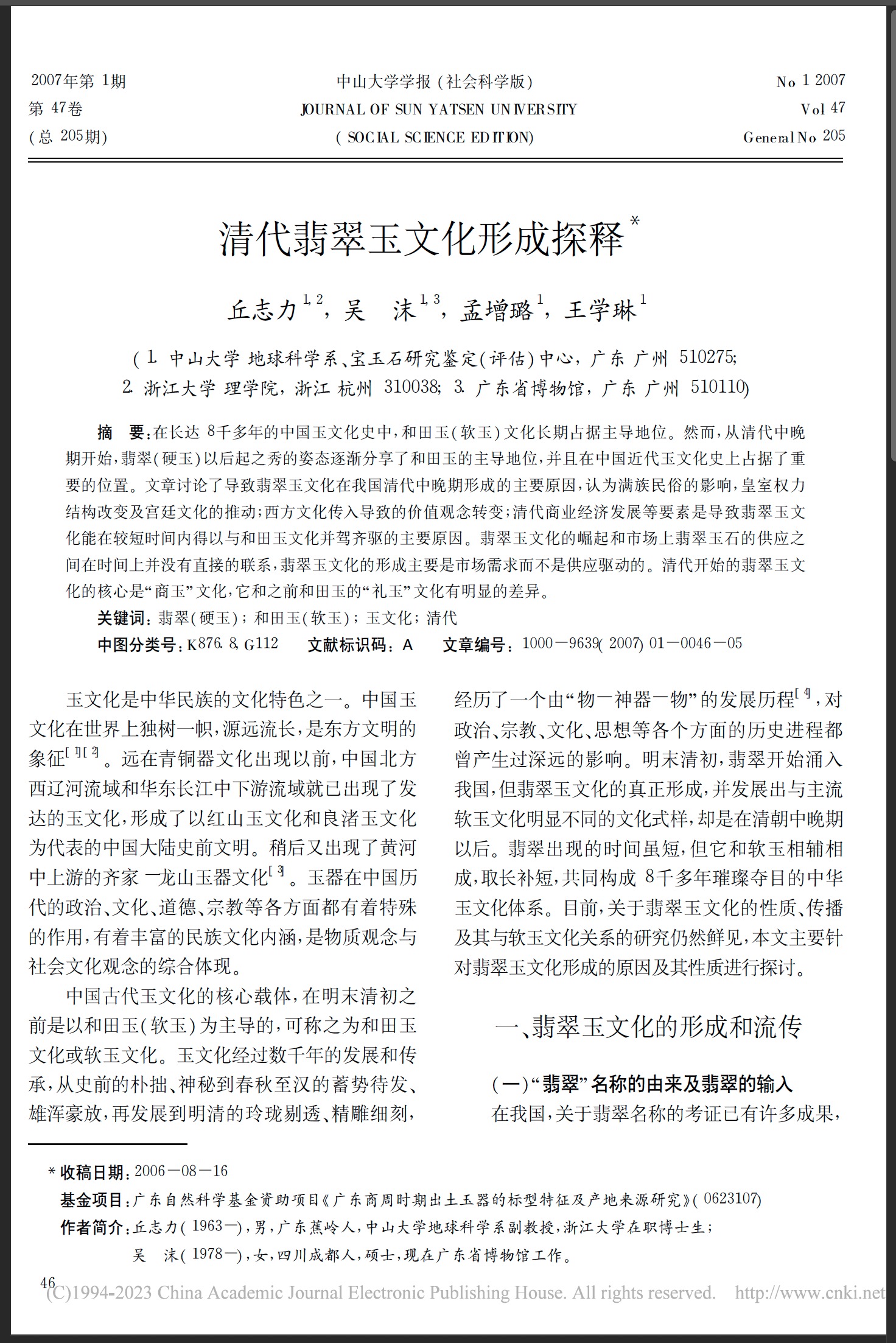
Exploration of the formation of jade culture in the Qing Dynasty
清代翡翠玉文化形成探释
Journal Article
Qiu, Z.-l., Wu, M., Meng, Z.-l. and Wang, X.-l. (2007) Exploration of the formation of jade culture in the Qing Dynasty. [清代翡翠玉文化形成探释] Journal of Sun Yat-sen University (Social Science Edition), Vol. 47, No. 1, pp. 46–51.
ISBN/ISSN: 10009639 | Sinkankas/Born No.: NIS/NIB | Language: in Chinese with English abstract | RWHL
gems, jade, fei cui, pyroxene jade, jade trade between China and Burma
In the history of Chinese jade culture for more than 8,000 years, Hetian jade (soft jade) culture has long occupied a dominant position. However, from the middle and late Qing Dynasty, the emerging posture of jade (hard jade) gradually shared the dominant position of Hetian jade, and occupied an important position in the history of modern Chinese jade culture. The article discusses the main reasons for the formation of jade culture in the middle and late Qing Dynasty of China. It is believed that the influence of Manchu folklore, the change of the royal power structure and the promotion of court culture; the transformation of values caused by the introduction of Western culture; the commercial economic development of the Qing Dynasty and other factors led to the jade culture in a relatively short time. The main reason for the parallelism with the Hetian jade culture. There is no direct time connection between the rise of jade culture and the supply of jade in the market. The formation of jade culture is mainly driven by market demand rather than supply. The core of the jade culture that began in the Qing Dynasty was the Shangyu" culture, which is obviously different from the "Liyu" culture of Hetianyu before."