
Four Treasures Reference Database
Record No. 17053
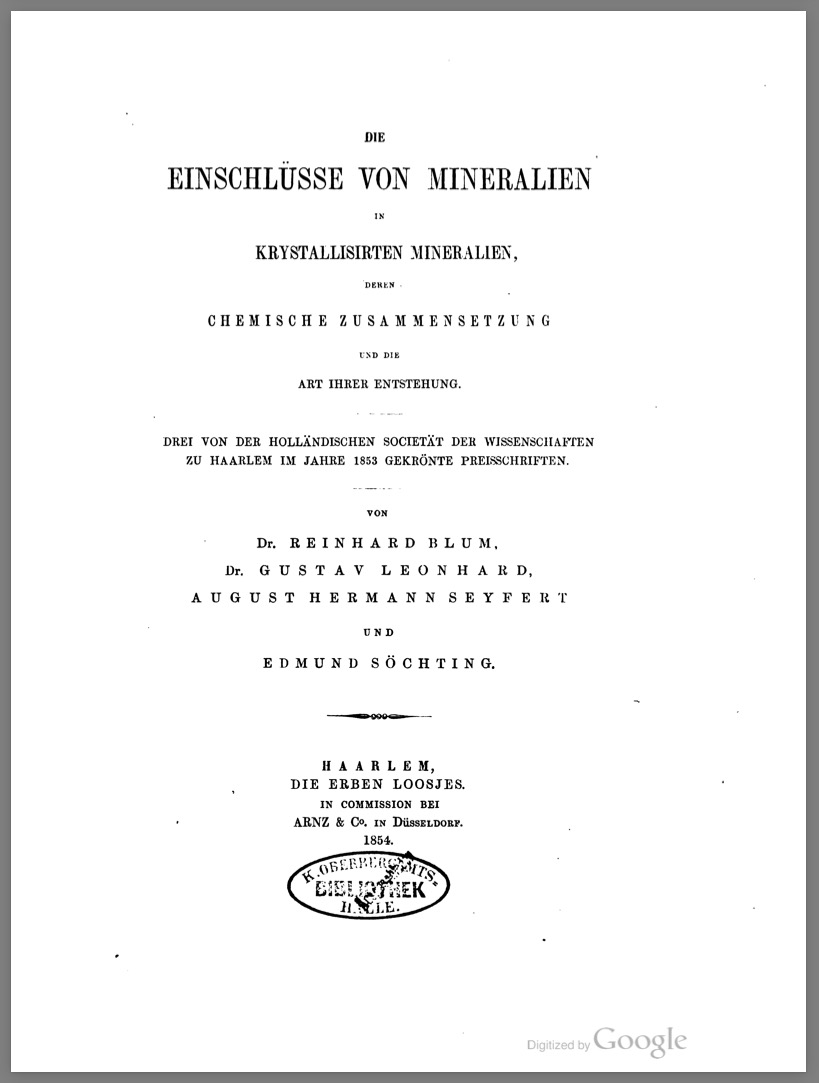
Die Einschlüsse von Mineralien in krystallisirten Mineralien; deren chemische Zusammensetzung und die Art ihrer Entstehung
The Inclusions of Minerals in Crystallized Minerals; Their Chemical Composition and the Nature of their Formation
Book
Blum, J.R., Leonhard, G., Seyfert, A.H. and Söchting, E. (1854) Die Einschlüsse von Mineralien in krystallisirten Mineralien; deren chemische Zusammensetzung und die Art ihrer Entstehung. [The Inclusions of Minerals in Crystallized Minerals; Their Chemical Composition and the Nature of their Formation] Haarlem, Loosjes, 264 pp., 8 color plates
Sinkankas/Born No.: 718A; NIB | Language: in German | RWHL*
gems, inclusions, quartz
Sinkankas: In a masterful introduction to the study of inclusions in crystallized minerals, the authors set forth the fundamental principles of paragenesis and the evidence supporting them, considering types of inclusions based on environment and genesis type, such as whether the minerals were grown from solution or in an igneous rock mass. The first part provides 334 examples of inclusions, followed by a table of 107 others, a table of chemical groups into which the minerals containing inclusions fall, and copious notes. In the second part, the authors begin with a brief historical survey of the knowledge of inclusions, mentioning Claudian to show that the ancients were already aware of watery inclusions in rock crystal, and naming mineralogists and collectors thereafter, especially in the latter half of the 18th century, who remarked on or zealously collected inclusions, regardless of cost. Notable authorities such as Pini, Collini, Davila, Rome Delisle, Reuss, Jameson, and others are featured. The text of this part starts with quartz, with no less than 43 examples of inclusions in rock crystal, amethyst, etc., followed by 13 in calcite and numerous others in fluorite, barite, topaz, tourmaline, adularia, beryl, analcime, apophyllite, and more. The second part concludes with a handsome colored plate of inclusions and phantoms in quartz, calcite, and fluorite. The third part begins with a further discussion and a list of periodicals the authors consulted. This is followed by examples of microscopic or “cryptic” inclusions, such as sunstone and bronzite, as well as a brief note on diamond, in which the “ashes of burnt diamonds showed traces of organic structure,” along with several examples of phantom growth and explanations of inclusion growth in minerals like tourmaline, cakite, aragonite, garnet, fluorite, and others. While this is the first systematic monograph to describe and offer paragenetic theories on the growth of inclusions, it does not mention the work of David Brewster of Scotland, who published important discoveries in his Edinburgh Philosophical Journal from 1823 onward, especially recognizing two- and three-phase inclusions in topaz. See also SOCHTING, J.W.E., 1860.