
Four Treasures Reference Database
Record No. 17125
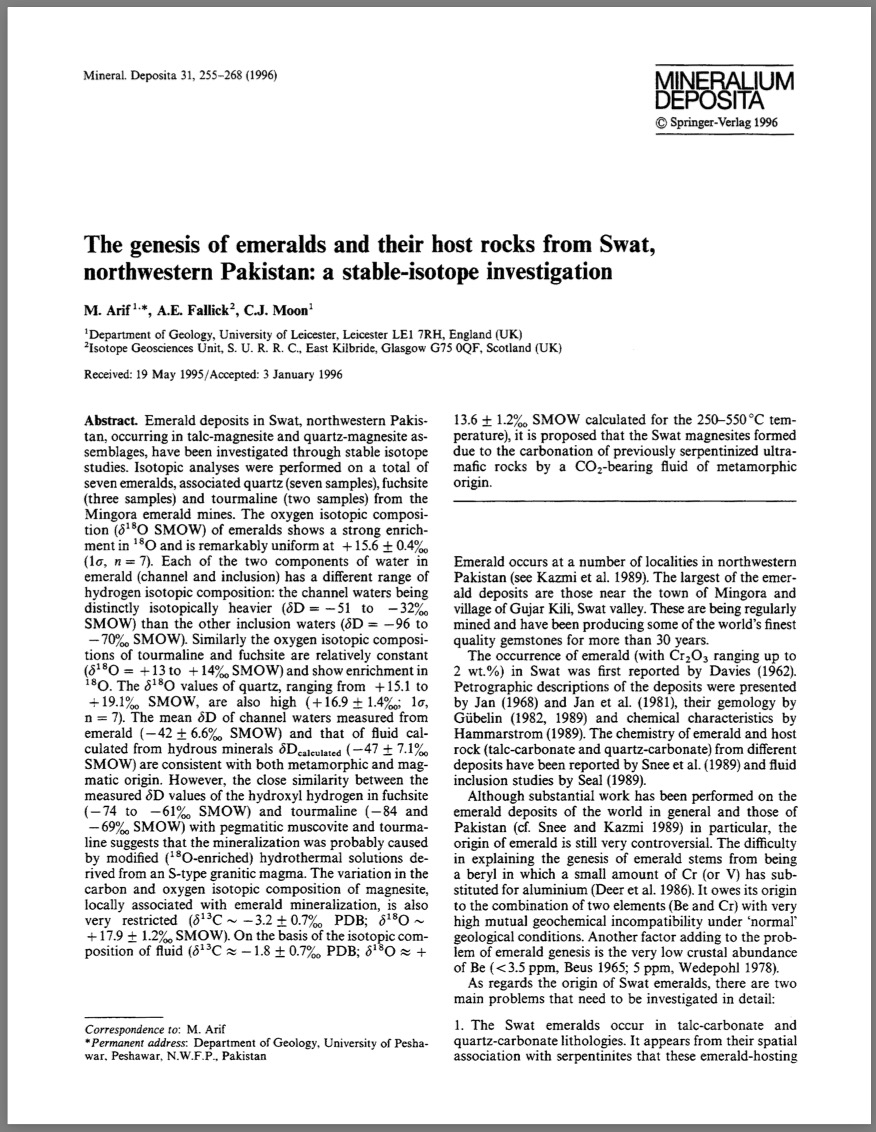
The genesis of emeralds and their host rocks from Swat, northwestern Pakistan: A stable isotope investigation
Journal Article
Arif, M., Fallick, A.E. and Moon, C.J. (1996) The genesis of emeralds and their host rocks from Swat, northwestern Pakistan: A stable isotope investigation. Mineralium Deposita, Vol. 31, No. 4, pp. 255–268.
RWHL
Close Abstract
Hide Keywords
Copy Reference
gems, beryl, emerald, Pakistan, Swat, emerald chemistry
Emerald deposits in Swat, northwestern Pakistan, occurring in talc-magnesite and quartz-magnesite assemblages, have been investigated through stable isotope studies. Isotopic analyses were performed on a total of seven emeralds, associated quartz (seven samples), fuchsite (three samples) and tourmaline (two samples) from the Mingora emerald mines. The oxygen isotopic composition (δ 18O SMOW) of emeralds shows a strong enrichment in18O and is remarkably uniform at + 15.6 ± 0.4‰ (1σ,n = 7). Each of the two components of water in emerald (channel and inclusion) has a different range of hydrogen isotopic composition: the channel waters being distinctly isotopically heavier (δD = −51 to −32‰ SMOW) than the other inclusion waters (δD = −96 to −70‰ SMOW). Similarly the oxygen isotopic compositions of tourmaline and fuchsite are relatively constant (δ 18O = + 13 to + 14‰ SMOW) and show enrichment in18O. Theδ 18O values of quartz, ranging from + 15.1 to + 19.1‰ SMOW, are also high (+ 16.9 ± 1.4‰ 1σ, n = 7). The meanδD of channel waters measured from emerald (−42 ± 6.6‰ SMOW) and that of fluid calculated from hydrous mineralsδDcalculated (−47 ± 7.1‰ SMOW) are consistent with both metamorphic and magmatic origin. However, the close similarity between the measuredδD values of the hydroxyl hydrogen in fuchsite (−74 to −6‰ SMOW) and tourmaline (−84 and −69‰ SMOW) with pegmatitic muscovite and tourmaline suggests that the mineralization was probably caused by modified (18O-enriched) hydrothermal solutions derived from an S-type granitic magma. The variation in the carbon and oxygen isotopic composition of magnesite, locally associated with emerald mineralization, is also very restricted (δ 13 ∼ −3.2 ± 0.7%, PDB;δ 18O ∼ + 17.9 ± 1.27‰ SMOW). On the basis of the isotopic composition of fluid (δ 13C ≈ −1.8 ± 0.7‰ PDB;δ 18O ≈ + 13.6 ± 1.2‰ SMOW calculated for the 250-550°C temperature), it is proposed that the Swat magnesites formed due to the carbonation of previously serpentinized ultramafic rocks by a CO2-bearing fluid of metamorphic origin.