
Four Treasures Reference Database
Record No. 17137
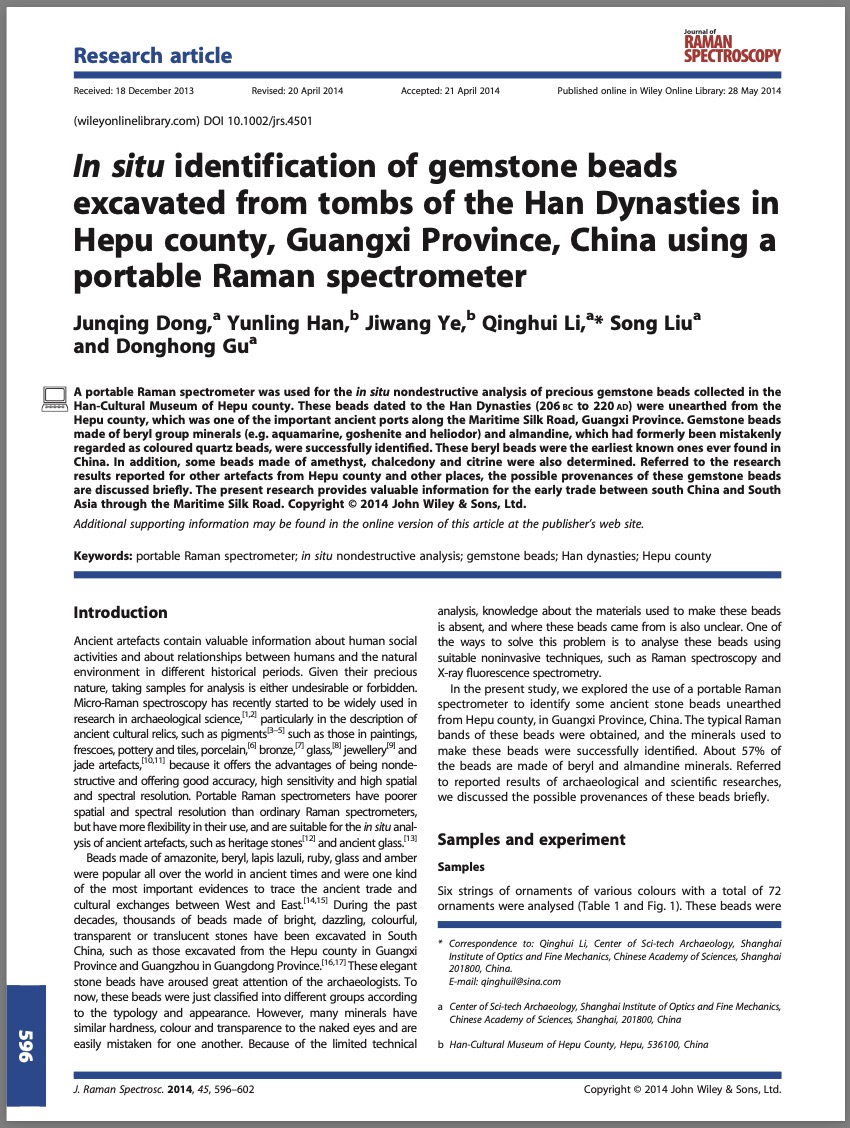
In situ identification of gemstone beads excavated from tombs of the Han Dynasties in Hepu county, Guangxi Province, China using a portable Raman spectrometer
Journal Article
Dong, J., Han, Y., Ye, J., Li, Q., Liu, S. and Gu, D. (2014) In situ identification of gemstone beads excavated from tombs of the Han Dynasties in Hepu county, Guangxi Province, China using a portable Raman spectrometer. Journal of Raman Spectroscopy, Vol. 45, No. 7,, 7/1/14 pp. 596–602.
gems, China, history of gemology, portable Raman spectrometer, in situ nondestructive analysis, gemstone beads, Han dynasties, Hepu county, beryl, garnet, quartz, chalcedony, amethyst, citrine
A portable Raman spectrometer was used for the in situ nondestructive analysis of precious gemstone beads collected in the Han-Cultural Museum of Hepu county. These beads dated to the Han Dynasties (206?BC to 220?AD) were unearthed from the Hepu county, which was one of the important ancient ports along the Maritime Silk Road, Guangxi Province. Gemstone beads made of beryl group minerals (e.g. aquamarine, goshenite and heliodor) and almandine, which had formerly been mistakenly regarded as coloured quartz beads, were successfully identified. These beryl beads were the earliest known ones ever found in China. In addition, some beads made of amethyst, chalcedony and citrine were also determined. Referred to the research results reported for other artefacts from Hepu county and other places, the possible provenances of these gemstone beads are discussed briefly. The present research provides valuable information for the early trade between south China and South Asia through the Maritime Silk Road. Copyright ? 2014 John Wiley & Sons, Ltd.