
Four Treasures Reference Database
Record No. 17183
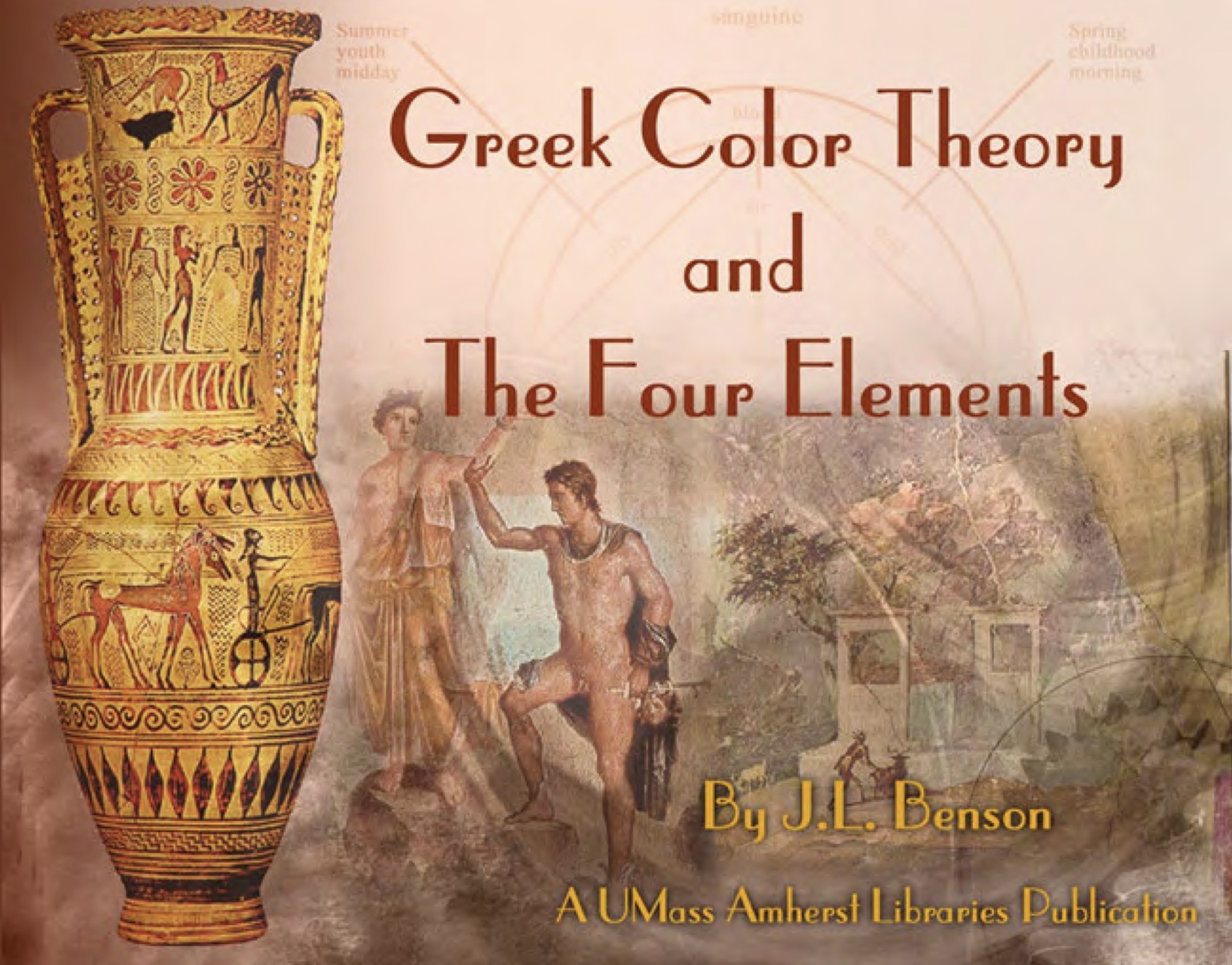
Greek Color Theory and the Four Elements | A Cosmological Interpretation
Book
Benson, J.L. (2000) Greek Color Theory and the Four Elements | A Cosmological Interpretation. Amherst, University of Massachusetts Amherst Libraries, 149 pp.
Sinkankas/Born No.: NIS/NIB | RWHL
gems, color science, color theory, art, Greek, Greece
The term color theory often evokes for many only Isaac Newton’s idea that colors arise from the refraction of white light—a concept so deeply embedded in modern thought that alternative explanations, if acknowledged at all, are typically relegated to the domain of history. Yet, historical research becomes skewed when it relies exclusively on Newtonian paradigms and language, applying standards that may be foreign to earlier ways of thinking. This issue, though seemingly self-evident, is highlighted in the evolving scholarship on ancient Greek notions of color, as discussed by Heinke Schulz in Die Farbe Purpur im frühen Griechentum. A genuine understanding of how Greek thinkers approached color is best achieved by a scholar whose own perspective prompts deep, ongoing inquiry—a process that demands creativity, since different scholars may interpret the same detail in vastly different ways. This variance appears not only across disciplines like philology, history of science, and art history, but also among individuals within the same field. In the end, each contribution may offer a small but valuable piece to a mosaic of ancient understanding that will always remain incomplete.