
Four Treasures Reference Database
Record No. 17211
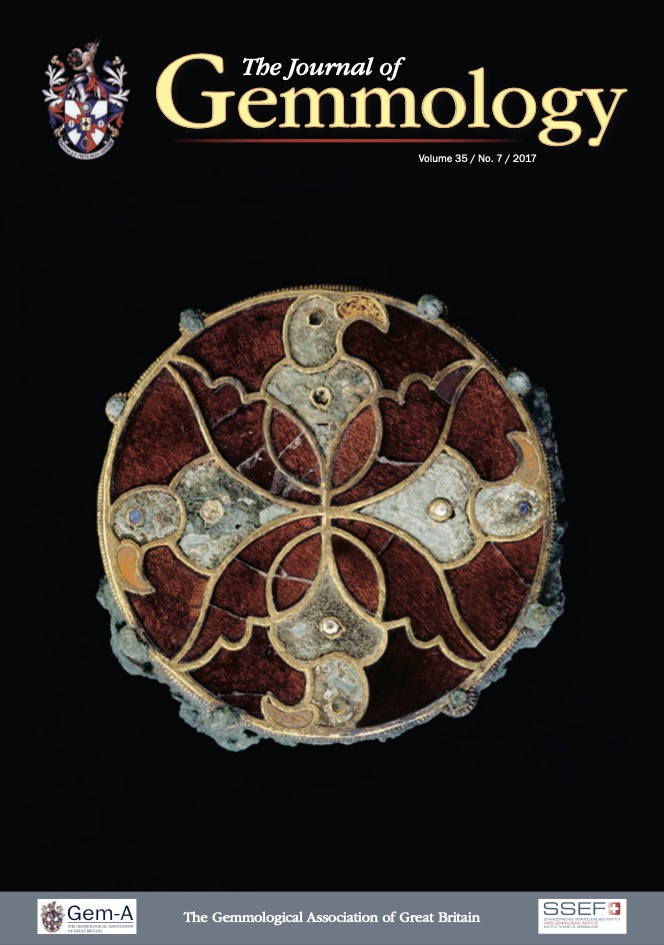
The linkage between garnets found in India at the Arikamedu archaeological site and their source at the Garibpet deposit
Journal Article
Schmetzer, K., Gilg, H.A., Schüssler, U., Panjikar, J., Calligaro, T. and Périn, P. (2017) The linkage between garnets found in India at the Arikamedu archaeological site and their source at the Garibpet deposit. Journal of Gemmology, Vol. 35, No. 7, pp. 598–627.
ISBN/ISSN: 221252 | DOI: http://dx.doi.org/10.15506/JoG.2017.35.7.598 | Sinkankas/Born No.: NIS/NIB | RWHL
gems, garnet, India, history of gemology, archaeogemology, archaeology, Indian lapidary
The archaeological site of Arikamedu, located in Tamil Nadu State on the east coast of India, was for many centuries the center of a significant bead-producing industry. Beads were made from both glass and stone, including garnet, though the source of the garnet rough material had not been confirmed. To investigate this, garnet beads found at Arikamedu were compared with rough material from the Garibpet deposit, located approximately 640 km away in Telangana State, east of Hyderabad. Samples from both locations showed substantial similarities in average composition, trace-element contents, chemical zoning of major and minor elements, inclusion assemblages, and zoning of inclusions between the rims and cores of the crystals. Chemically, the garnets were almandine-rich (averaging 81.0% almandine, 11.5% pyrope, 3.3% spessartine, and 1.5% grossular), with clear zoning for manganese (Mn) and magnesium (Mg), as well as trace elements such as yttrium (Y), phosphorus (P), and zinc (Zn). The most distinctive aspect of the inclusion pattern was the presence of sillimanite fibers concentrated in a zone between the inclusion-rich core and the inclusion-poor rim. Combining microscopic observations, inclusion identification, and chemical analyses, it was determined that the rough material used to produce garnet beads at Arikamedu historically originated from the Garibpet deposit. Additionally, the results suggest that current classification systems for historical garnets need further refinement.