
Four Treasures Reference Database
Record No. 17213
Lapis lazuli: The early phases of its trade
Journal Article
Herrmann, G. (1968) Lapis lazuli: The early phases of its trade. Iraq, Vol. 30, No. 1, pp. 21–57.
Sinkankas/Born No.: NIS/NIB | RWHL
gems, lapis lazuli, Afghanistan, amazonite, turquoise, history of gemology, gem trade, Central Asia
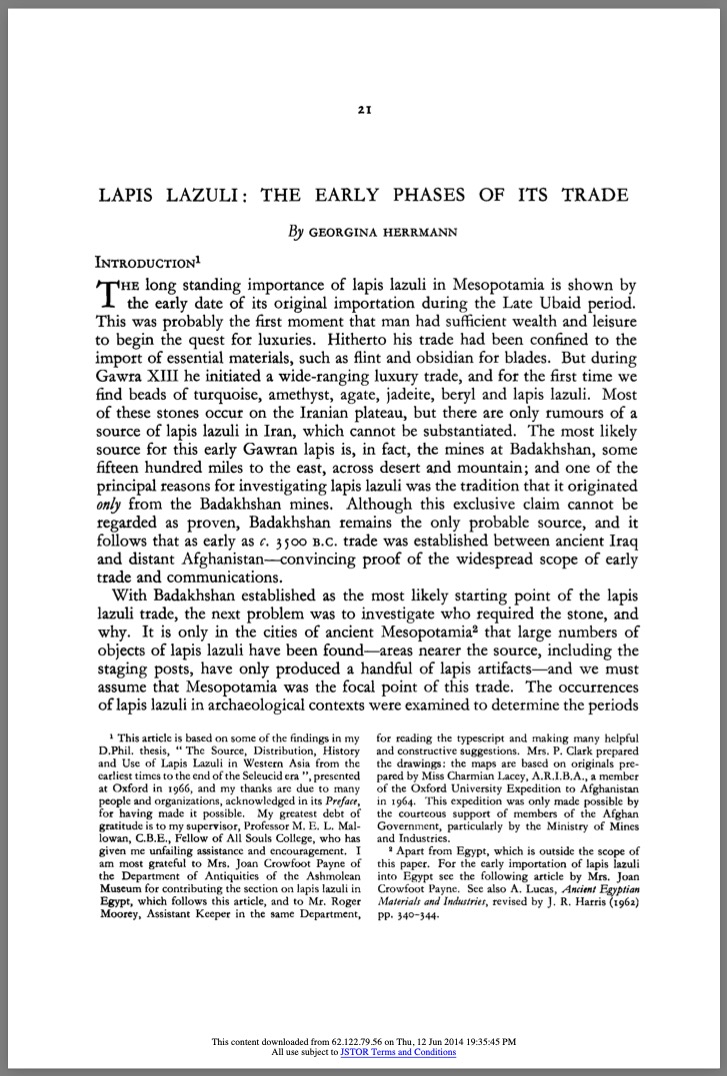
The long-standing importance of lapis lazuli in Mesopotamia is evident from its early importation during the Late Ubaid period, likely marking the first time humans possessed the wealth and leisure to seek out luxury items. Prior to this, trade had been limited to essential materials like flint and obsidian for toolmaking. However, by the time of Gawra XIII, a broad luxury trade had begun, introducing beads made of turquoise, amethyst, agate, jadeite, beryl, and lapis lazuli. While most of these stones are found on the Iranian plateau, there is no confirmed source of lapis lazuli in Iran. The most plausible source of the early Gawran lapis is the Badakhshan mines, located approximately 1,500 miles east across deserts and mountains. One of the primary motivations for studying lapis lazuli has been the tradition that it originates solely from Badakhshan. Although this exclusive claim remains unproven, Badakhshan is still considered the only likely source. This suggests that as early as around 3500 B.C., trade routes connected ancient Iraq with distant Afghanistan, offering compelling evidence of the vast reach of early trade and communication networks.