
Four Treasures Reference Database
Record No. 17230
The occurence and genetical interpretation of the opal deposit around the Gevrekseydi (Seyitömer/Kütahya-Turkey)
Conference Paper
Yanık, G., Hatipoğlu, M., Kİbİcİ, Y., Demİrbİlek, M. and Özkul, C. (2015) The occurence and genetical interpretation of the opal deposit around the Gevrekseydi (Seyitömer/Kütahya-Turkey). Proceedings of 9th International Industrial Minerals Symposium, 4–15 May, Fuar/İzmir/Turkey pp. 211–224.
Sinkankas/Born No.: NIS/NIB | RWHL
gems, opal, Turkey, history of gemology, chalcedony, chrome chalcedony, chrysoprase, nickel
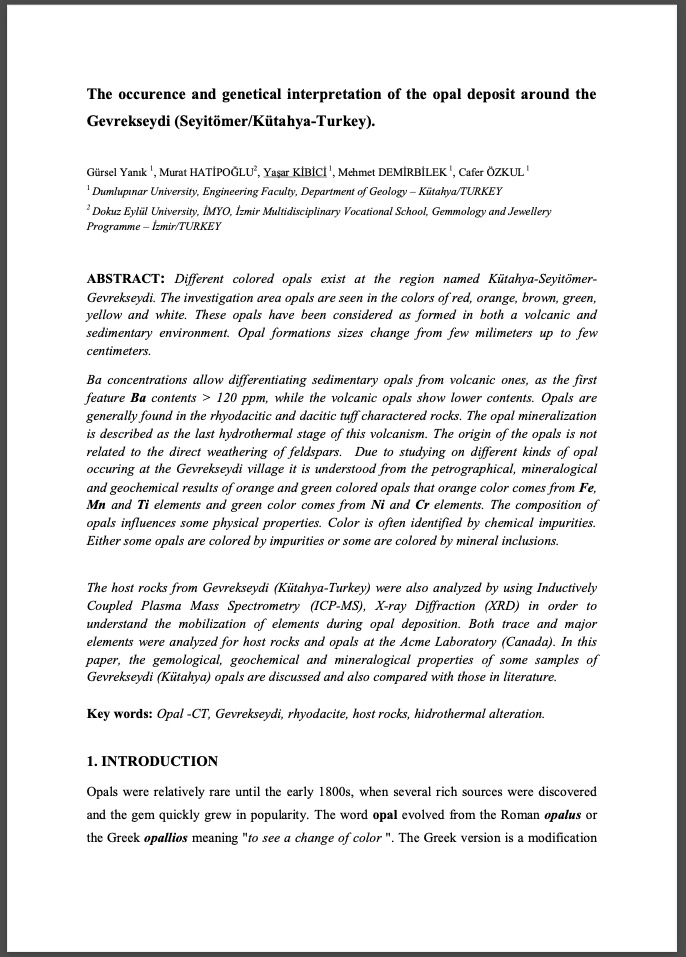
Different colored opals are found in the Kütahya-Seyitömer-Gevrekseydi region, displaying hues of red, orange, brown, green, yellow, and white. These opals are considered to have formed in both volcanic and sedimentary environments, with sizes ranging from a few millimeters to several centimeters. The concentration of barium (Ba) helps distinguish between sedimentary and volcanic opals, as sedimentary ones typically contain more than 120 ppm of Ba, while volcanic opals show lower levels. Generally, the opals are hosted in rhyodacitic and dacitic tuff rocks, and their mineralization is interpreted as the final hydrothermal phase of local volcanism. Their formation is not directly linked to feldspar weathering. Petrographic, mineralogical, and geochemical studies on various opals from the village of Gevrekseydi reveal that orange coloration is associated with the presence of Fe, Mn, and Ti, while green coloration is linked to Ni and Cr. These chemical components not only influence color but also affect some physical properties of the opals. While some opals owe their color to chemical impurities, others are influenced by mineral inclusions. To better understand elemental mobilization during opal formation, host rocks from Gevrekseydi were analyzed using Inductively Coupled Plasma Mass Spectrometry (ICP-MS) and X-ray Diffraction (XRD). Both major and trace elements in the host rocks and opals were examined at Acme Laboratory in Canada. This paper presents the gemological, geochemical, and mineralogical characteristics of selected opal samples from Gevrekseydi (Kütahya) and compares them with findings from previous literature.