
Four Treasures Reference Database
Record No. 17245
Routes through the Eastern Desert of Egypt
Journal Article
Sidebotham, S.E. and Zitterkopf, R.E. (1995) Routes through the Eastern Desert of Egypt. Expedition, Vol. 37, No. 2, pp. 39–51.
Sinkankas/Born No.: NIS/NIB | RWHL
gems, Red Sea, Egypt, emerald, ancient gems, ancient trade, glyptic, archaeology, archaeogemology, trade routes, Roman
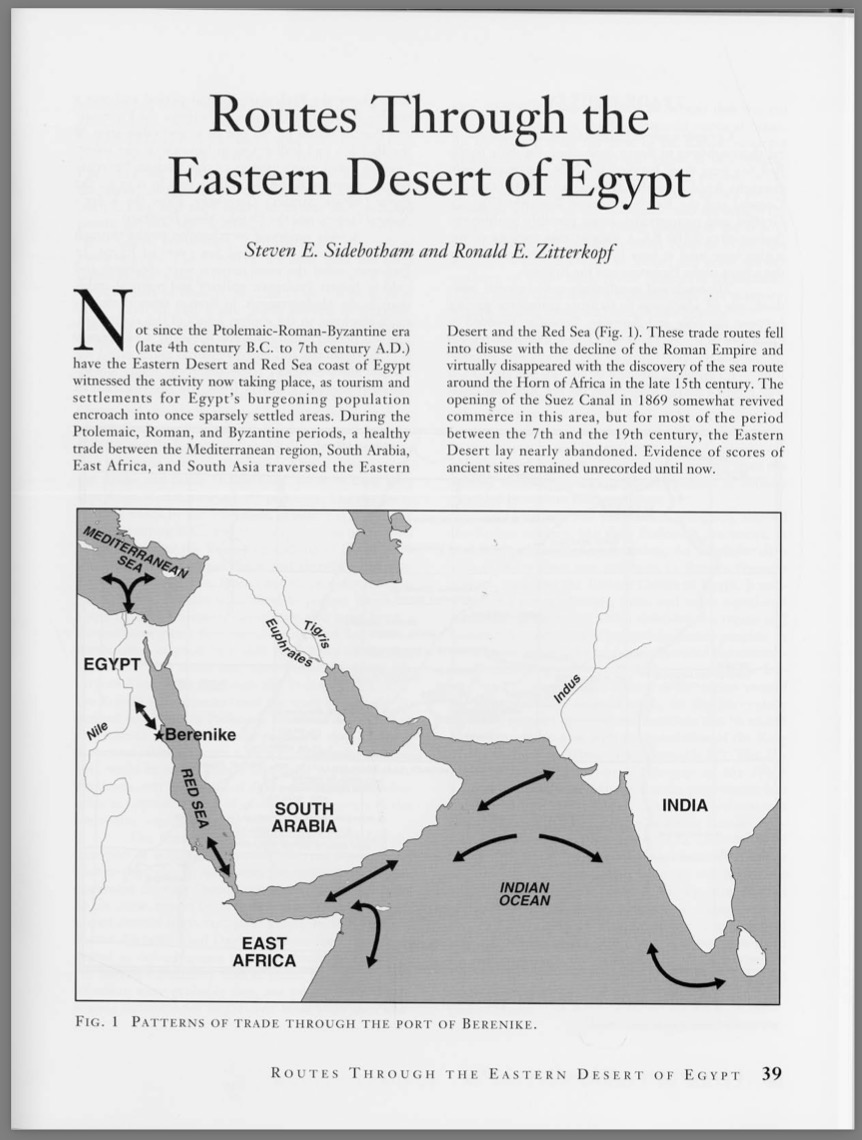
Not since the Ptolemaic-Roman-Byzantine era (late 4th century B.C. to 7th century A.D.) have the Eastern Desert and Red Sea coast of Egypt witnessed the activity now taking place, as tourism and settlements for Egypt’s burgeoning population encroach into once sparsely settled areas. During the Ptolemaic, Roman, and Byzantine periods, a healthy trade between the Mediterranean region, South Arabia, East Africa, and South Asia traversed the Eastern Desert and the Red Sea (Fig. 1). These trade routes fell into disuse with the decline of the Roman Empire and virtually disappeared with the discovery of the sea route around the Horn of Africa in the late 15th century. The opening of the Suez Canal in 1869 somewhat revived commerce in this area, but for most of the period between the 7th and the 19th century, the Eastern Desert lay nearly abandoned. Evidence of scores of ancient sites remained unrecorded until now.