
Four Treasures Reference Database
Record No. 17284
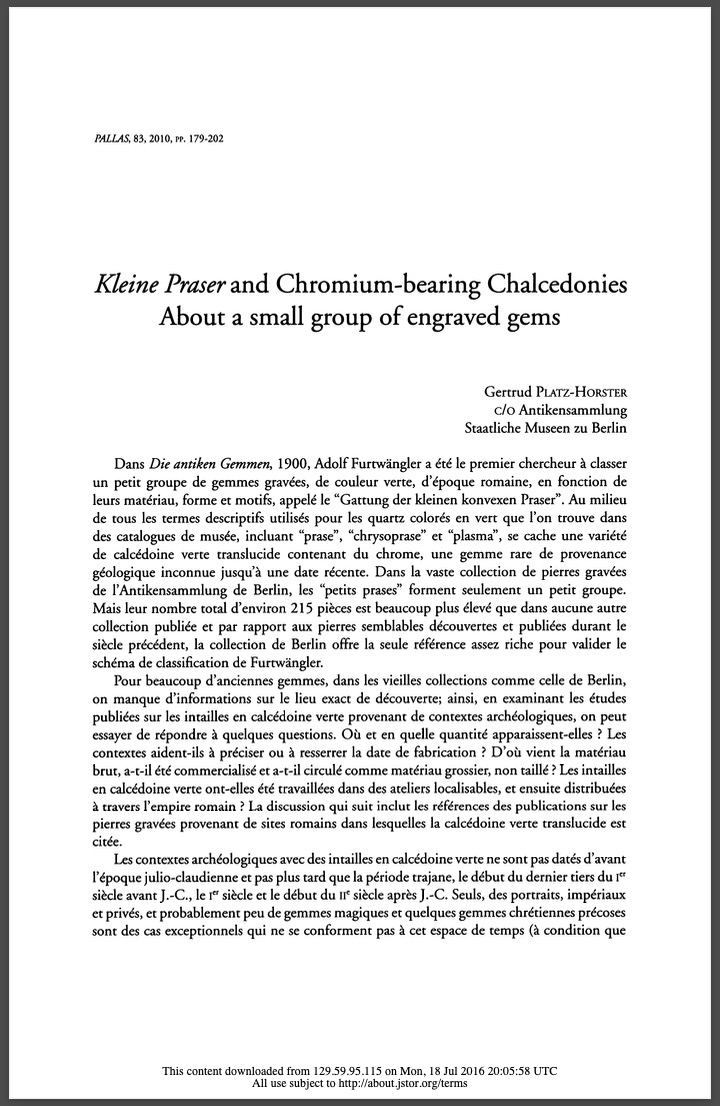
Kleine Praser and chromium-bearing chalcedonies: About a small group of engraved gems
Journal Article
Platz-Horster, G. (2010) Kleine Praser and chromium-bearing chalcedonies: About a small group of engraved gems. PALLAS, No. 83, pp. 179–202.
Sinkankas/Born No.: NIS/NIB | RWHL
gems, ancient gems, glyptic, archaeology, archaeogemology, beads, Rome, quartz, green chalcedony, prase, chrysoprase, Kleine Praser
This paper examines a small but significant group of Roman-era engraved gemstones, primarily composed of green chalcedony, classified by Adolf Furtwängler as “Kleine Praser”. These gemstones, often described with terms like “prase,” “chrysoprase,” and “plasma,” have traditionally been identified as various forms of green quartz. The study introduces the rare chromium-bearing chalcedony variety, a translucent, green microcrystalline quartz that was previously of uncertain geological origin. The paper traces the history of these gemstones, discussing their use, classification, and material properties. It emphasizes the Berlin collection of engraved gems, where the “Kleine Praser” form is particularly well-represented, with approximately 215 pieces—far more than in any other known collection. This paper also explores archaeological contexts, examining the distribution and dating of these stones within the Roman Empire, and the role of the stones in personal adornment, particularly as small rings. The study also addresses the complex nomenclature issues in gemology and how ancient and modern classifications sometimes overlap or conflict, offering a clearer understanding of these gemstones’ properties and historical significance.