
Four Treasures Reference Database
Record No. 194
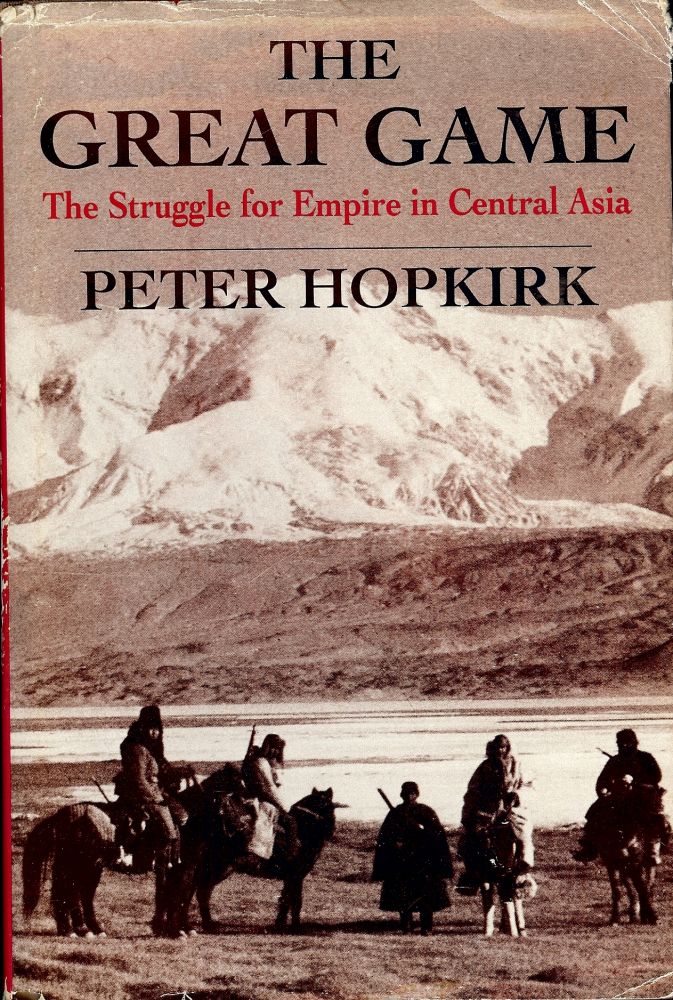
The Great Game: The Struggle for Empire in Central Asia
Book
Hopkirk, P. (1992) The Great Game: The Struggle for Empire in Central Asia. New York, Kodansha, 565 pp.
ISBN/ISSN: 4770017030 | Sinkankas/Born No.: NIS / NIB | RWHL
Great Game, Afghanistan, Pakistan, Central Asia, History, gems
Peter Hopkirk’s The Great Game: The Struggle for Empire in Central Asia recounts the nineteenth-century rivalry between the British and Russian empires for political, military, and commercial influence across Central Asia, particularly Afghanistan, Persia, the Pamirs, Tibet, and the territories bordering British India. Drawing extensively on contemporary travel narratives, military dispatches, diplomatic correspondence, memoirs, and historical studies, Hopkirk reconstructs the activities of explorers, spies, soldiers, merchants, and political agents who ventured into remote and frequently dangerous regions. The narrative begins with Russia’s expansion across Siberia and the Caucasus, tracing the growing British fear that Russian armies might eventually threaten India through Afghanistan and the mountain passes of the Hindu Kush. Among the principal figures are Henry Pottinger, Charles Christie, William Moorcroft, Alexander Burnes, Arthur Conolly, Francis Younghusband, and their Russian counterparts, including Nikolai Muraviev and Bronislav Gromchevsky. Hopkirk describes clandestine surveying expeditions, diplomatic intrigues, the conquest of the Central Asian khanates, the disastrous British invasion of Afghanistan in 1839, and the subsequent struggle for control of strategic mountain corridors. Particular attention is devoted to the geographical obstacles confronting imperial expansion, including the deserts of Baluchistan and Turkestan, the Karakoram and Pamir mountain systems, and the difficult approaches to Kashmir, Ladakh, and Chinese Turkestan. For gemological and mineralogical history, the book provides valuable incidental evidence concerning the movement of precious stones, gold, and luxury goods along the commercial networks connecting Central Asia with India, Persia, Russia, and China. Hopkirk describes Peter the Great’s interest in reported gold deposits along the River Oxus and his unsuccessful attempt to establish a Russian presence at Khiva in 1717, partly to facilitate mineral exploration and overland commerce (pp. 16–20). The diplomatic use of gemstones is illustrated by the British mission of Sir Harford Jones to Persia, during which a large diamond presented on behalf of George III helped restore relations with the Shah (p. 35). The book also recounts the activities of Aga Mehdi, a Persian-Jewish merchant operating as a Russian agent, who carried valuable rubies and emeralds through Central Asia, apparently intended as diplomatic gifts for Ranjit Singh and other influential rulers (p. 94). The famous Koh-i-Noor diamond and Peacock Throne appear in the account of Nadir Shah’s sack of Delhi in 1739, illustrating the importance of jewels as symbols of imperial wealth and conquest (p. 69). Beyond these references, Hopkirk’s descriptions of caravan routes, trading centers, political boundaries, and the opening of previously inaccessible territories provide historical context for understanding the circulation of gemstones and other valuable commodities between the Himalayan region, Central Asia, and international markets. Although not a gemological treatise, the work is an important historical resource for reconstructing the political and geographical circumstances surrounding nineteenth-century exploration, commerce, and the movement of precious materials across Inner Asia.