
Four Treasures Reference Database
Record No. 1955
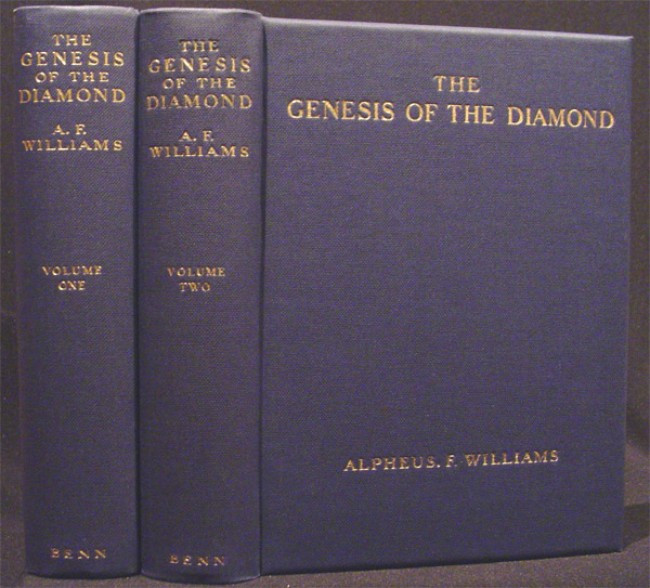
The Genesis of the Diamond
Book
Williams, A.F. (1932) The Genesis of the Diamond. London, Ernest Benn Ltd., 2 Vols., xv + 352, xii + 353–636 pp.
Sinkankas/Born No.: 7224 / NIB | not seen
diamond, formation, geology, gems
Sinkankas: A truly monumental work of increasing scientific importance, not so much for its information on diamond and its mining as for its detailed studies of the petrology and mineralogy of kimberlitic pipe-fillings. Such treatment of originally deep-seated mantle-derived rocks was well ahead of its time in providing clues as to the nature of the mantle and the formation of the crust in general. The significance of Williams’ studies escaped even himself, and certainly most others, as evidenced in the niggardly review accorded the work by E.H. Kraus, American Mineralogist, 18, 4, 1933, 176, who saw it as merely “supplementing and bringing up-to-date the monumental and classic work of his father.” Because of the greatly increased interest in mantle problems and plate tectonics, the work now appears to be one of those inadvertently fortunate amassments of accurate data which find applications at a later time. The lukewarm reception accorded the book resulted in the issue of relatively few copies, and the book is now difficult to find. It is far from a “popular” presentation, such as might be said about his father’s general work on the diamond mines of South Africa, despite the remark of Kraus noted above, and is most useful to the petrologist and geologist rather than to the gemologist, although it does contain a great deal of interest to the latter as well. Volume I opens with a short chapter on modern mining practice at Kimberley and then describes the geological relationships of the intrusive kimberlites to host rocks and possible origins, with details on the kimberlites themselves. Practically all of this volume is devoted to petrography. The second volume continues similar studies with emphasis upon the inclusions in kimberlites, but now with much space devoted to the diamond itself, taking up such matters as the characteristics of diamonds from various mines, speculations as to their genesis, inclusions in diamond, crystallography and X-ray analyses, physical properties, chemical composition, and growth phenomena. The final chapter treats diamondiferous alluvial deposits of South Africa and the diamonds found therein. There is a long table of diamonds that weighed over 100 carats on pp. 619–636; it is mostly a listing of crystals from the Kimberley district, although some large Brazilian stones are included in an appended list. As may be expected from a largely petrological work, many of the color plates depict kimberlite thin sections with careful descriptions of the minerals therein, but other plates are of more general interest, one showing the now-famous collection of colored diamond crystals formed by the author during his tenure in De Beers. From the gemologist’s standpoint, the work is deemed most important for its studies on inclusions in diamond. Extended review by A.T.J. Dollar, The Gemmologist, 2, 16, 1932, 111–115; 18, 1933, 181–183; 19, 205–207; 21, 268–272; 22, 305–310.