
Four Treasures Reference Database
Record No. 2021
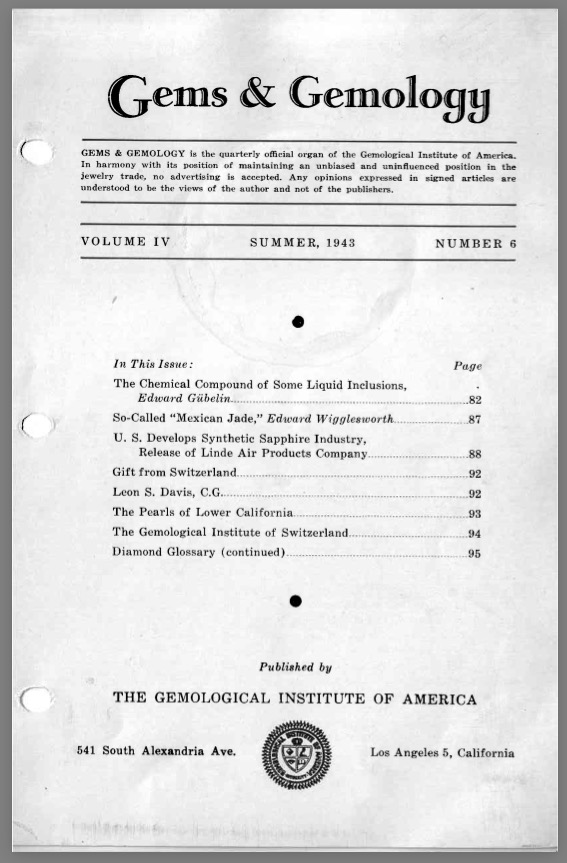
The chemical compounds of some liquid inclusions
Journal Article
Gübelin, E.J. (1943) The chemical compounds of some liquid inclusions. Gems & Gemology, Vol. 4, No. 6, Summer, pp. 82–86; No. 7, Fall, pp. 98–100.
ISBN/ISSN: 0016626X | Sinkankas/Born No.: NIS/NIB | RWHL
inclusions, gems
Gübelin investigates the composition of fluid inclusions in gemstones through microscopic observation during heating and cooling, relating their phase behavior to the conditions of gem formation. He reviews earlier work by David Brewster, R.Th. Simmler, H. Vogelsang, H. Geissler, H.C. Sorby, and P.J. Butler, emphasizing evidence for water and carbon dioxide in cavities within quartz, corundum, beryl, topaz, and other minerals. The experimental method uses heat from a diamondscope’s illuminator, regulated through its transformer, together with temperature measurements; further investigations employ a special electric heating furnace attached to a microscope. Inclusions containing a mobile gas bubble are particularly suitable because changes in the liquid–gas boundary can be followed directly. A large negative-crystal inclusion in smoky quartz provides the principal example. As the stone warms, the curved meniscus progressively flattens, the liquid expands, and the bubble diminishes. At a reported temperature of 29.9 ± 0.1 °C, the boundary disappears abruptly; cooling restores the two-phase appearance, sometimes after a transient mist develops within the cavity. Gübelin interprets this behavior as evidence of nearly pure carbon dioxide with minor impurities, comparing the observed transition with the approximately 31 °C critical temperature of pure carbon dioxide. He reports comparable behavior in selected inclusions in Colombian emerald, Ceylon ruby, sapphire, and alexandrite, other beryls, topaz, phenakite, and several quartz varieties. The same response was absent from the tourmaline and chrysoberyl specimens examined, certain topaz inclusions, and some solid-bearing three-phase inclusions in Colombian and Ural emeralds. The continuation discusses cavities containing two distinguishable liquids and a gas bubble. Heating experiments lead the author to identify the liquids as water and liquid carbon dioxide, with water wetting the cavity walls and occupying marginal extensions, while carbon dioxide occupies the central region and contains the gas bubble. From these observations, he proposes a model in which crystals initially grow from aqueous solutions saturated with carbon dioxide under pressure. A sudden pressure release, possibly caused by tectonic movement, induces boiling and the separation of bubbles containing water vapor and carbon dioxide. Rapid subsequent crystal growth traps these bubbles against crystal surfaces. Larger cavities may reproduce an earlier crystal outline, whereas smaller inclusions preserve rounded or elongated bubble shapes. Gübelin also proposes pressure and temperature limits for formation from the phase relationships, presenting these as deductions from his interpretation. He considers the occurrence of carbon dioxide particularly consistent with gems associated with limestone and dolomite. The study presents thermal microscopy as a practical means of investigating inclusion chemistry and developing hypotheses about gemstone genesis.