
Four Treasures Reference Database
Record No. 2171
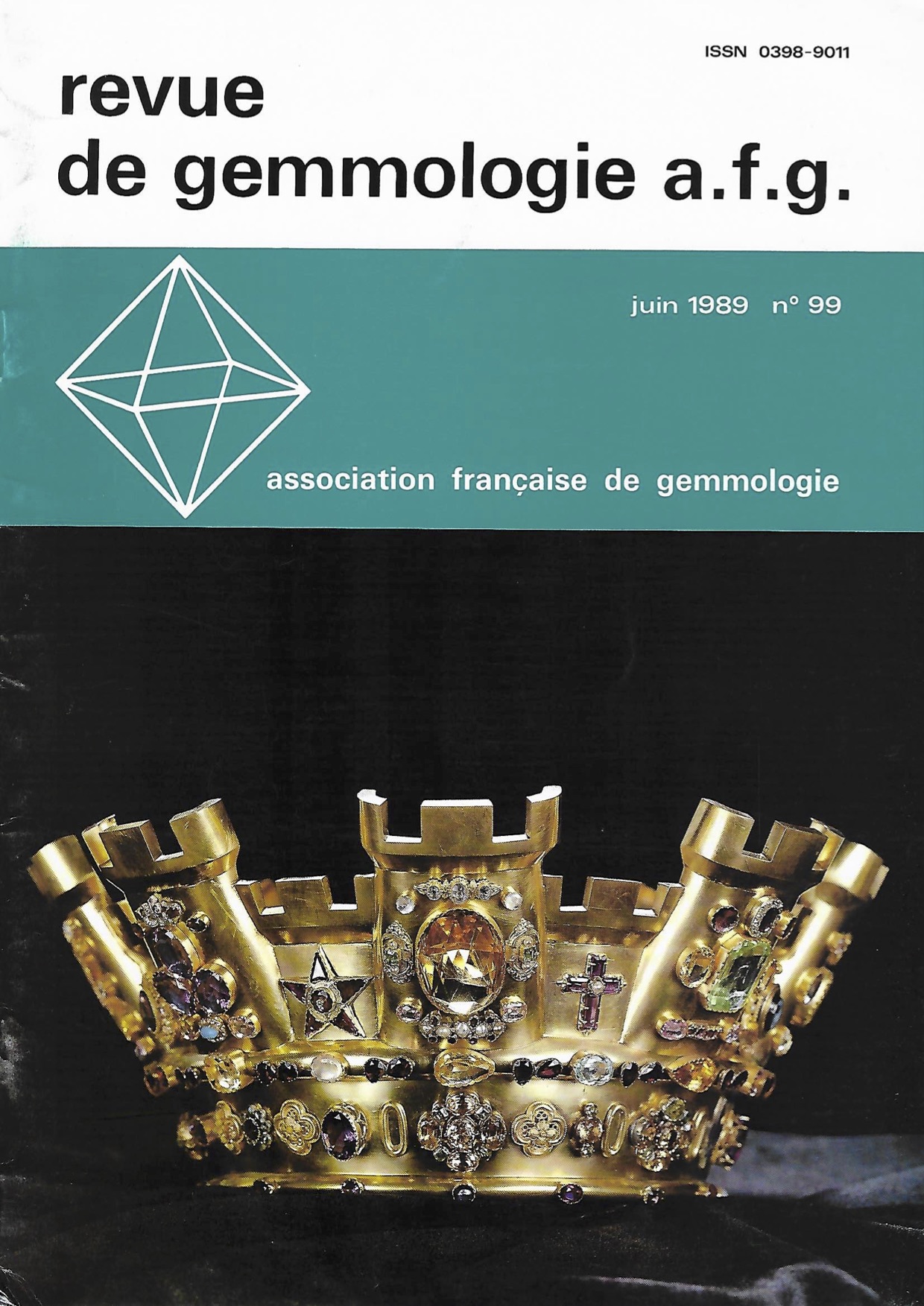
Identification des nouveaux saphirs synthétiques et des saphirs traités
Identification of new synthetic sapphires and treated sapphires
Journal Article
Gübelin, E.J. (1985) Identification des nouveaux saphirs synthétiques et des saphirs traités. [Identification of new synthetic sapphires and treated sapphires] Revue de Gemmologie A.F.G., No. 82, March,
Sinkankas/Born No.: NIS/NIB | Language: in French | not seen
Close Abstract
Hide Keywords
Copy Reference
corundum, synthetic corundum.7, gems
Gübelin examines the identification of newly introduced Chatham flux-grown blue and orange synthetic sapphires and of natural sapphires whose color has been altered by heat treatment or surface diffusion. The physical properties of the Chatham synthetics differ little from those of natural sapphire, making microscopic examination particularly important. Blue Chatham sapphires may show irregular blue, yellow, and colorless zoning, straight or angular growth structures, polysynthetic twinning, coarse or delicate flux residues forming feathers, veils, nets, lace-like patterns, and misleading “fingerprints,” together with black platinum platelets, rods, splinters, and needles that reflect with a characteristic silvery metallic lustre; X-ray analysis confirmed the metallic inclusions as platinum. Some blue specimens also fluoresce intense pale green under long-wave ultraviolet radiation. Chatham orange sapphires range from brownish orange through orange-red to pinkish-orange “padparadschah” colors and likewise contain flux residues and platinum inclusions that provide important evidence of synthetic origin; ultraviolet absorption and electron-spin-resonance measurements are also investigated as possible means of separation from natural stones. Gübelin then discusses heat-treated natural sapphires, in which high temperatures may produce pockmarked surfaces, altered or melted mineral inclusions, circular tension fractures with lace-like rims, enhanced cloudy or phantom-like zoning, and fine exsolved particles producing turbidity. Diffusion-treated sapphires may additionally show strongly colored surface-reaching fissures and inclusions, irregular surface coloration, and concentrations of color along facet junctions and the girdle; immersion in a highly refractive liquid makes these features particularly conspicuous. Gübelin emphasizes that no single characteristic is universally diagnostic and recommends careful comparison of macroscopic appearance, physical properties, ultraviolet response, spectra, and especially microscopic inclusions when distinguishing natural, synthetic, heat-treated, and diffusion-treated sapphires.