
Four Treasures Reference Database
Record No. 2547
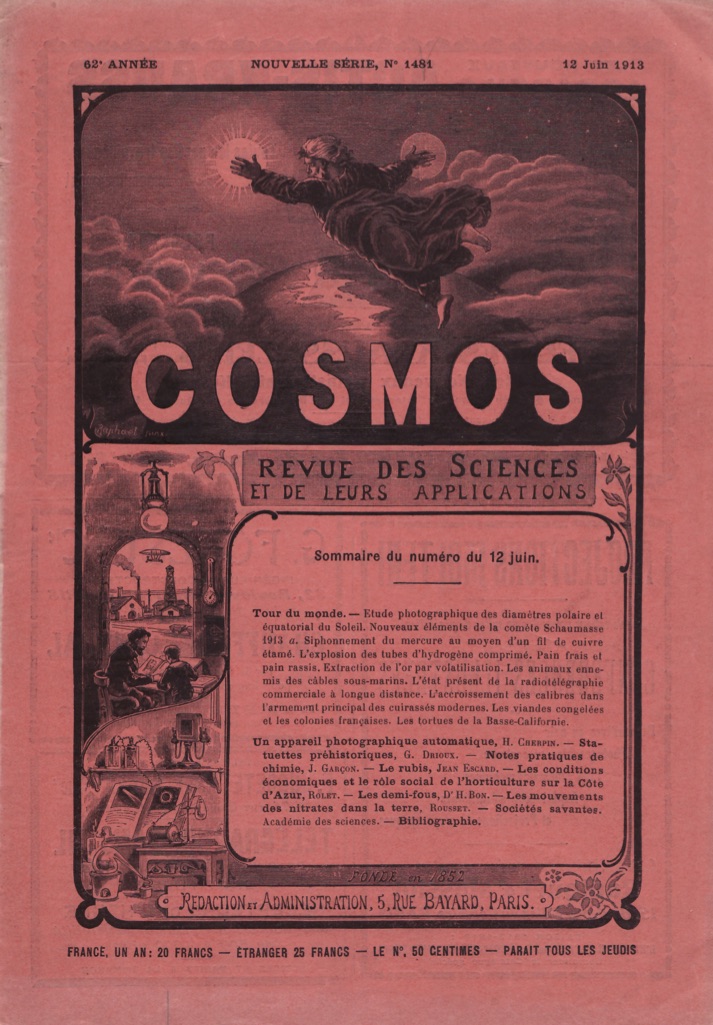
Le rubis
The ruby
Journal Article
Escard, J.-G. (1913) Le rubis. [The ruby] Cosmos, Vol. 62, No. 1481,, 12 Juin pp. 655–660.
Sinkankas/Born No.: NIS/NIB | Language: in French | RWHL
Close Abstract
Hide Keywords
Copy Reference
corundum, inclusions.5, Burma.12, Sri Lanka.12, Thailand.12, gems
Escard provides a concise survey of the ruby, describing its varieties, physical properties, geographical sources, mining, cutting, valuation, and methods of distinguishing natural stones from imitations and artificial products. [655] He identifies ruby as red corundum and discusses differences in color among rubies from Burma, Siam, and Ceylon, noting that terminology such as “Oriental ruby” and “Siam ruby” was often applied inconsistently in commerce. [656] Particular attention is given to microscopic examination: natural rubies may contain crystalline inclusions and other internal features, while differences in color and dichroism can help separate stones from different sources; illustrations show characteristic inclusions and a Ceylonese lapidary at work. [657] Escard discusses the distinctive internal structure of Burmese and Siamese rubies, differences observed with the dichroscope, and variations in specific gravity, accompanied by photomicrographs and a map of the ruby-bearing district of Burma. [658] Fluorescence and phosphorescence are described as useful diagnostic properties, Burmese rubies showing particularly strong fluorescence; the principal ruby deposits are said to occur in Burma and Ceylon, where ruby-bearing gravels are washed and sorted, with an account of mining and recovery methods in the Mogok district and illustrations of the Burmese mines. [659] The article gives production and value figures for Burmese ruby mining, mentions occurrences in Ceylon, Siam, Afghanistan, and elsewhere, discusses the considerable variation in value according to color, quality, and size, and briefly describes cutting practices, including the preference for the oval form. [660] Escard concludes with remarks on celebrated rubies, including stones associated with European collections, and emphasizes the commercial importance of distinguishing natural rubies from artificial stones, illustrating a certificate of authenticity for a natural Burmese ruby.