
Four Treasures Reference Database
Record No. 26325
Innovative methods in the manufacture of Sasanian seals
Journal Article
Gorelick, L. and Gwinnett, A.J. (1996) Innovative methods in the manufacture of Sasanian seals. Iran, Vol. 34, pp. 79–84.
Sinkankas/Born No.: NIS / NIB | RWHL
gems, ancient gems, glyptic, archaeology, archaeogemology, ancient history, Greek, Roman, Near East, India, Persia, Indian lapidary
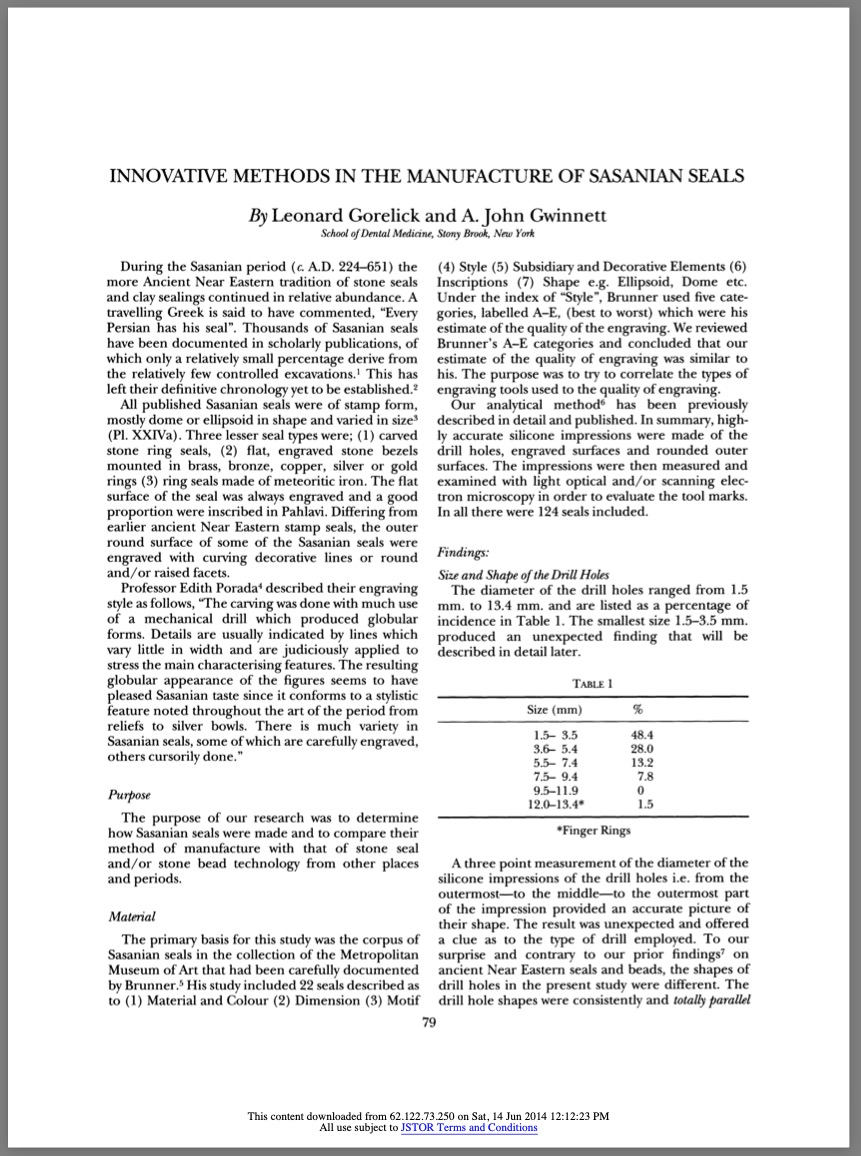
During the Sasanian period (c. A.D. 224–651), the longstanding Near Eastern tradition of using stone seals and clay sealings persisted in notable abundance. A traveling Greek reportedly remarked, “Every Persian has his seal,” highlighting the ubiquity of this practice. Thousands of Sasanian seals have been documented, though only a small percentage come from controlled excavations, leaving aspects of their precise chronology unresolved. All published examples are stamp seals—typically dome- or ellipsoid-shaped and varying in size—with three additional forms noted: carved stone ring seals; flat, engraved stone bezels mounted in metal rings (brass, bronze, copper, silver, or gold); and rarer examples made from meteoritic iron. The engraved flat surfaces often bear inscriptions in Pahlavi, while some seals also feature curved decorative lines or facets on their outer edges, distinguishing them from earlier stamp seals. Professor Edith Porada described the Sasanian engraving style as heavily reliant on the mechanical drill, which produced globular forms. Lines of uniform width defined key features, contributing to the rounded, stylized look characteristic of Sasanian art across various media—from stone reliefs to silver vessels. The seals themselves show considerable variety, ranging from finely executed pieces to more hastily carved examples.