
Four Treasures Reference Database
Record No. 26328
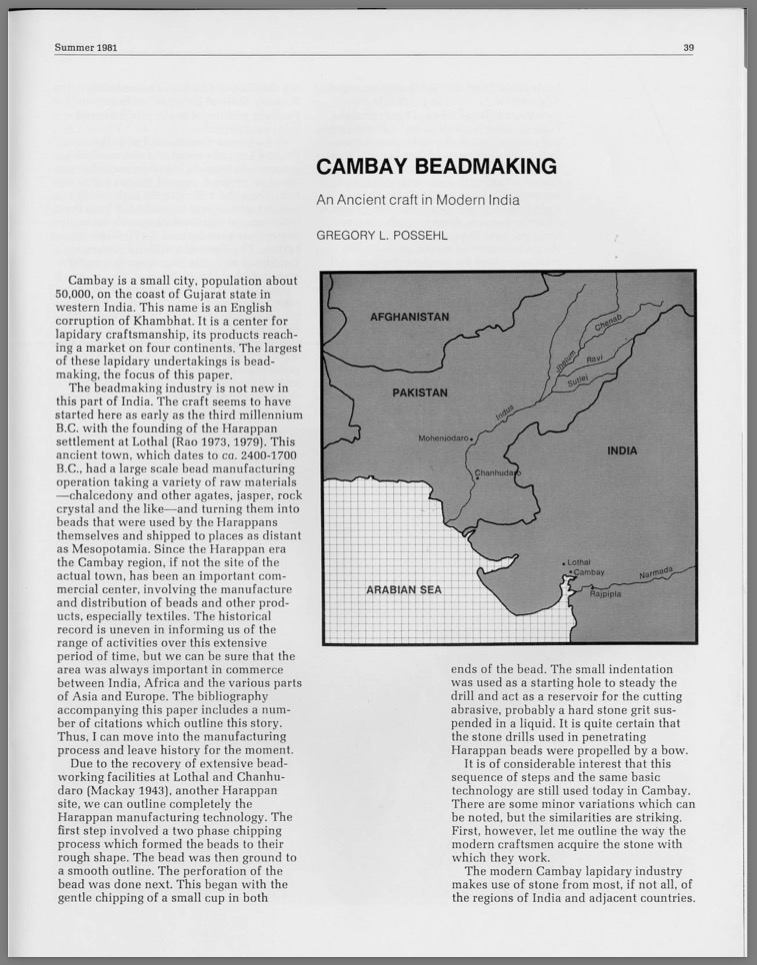
Cambay bead making: An ancient craft in modern India
Journal Article
Possehl, G.L. (1981) Cambay bead making: An ancient craft in modern India. Expedition, Vol. 23, Summer, pp. 39–46.
Sinkankas/Born No.: NIS/NIB | RWHL
gems, ancient gems, glyptic, archaeology, archaeogemology, ancient history, beads, India, Gujarat, Cambay, Indian lapidary
Cambay, a small city of about 50,000 people on the coast of Gujarat in western India—known in English as Cambay but originally called Khambhat—is renowned for its lapidary craftsmanship, with its products reaching markets across four continents. The most prominent of these crafts is bead-making, which is the focus of this discussion. This industry is far from new; it likely began as early as the third millennium B.C. with the founding of the Harappan settlement at Lothal, a site dating to approximately 2400–1700 B.C. Lothal featured a large-scale bead manufacturing operation that transformed raw materials such as chalcedony, agates, jasper, and rock crystal into beads used both locally and exported as far as Mesopotamia. Since that era, the Cambay region—if not the exact site of the ancient town—has remained a vital commercial hub, particularly known for the production and trade of beads and textiles. While the historical record is uneven, it is evident that Cambay has consistently played a key role in trade between India, Africa, Asia, and Europe. With this context in place, the discussion now turns to the bead manufacturing process itself.